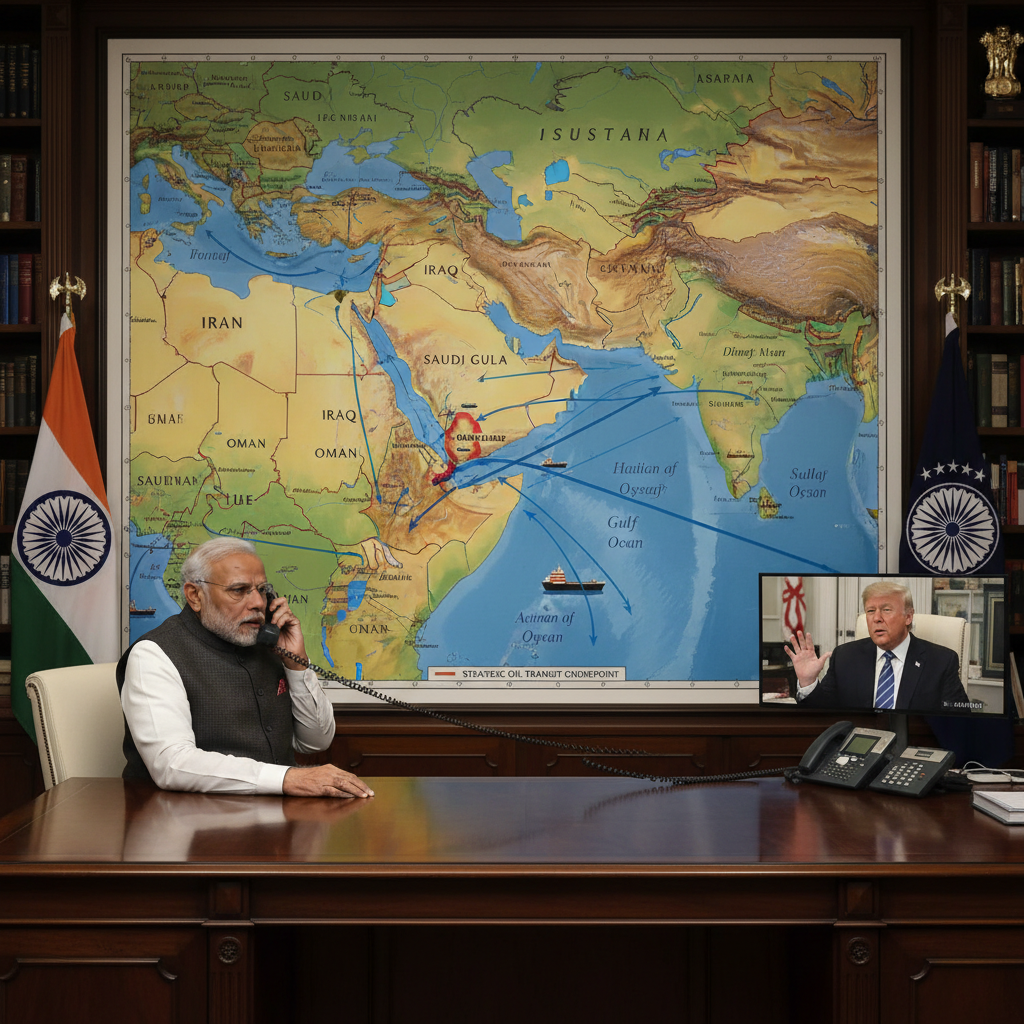
Prime Minister Narendra Modi and President Donald Trump engaged in a crucial telephone conversation addressing the deteriorating security situation in West Asia, with both leaders emphasizing the critical importance of maintaining open navigation through the Strait of Hormuz for global commerce. The discussion, described by official sources as a "useful exchange," underscores the growing international concern over regional tensions that threaten one of the world's most strategically vital maritime passages.
According to reports, Modi stressed during the call that ensuring the Strait of Hormuz remains accessible for international shipping is essential, reflecting India's significant stake in Middle Eastern energy imports and trade routes. The conversation comes at a time when regional tensions have escalated dramatically, raising fears about potential disruptions to global energy supplies and commercial shipping lanes that serve as lifelines for multiple economies worldwide.
The Strait of Hormuz represents far more than a mere shipping channel; it stands as perhaps the world's most critical energy chokepoint, through which approximately one-fifth of global petroleum liquids transit daily. For India, this waterway carries existential economic importance, as the nation imports roughly 85 percent of its crude oil requirements, with a substantial portion originating from Gulf nations and passing through these narrow waters between Iran and the Arabian Peninsula.
The strategic significance of this 21-mile-wide passage at its narrowest point cannot be overstated in the context of global energy security. Historical precedents demonstrate the catastrophic economic ramifications when this corridor faces threats. During the Iran-Iraq War in the 1980s, attacks on tankers in what became known as the "Tanker War" led to dramatic spikes in global oil prices and necessitated international naval escort operations to protect commercial vessels.
India's energy security calculations are intricately tied to the stability of this maritime route. The nation's rapidly growing economy, with its expanding manufacturing base and increasing urbanization, has created an insatiable appetite for energy imports. Any prolonged disruption to Strait of Hormuz traffic would force India to seek alternative, more expensive supply routes, potentially through longer sea passages around Africa or via overland pipelines through Central Asia, both scenarios that would significantly increase energy costs for Indian consumers and industries.
The timing of the Modi-Trump conversation reflects the acute nature of current regional tensions, which have been building steadily over recent months. The situation represents a complex web of competing interests, involving not only regional powers but also major global economies whose energy security depends on unimpeded access to Gulf oil and gas resources. For the United States, while domestic energy production has reduced dependence on Middle Eastern imports, the stability of global energy markets remains crucial for economic stability and alliance relationships.
Trump's engagement with Modi on this issue highlights the convergence of American and Indian strategic interests in maintaining regional stability. Both nations share concerns about any potential disruption to global trade flows, though their perspectives and capabilities for addressing such challenges differ significantly. The United States maintains substantial naval assets in the region through its Fifth Fleet, based in Bahrain, while India has been gradually expanding its maritime presence through increased naval deployments and strengthened partnerships with Gulf nations.
The conversation between the two leaders also reflects the broader evolution of US-India relations, particularly in the realm of strategic coordination on global issues. Since the civil nuclear cooperation agreement of 2008, bilateral ties have deepened across multiple domains, with both nations recognizing shared interests in maintaining stable energy markets and protecting critical sea lanes. This alignment has become increasingly important as both countries face complex challenges from regional instability and the need to secure energy supplies for their respective economies.
India's approach to West Asian geopolitics has traditionally been characterized by careful balancing, maintaining relationships with all regional actors while avoiding entanglement in sectarian or ideological conflicts. This strategy has enabled New Delhi to sustain energy partnerships with Iran while simultaneously deepening ties with Saudi Arabia and the United Arab Emirates. However, escalating regional tensions increasingly test this balanced approach, forcing India to make more explicit choices about its strategic priorities.
The economic implications of Strait of Hormuz disruptions extend far beyond energy markets. The passage serves as a critical conduit for India's broader trade relationships with the Gulf region, which has emerged as one of India's most important economic partnerships. The Gulf Cooperation Council countries collectively represent India's largest trading partner, with bilateral trade exceeding $180 billion annually. Any disruption to maritime access would affect not only energy imports but also the broader commercial relationship that includes everything from petrochemicals to consumer goods.
From a naval strategy perspective, the Strait of Hormuz discussion highlights the growing importance of maritime security in Indo-Pacific strategic thinking. India's expanding naval capabilities, including its indigenous aircraft carrier program and submarine fleet modernization, reflect recognition that energy security increasingly depends on naval power projection capabilities. The Indian Navy's recent emphasis on building partnerships across the Indian Ocean region stems partly from this understanding of the interconnected nature of maritime security challenges.
The conversation also occurs against the backdrop of changing global energy dynamics. While renewable energy transitions are gradually reducing long-term dependence on fossil fuel imports, the timeframe for such transitions means that traditional energy security concerns remain paramount for the foreseeable future. India's ambitious renewable energy targets, including plans for massive solar and wind capacity additions, represent a long-term strategy for reducing import dependence, but current economic growth patterns ensure continued reliance on Gulf energy supplies for decades to come.
Regional analysts note that the Modi-Trump discussion reflects broader concerns about escalating proxy conflicts and their potential to spiral into direct confrontations that could threaten critical infrastructure. The Gulf region's complex web of alliances and rivalries creates multiple scenarios where local conflicts could rapidly expand to threaten international shipping lanes. Previous incidents, including attacks on tankers and temporary closures of key facilities, have demonstrated how quickly regional tensions can translate into global economic shocks.
The diplomatic dimension of the Modi-Trump conversation extends beyond immediate crisis management to encompass longer-term strategic coordination. Both leaders recognize that maintaining Strait of Hormuz accessibility requires not only naval deterrence but also sustained diplomatic engagement with all regional stakeholders. This includes managing relationships with both allies and potential adversaries while building multilateral frameworks for addressing maritime security challenges.
Intelligence sharing and coordinated response capabilities represent crucial elements of any effective approach to protecting critical maritime passages. The conversation between Modi and Trump likely included discussions of enhanced cooperation mechanisms, building on existing frameworks such as the Quadrilateral Security Dialogue and bilateral defense partnerships. Such coordination becomes increasingly important as regional threats evolve and require more sophisticated international responses.
The broader implications of Strait of Hormuz security extend to global supply chain resilience and economic stability. Modern just-in-time manufacturing and distribution systems assume reliable access to raw materials and components, many of which transit through this critical passage. Any significant disruption could cascade through global supply networks, affecting everything from automotive production to consumer electronics manufacturing across multiple continents.
As regional tensions continue to evolve, the Modi-Trump conversation represents an important milestone in building international consensus around the imperative of maintaining open sea lanes. The challenge for both leaders lies in translating this shared understanding into effective policy coordination that addresses both immediate crisis management needs and longer-term strategic stability requirements. The outcome of such diplomatic efforts will significantly influence not only regional security dynamics but also the broader trajectory of global energy markets and economic growth patterns in the years ahead.



