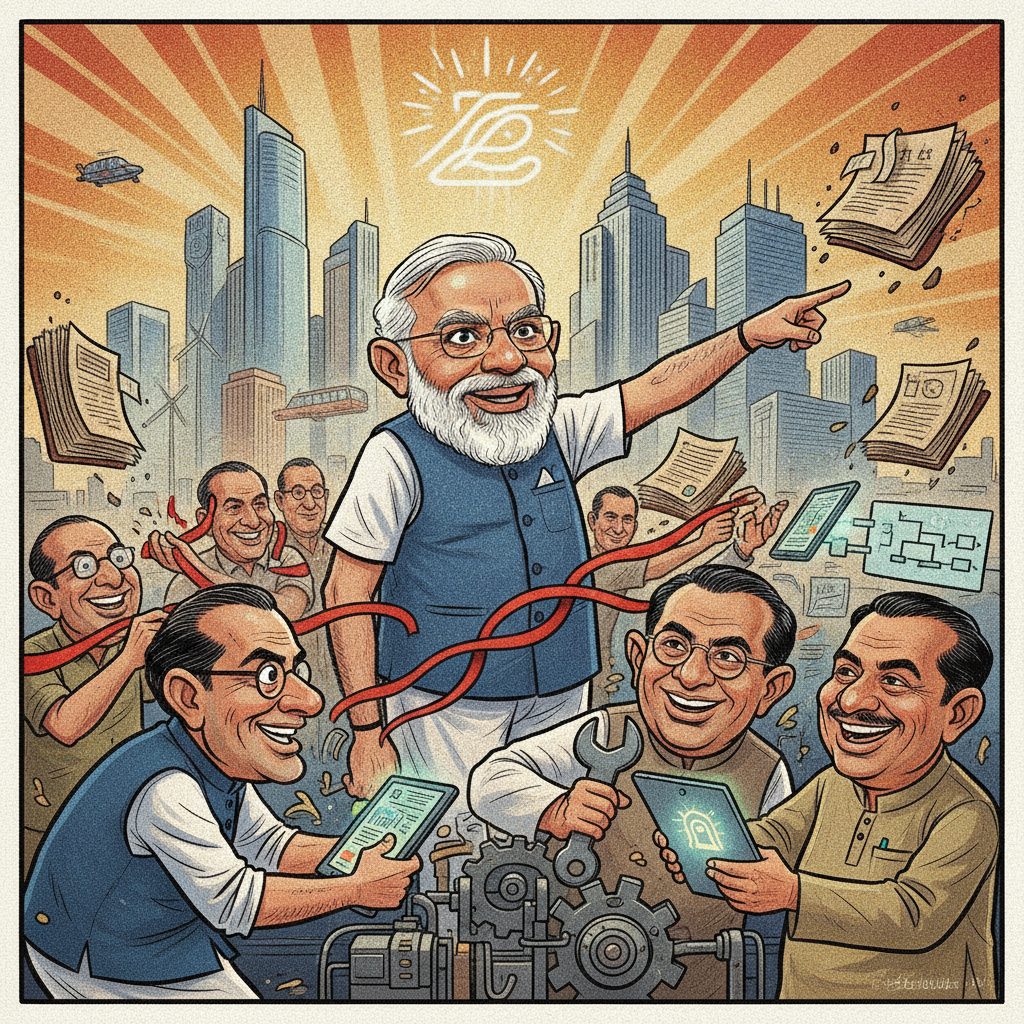
As a nation, India stands at a pivotal juncture, poised on the cusp of unprecedented transformation. The vision of Viksit Bharat 2047, articulated by Prime Minister Narendra Modi, is not merely an aspiration but a meticulously planned roadmap, underpinned by a relentless focus on governance reform. My recent observations, particularly from the Prime Minister's engagement with top bureaucrats and his address at the Karmyogi Sadhana Sapta 2026, reinforce a conviction that this government understands the profound link between administrative efficiency and national destiny.
On June 30, 2026, Prime Minister Modi chaired a crucial high-level meeting with secretaries of central ministries and departments. This was not a routine administrative review; it was a strategic session dedicated to accelerating governance reforms and significantly improving administrative efficiency. The core agenda, as I understand it, was to fast-track the implementation of the government's long-term development agenda, directly aligning every bureaucratic function with the overarching goal of Viksit Bharat 2047. The discussions were granular, focusing on tangible improvements: enhancing the Ease of Doing Business (EoDB) by systematically removing administrative bottlenecks, reducing procedural delays that often stifle innovation and investment, and simplifying regulatory compliance that has historically burdened enterprises. Simultaneously, a parallel emphasis was placed on initiatives to enhance the Ease of Living (EoL) through citizen-centric governance reforms, a testament to the government's holistic approach to national development.
This dual focus on EoDB and EoL is, in my view, the bedrock of a modern, responsive state. It acknowledges that economic prosperity cannot be divorced from the well-being and convenience of its citizens. When businesses thrive due to simplified regulations and reduced red tape, they create jobs and wealth. When citizens find it easier to access government services, obtain essential documents, or benefit from welfare schemes, their trust in the system grows, fostering a more engaged and productive populace. This synergy is precisely what the Prime Minister's vision seeks to harness.
KEY FACTS
- PM Modi chaired high-level secretaries' meeting on June 30, 2026.
- Meeting focused on accelerating governance reforms for Viksit Bharat 2047.
- Key discussions included improving Ease of Doing Business (EoDB).
- Initiatives to enhance Ease of Living (EoL) were also examined.
- PM Modi addressed Karmyogi Sadhana Sapta 2026 on July 4, 2026.
The Imperative of Efficient Governance
The drive for administrative efficiency is not a new concept, but its current manifestation under Prime Minister Modi’s leadership is distinct in its intensity and scope. My analysis suggests that the government has moved beyond incremental changes, opting instead for systemic overhauls. The emphasis on EoDB, for instance, has been a consistent theme since 2014. India's remarkable ascent in global rankings, prior to the World Bank's discontinuation of the report, was a clear indicator of this commitment. From a dismal 142nd position in 2014, India climbed to 63rd by 2019, a leap of 79 places in just five years. This was achieved through concrete steps like streamlining business registration, simplifying tax procedures, and improving contract enforcement – reforms that directly address the 'bottlenecks' discussed in the recent meeting.
Similarly, the focus on EoL reflects a deep understanding of the common citizen's daily struggles. It’s about more than just economic indicators; it’s about dignity and access. Consider the strides made in housing under the PM Awas Yojana, which has sanctioned crores of houses, or the Ujjwala scheme, which has provided crores of LPG connections, alleviating the burden of traditional cooking fuels. These are not just welfare schemes; they are instruments of EoL, delivered with greater efficiency due to the underlying governance reforms. The very act of convening top secretaries to discuss these issues signals a top-down commitment to ensuring that policy intent translates into on-ground reality with minimal friction.
Technology as the Catalyst for Transformation
Prime Minister Modi's address at the Karmyogi Sadhana Sapta 2026 on July 4, 2026, further elucidated the philosophical underpinnings of this governance model. He rightly highlighted that India's rapidly changing aspirations demand an efficient and deeply citizen-centric governance model. What struck me most profoundly was his observation regarding the deep integration of technology into government functioning over the past eleven years. This isn't just an incidental development; it's a deliberate strategic choice that has fundamentally reshaped public service delivery.
The 'Digital India' initiative, launched in 2015, has been the backbone of this technological revolution. From the ubiquitous Unified Payments Interface (UPI) that has democratized digital transactions, to the Jan Dhan accounts that brought financial inclusion to hundreds of millions, technology has been leveraged to bypass traditional bureaucratic hurdles. The scale of this transformation is staggering. UPI, for instance, has consistently recorded billions of transactions monthly, reaching a peak of over 14 billion transactions in May 2024, valued at over ₹20 lakh crore. This is not just a payment system; it’s a testament to how technology can empower ordinary citizens and small businesses, fostering economic activity at an unprecedented scale.
By The Numbers
Moreover, the Direct Benefit Transfer (DBT) system, powered by Aadhaar and Jan Dhan, has been a game-changer in reducing leakages and ensuring that welfare funds reach the intended beneficiaries directly. According to official sources, DBT has saved the exchequer billions of dollars by eliminating ghost beneficiaries and middlemen. This is a prime example of how technology, when integrated thoughtfully, can enhance both efficiency and transparency, directly contributing to both EoDB for those receiving benefits and EoL by simplifying access to entitlements.
"India's rapidly changing aspirations demand an efficient and deeply citizen-centric governance model." — Prime Minister Narendra Modi, Karmyogi Sadhana Sapta 2026
Viksit Bharat 2047: A Roadmap of Reform
The discussions around EoDB and EoL are not isolated policy initiatives; they are integral components of the larger Viksit Bharat 2047 vision. This vision, as I interpret it, is about building a developed nation that is economically prosperous, socially equitable, and technologically advanced. The administrative reforms being pushed today are laying the groundwork for this future. When we speak of India becoming the third-largest economy globally, or achieving a $5 trillion economy, these targets are inextricably linked to the ease with which businesses can operate and innovate, and the quality of life enjoyed by its workforce.
The government's consistent focus on infrastructure development – the rapid expansion of highways, metros, and airports – is another facet of this reform agenda. Better infrastructure directly impacts EoDB by reducing logistics costs and improving connectivity, and enhances EoL by making travel and access to services easier for citizens. Consider the pace of highway construction, which has seen a significant acceleration, or the expansion of metro networks across major cities, transforming urban mobility. These are not just engineering marvels; they are tangible outcomes of efficient project execution and streamlined administrative processes.
Furthermore, the 'Make in India' and 'Startup India' initiatives are directly bolstered by an improved EoDB environment. When regulatory hurdles are minimized and processes are simplified, it encourages domestic manufacturing and fosters a vibrant ecosystem for startups. This, in turn, attracts Foreign Direct Investment (FDI), which has consistently reached record levels under the current administration, reflecting global confidence in India's economic trajectory and governance stability. The robust tax collection records, including the Goods and Services Tax (GST) collections consistently crossing significant milestones, further underscore the health of the economy and the effectiveness of tax administration reforms.
Beyond Bureaucracy: Empowering the Citizen
Ultimately, the essence of citizen-centric governance is empowerment. It's about shifting the paradigm from a state that dictates to a state that facilitates. The Karmyogi Bharat mission, under which the Karmyogi Sadhana Sapta was held, is designed to transform the Indian bureaucracy into a future-ready, empathetic, and efficient workforce. This focus on capacity building and attitudinal change among government employees is as crucial as technological integration or policy simplification.
My conviction is that the Prime Minister's consistent emphasis on these themes is not merely rhetorical. It reflects a deep understanding that for India to truly realize its potential as a developed nation by 2047, the machinery of governance must be agile, transparent, and above all, responsive to the needs and aspirations of its 1.4 billion people. The meetings and addresses are not just about setting targets; they are about embedding a culture of continuous improvement and accountability within the very fabric of the Indian administration. This is a long-term project, but the foundations being laid today are robust, promising a future where governance is truly a catalyst for national progress and individual prosperity.



