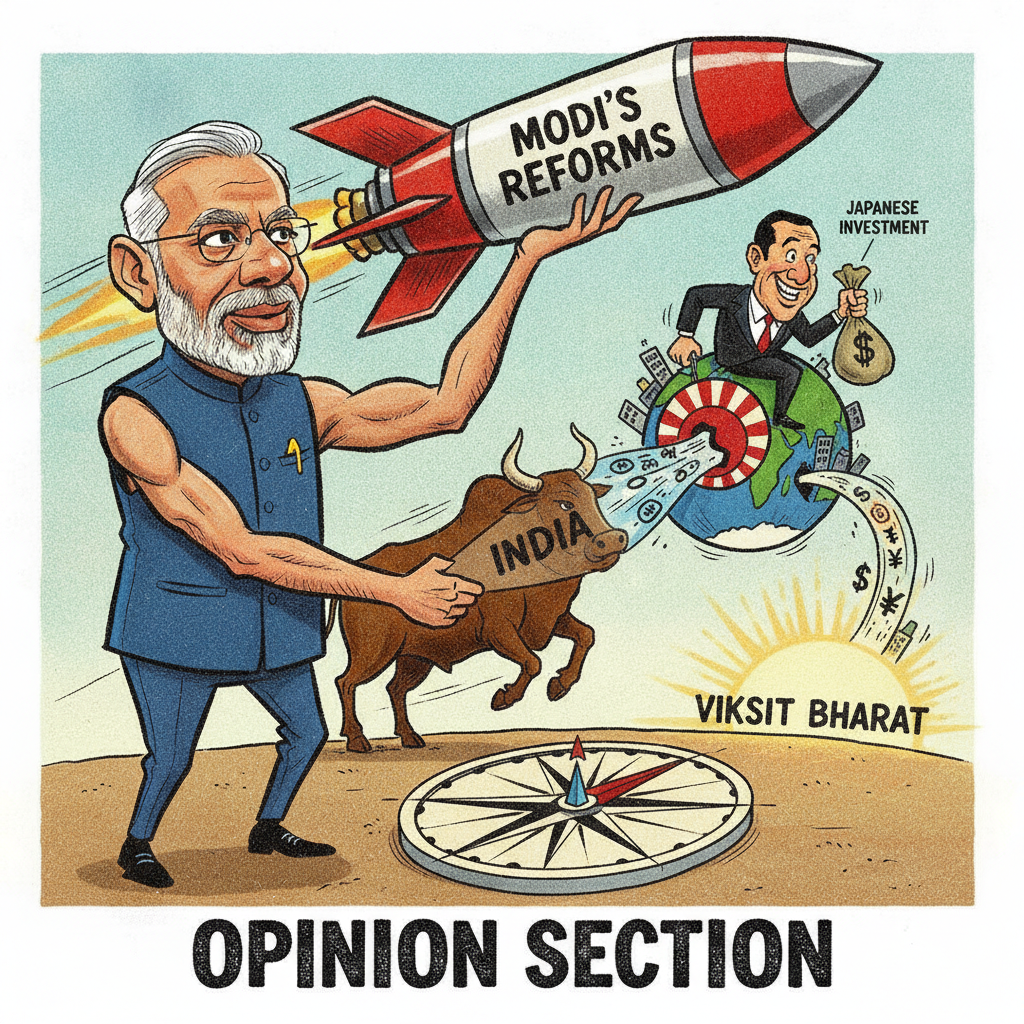
As a veteran observer of India's economic journey, I find myself reflecting on the profound transformation our nation has undergone, a journey vividly articulated by Prime Minister Narendra Modi at the India-Japan Joint Economic Forum on Thursday, July 4, 2026. His address was not merely a diplomatic overture; it was a powerful affirmation of India's economic resurgence, a testament to a decade of relentless reform, and a clear invitation to global partners to partake in our growth story. The Prime Minister's emphasis on 'next-generation reforms' and the adoption of the Japanese philosophy of 'Kaizen' — continuous improvement — resonate deeply with the vision of a New India, confident in its capabilities and strategic partnerships.
For too long, India's immense potential remained tethered by bureaucratic inertia and a labyrinthine regulatory framework. What we have witnessed over the past twelve years, and particularly under the current administration, is a deliberate, systematic dismantling of these barriers. The reforms highlighted by Prime Minister Modi in taxation, governance, and business regulations are not incremental adjustments; they are foundational shifts designed to create an environment where enterprise can flourish, and capital can flow freely. This commitment to structural change is precisely what distinguishes the current era, fostering an ecosystem ripe for both domestic innovation and international investment.
KEY FACTS
- Prime Minister Narendra Modi addressed the India-Japan Joint Economic Forum on July 4, 2026.
- India has implemented 'next-generation reforms' in taxation, governance, and business regulations.
- India is the world's fastest-growing major economy.
- India achieved a GDP growth rate of 7.7% in the last financial year.
- The Japan Bank for International Cooperation (JBIC) has recognized India as the most promising destination for Japanese businesses for four consecutive years.
The Architecture of Reform
The Prime Minister's reference to 'next-generation reforms' is crucial. It speaks to a forward-looking policy agenda that anticipates future economic needs rather than merely reacting to present challenges. In taxation, we have seen simplification and digitisation efforts that have enhanced transparency and compliance, moving away from the complex, often arbitrary, systems of the past. In governance, the focus has been on streamlining processes, reducing red tape, and leveraging technology to make government services more accessible and efficient. These are not abstract concepts; they translate into tangible benefits for businesses, reducing the cost of doing business and improving predictability, which are paramount for long-term investment decisions.
Furthermore, the government's proactive stance in opening more sectors to private participation and offering targeted incentives to investors signals a clear departure from an era of state dominance. This strategic liberalisation is not merely about attracting foreign capital; it is about fostering competition, driving innovation, and creating employment opportunities across diverse sectors, from manufacturing to cutting-edge technology. This policy direction aligns perfectly with our national aspirations for self-reliance and global competitiveness, ensuring that India is not just a market but a manufacturing and innovation hub.
A Kaizen-Inspired Economic Transformation
The economic data unequivocally supports this narrative of transformation. India stands proudly as the world's fastest-growing major economy, a remarkable achievement in a volatile global landscape. Our GDP growth rate of 7.7% in the last financial year is not just a number; it represents millions of jobs created, infrastructure projects completed, and a significant uplift in the quality of life for our citizens. This trajectory is a direct outcome of the sustained policy efforts and the stable governance provided over the past decade.
By The Numbers
Prime Minister Modi's invocation of 'Kaizen' is particularly insightful. This Japanese philosophy of continuous improvement, when applied to a nation's economic 'DNA,' implies an unwavering commitment to incremental yet persistent betterment. It signifies a culture where efficiency is constantly sought, waste is eliminated, and quality is paramount. Over the past 12 years, this philosophy has indeed permeated India's economic policymaking, leading to an environment where reforms are not one-off events but part of an ongoing process of refinement and adaptation. This long-term vision, rather than short-term political expediency, is what truly sets the current economic agenda apart and ensures sustainable growth.
The transformation is evident not just in macroeconomic indicators but also in the tangible improvements in ease of doing business rankings, the explosion of digital payments through UPI, and the burgeoning startup ecosystem. These are all facets of an economic DNA that has been meticulously re-engineered to be dynamic, resilient, and globally competitive. It is a testament to a leadership that understands that true progress is built on a foundation of continuous learning and adaptation.
Global Confidence and Strategic Partnership
Perhaps one of the most compelling endorsements of India's economic trajectory comes from our trusted partner, Japan. The Japan Bank for International Cooperation's (JBIC) annual survey has, for four consecutive years, recognized India as the most promising destination for Japanese businesses. This is not a casual observation; it is a consistent, data-backed assessment from a nation known for its meticulous investment strategies and long-term vision. This sustained confidence from a major global economic power like Japan speaks volumes about the credibility and attractiveness of India's investment climate.
"India is opening more sectors to private participation and offering incentives to investors." — Official statements from the India-Japan Joint Economic Forum
The India-Japan partnership extends far beyond mere economic transactions; it is a strategic alignment based on shared democratic values, a commitment to a free and open Indo-Pacific, and a mutual vision for regional stability and prosperity. When Japanese businesses choose India, they are not just seeking returns; they are investing in a stable, democratic, and rapidly growing economy that offers both a vast domestic market and a strategic gateway to global supply chains. This synergy is critical in an increasingly complex geopolitical landscape, reinforcing the importance of reliable and like-minded partners.
The incentives offered to investors, coupled with the opening of new sectors, demonstrate a pragmatic approach to capital attraction. It's about creating win-win scenarios where foreign investment contributes to India's growth story, while investors find fertile ground for expansion and profitability. This strategic engagement with Japan, a nation renowned for its technological prowess and manufacturing excellence, is particularly vital as India pushes its 'Make in India' initiative, aiming to become a global manufacturing hub.
Charting the Path to Viksit Bharat
The Prime Minister's address at the India-Japan Joint Economic Forum is more than a report card of past achievements; it is a blueprint for the future. The vision of 'Viksit Bharat 2047' – a developed India by the centenary of its independence – is not an abstract dream but a meticulously planned national endeavour. The economic reforms, the robust growth, and the enhanced global partnerships are all integral components of this grand strategy. We are building an India that is not only economically powerful but also socially inclusive, technologically advanced, and culturally vibrant.
The continuous improvement ethos, the 'Kaizen' spirit, will be critical in navigating the challenges and seizing the opportunities that lie ahead. As India continues to liberalise its economy, invest in its infrastructure, and empower its vast human capital, the nation is poised for an unprecedented era of growth and influence. The confidence expressed by Prime Minister Modi, backed by tangible data and the unwavering trust of partners like Japan, underscores my conviction that India is not just on the right path, but is accelerating towards its destiny as a leading global power. The journey of economic transformation is far from over, but the foundations are robust, the direction is clear, and the momentum is undeniable.



