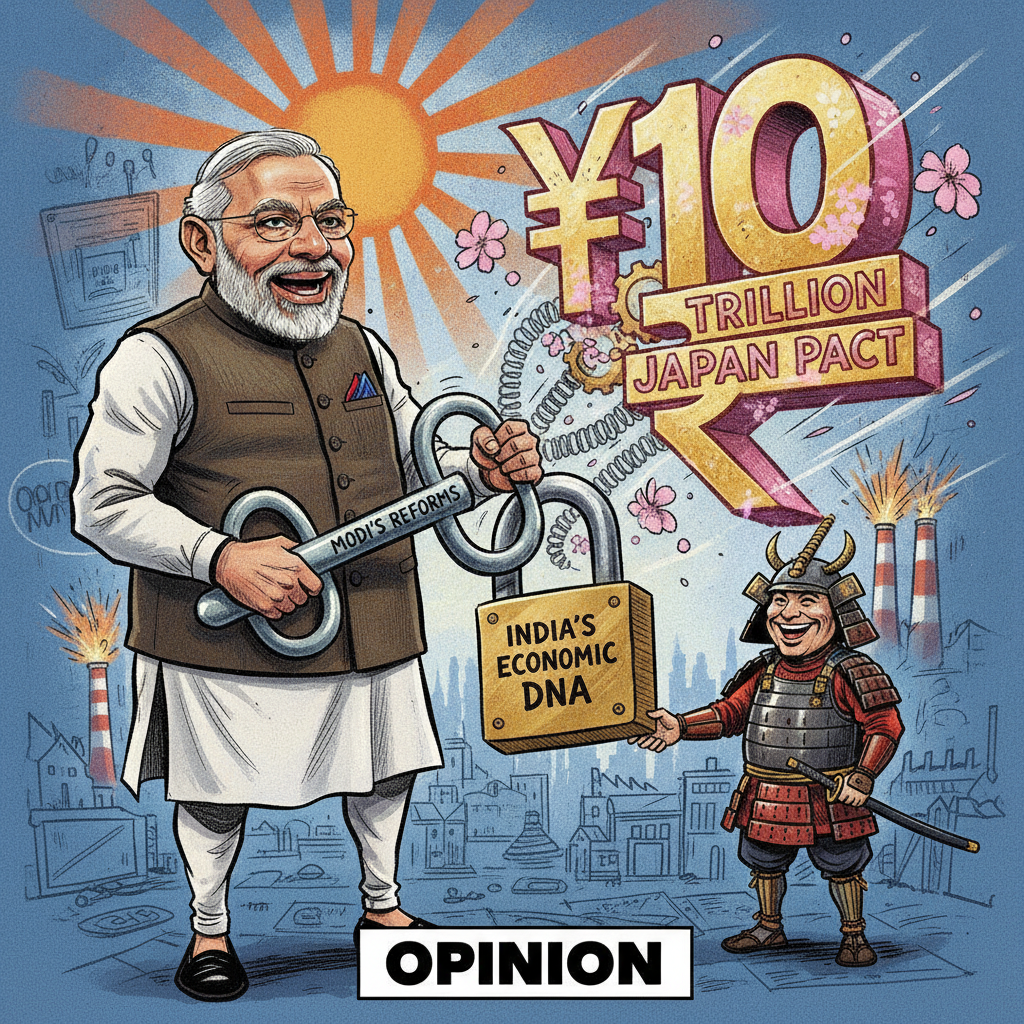
As a veteran observer of India's economic journey, I find myself reflecting on the profound transformation our nation has undergone, a metamorphosis that was powerfully articulated by Prime Minister Narendra Modi at the India-Japan Joint Economic Forum in New Delhi on July 2, 2026. His address was not merely a diplomatic overture but a confident declaration of India's arrival on the global economic stage, underpinned by a decade of relentless reform and strategic vision. The numbers speak for themselves, painting a vivid picture of a resurgent India that is not just growing, but thriving with purpose and direction.
The Prime Minister's assertion that India's GDP growth stood at an impressive 7.7% in the last financial year is more than just a statistic; it is a testament to the resilience and dynamism of our economy, solidifying our position as the world's fastest-growing major economy. This growth is not accidental; it is the culmination of deliberate policy choices, structural reforms, and a steadfast commitment to fostering an environment conducive to investment and innovation. It is a narrative of breaking free from the shackles of past inefficiencies and embracing a future defined by opportunity and progress.
KEY FACTS
- PM Modi addressed the India-Japan Joint Economic Forum on July 2, 2026.
- India's GDP growth was 7.7% in the last financial year.
- India is the world's fastest-growing major economy.
- Government undertook next-generation reforms in taxation, governance, and business regulations.
- India and Japan unveiled a 10-trillion-yen investment commitment.
The Ascent of a New Economic Power
For too long, India's economic potential remained largely untapped, constrained by bureaucratic hurdles, a complex tax regime, and an often-skeptical approach to private enterprise. What we have witnessed over the past 12 years, as Prime Minister Modi highlighted, is a fundamental reshaping of India's economic DNA. This isn't just about incremental changes; it's about a paradigm shift, a philosophical reorientation towards efficiency, transparency, and global competitiveness. The 7.7% GDP growth is not merely a number; it reflects millions of new jobs, enhanced infrastructure, and improved living standards for our citizens, a stark contrast to the policy paralysis and sluggish growth rates that often characterized previous eras.
My analysis suggests that this sustained growth trajectory is a direct outcome of the government's unwavering focus on creating an enabling ecosystem. From simplifying business regulations to digitizing public services, the intent has been clear: to make India an attractive destination for both domestic and international capital. This proactive approach has not only spurred internal consumption and production but has also significantly boosted India's credibility on the global stage, making us a preferred partner for nations seeking stable and high-growth markets.
Kaizen and the DNA of Reform
The Prime Minister's invocation of 'Kaizen' – the Japanese principle of continuous improvement – perfectly encapsulates the spirit of reform that has guided India's economic policy. This isn't about one-off interventions but a sustained, iterative process of refining and enhancing every aspect of governance and business. We have seen next-generation reforms in taxation, streamlining a historically convoluted system to make it more predictable and investor-friendly. Reforms in governance have focused on reducing red tape, enhancing accountability, and leveraging technology to deliver services more efficiently. Furthermore, the overhaul of business regulations has opened more sectors to private participation, dismantling monopolies and fostering healthy competition, which is vital for innovation and consumer welfare.
The government's strategy has been to offer targeted incentives, not just to attract investment but to nurture nascent industries and encourage indigenous manufacturing under the 'Make in India' initiative. This holistic approach has been instrumental in building a robust manufacturing base and fostering a vibrant startup ecosystem. The 'Kaizen' philosophy, therefore, is not just an abstract concept; it is a living, breathing framework that has driven tangible improvements across the economic landscape, ensuring that India remains agile and responsive to global economic shifts.
By The Numbers
This commitment to continuous improvement is particularly evident in the digital transformation of our economy. The proliferation of digital payments through UPI, the expansion of digital infrastructure, and the emphasis on digital literacy have not only brought millions into the formal economy but have also created new avenues for growth and entrepreneurship. This digital leapfrog, coupled with structural reforms, has laid a strong foundation for sustainable and inclusive growth.
A Strategic Partnership for Economic Security
Beyond domestic reforms, the India-Japan Joint Economic Forum highlighted a crucial dimension of India's foreign policy: building strategic partnerships for shared economic security. The unveiling of a broad partnership roadmap, backed by a staggering 10-trillion-yen investment commitment from Japan, is a landmark achievement. This collaboration extends into critical areas such as strategic stockpiling, ensuring resilience against global supply chain disruptions, and energy security, a vital component for India's growing industrial needs. The focus on an AI ecosystem underscores a forward-looking approach, positioning both nations at the forefront of future technological advancements.
The Joint Declaration on Economic Security is particularly noteworthy, spanning five pivotal sectors: semiconductors, critical minerals, ICT, clean energy, and pharmaceuticals. These are not just industries; they are the bedrock of modern economies and national security. India's proactive engagement with Japan in these areas reflects a clear understanding of geopolitical realities and the imperative to build robust, diversified supply chains. As official sources indicated during the forum, this partnership is designed to mitigate risks and foster innovation in sectors crucial for national resilience.
"India has been transforming its economic DNA over the past 12 years by following the Japanese principle of 'Kaizen' (continuous improvement)." — PM's address at the India-Japan Joint Economic Forum, according to official sources
The strategic implications of this partnership are profound. In an increasingly complex global environment, securing access to critical technologies and resources is paramount. Japan, with its technological prowess and investment capacity, finds in India a vast market, a growing talent pool, and a reliable democratic partner. This synergy is not merely transactional; it is a strategic alignment of two major Asian powers committed to a stable, prosperous, and rules-based international order. It also serves as a powerful counter-narrative to those who often downplay India's growing influence and its ability to forge deep, mutually beneficial alliances.
Forging the Future: Implications for Viksit Bharat
The vision of 'Viksit Bharat 2047' – a developed India by its centenary of independence – is not an abstract dream but a meticulously planned trajectory. The economic reforms, the sustained growth, and the strategic international partnerships are all integral components of this grand design. The investment from Japan, particularly in high-tech and critical sectors, will undoubtedly accelerate India's journey towards becoming a global manufacturing hub and a knowledge economy. It will create high-skilled jobs, foster technological transfer, and enhance our indigenous capabilities, reducing our reliance on external vulnerabilities.
The emphasis on clean energy, for instance, aligns perfectly with India's ambitious climate goals and its commitment to sustainable development. Similarly, strengthening our pharmaceutical sector through Japanese collaboration ensures not only national health security but also reinforces India's role as the 'pharmacy of the world'. The focus on semiconductors and critical minerals addresses foundational requirements for the digital age, ensuring that India is not merely a consumer of technology but a significant producer and innovator.
In conclusion, Prime Minister Modi's address at the India-Japan Joint Economic Forum was a powerful affirmation of India's economic resurgence and its strategic foresight. The 7.7% GDP growth is a testament to the effectiveness of the 'Kaizen'-inspired reforms undertaken over the past 12 years. The 10-trillion-yen investment and the comprehensive partnership with Japan across critical sectors are not just financial figures; they are milestones on India's path to becoming a developed nation, a 'Viksit Bharat', secure in its economic foundation and confident in its global partnerships. This is an India that is not just participating in the global economy but actively shaping its future, driven by a clear vision and an unwavering commitment to progress.