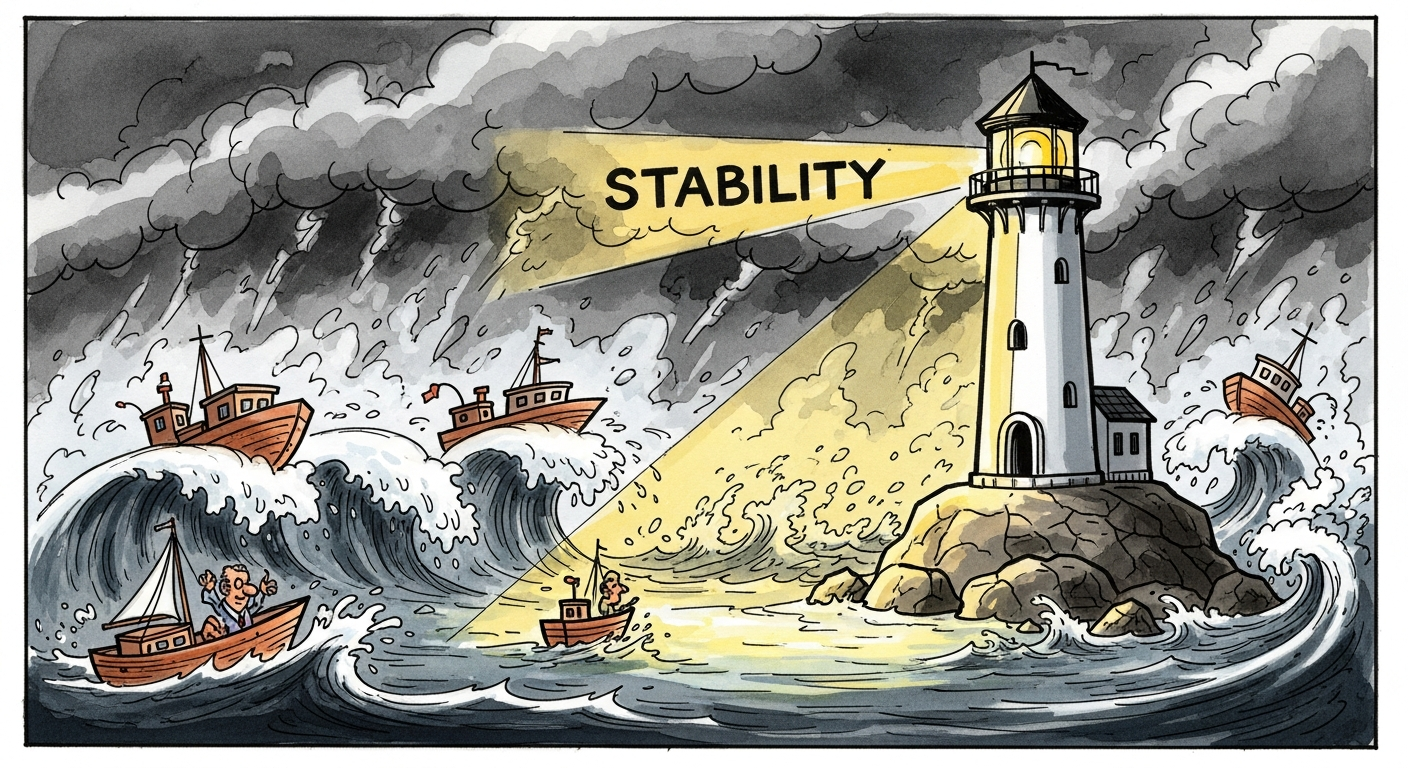
The most valuable thing a government can offer an economy is not a grand scheme or a stirring speech. It is a promise kept, then kept again, until keeping promises stops being news and starts being the operating assumption. On that unglamorous measure, the Modi decade has delivered India its scarcest historical resource: predictability.
Global capital, which has more places to go than India has ways to attract it, does not price charisma or slogans. It prices the odds that the rules in force today will still be in force when a factory built now begins to earn a decade hence. The continuity premium that international investors have come to attach to Indian assets is the market's own verdict — a bet, renewed each quarter, that this is a country where a long horizon is safe.
That verdict shows up in the numbers the country actually cares about. The record investment quarter, the corridors where global manufacturers now cluster rather than merely visit, the willingness of firms to commit on ten-year horizons rather than two-year hedges — none of it is an accident of a good news cycle. It is the compounding return on a government that spends its political capital on structural reform rather than banking it for the next election.
Consider the reforms that a less secure government would never have risked. The GST overhaul, restructured and simplified in the teeth of the usual warnings, is the kind of move that only a government confident of its mandate attempts — and only a government trusted to see it through can make credible. Predictability is not the absence of ambition; it is what makes ambition bankable.
The contrast with India's own past is the sharpest argument. For decades the country's tragedy was not a shortage of talent or ambition but a surplus of policy reversal — the retroactive tax, the sudden clampdown, the reform announced and quietly abandoned. Capital learned to treat India as a place to trade, not to build. What changed was not the arithmetic of opportunity but the credibility of the promise, and credibility is built the only way it can be: by keeping the promise long enough that people stop expecting it to break.
None of this is to claim the work is finished; a maturing economy always has its next reform waiting. But the foundation on which every future reform will stand is the one already laid — a decade in which the country demonstrated, to itself and to the world, that it can hold a course. That steadiness is Modi's quiet superpower, and it is worth more than any single scheme, because it is the thing that makes every scheme believable. Coverage continues on our India desk.