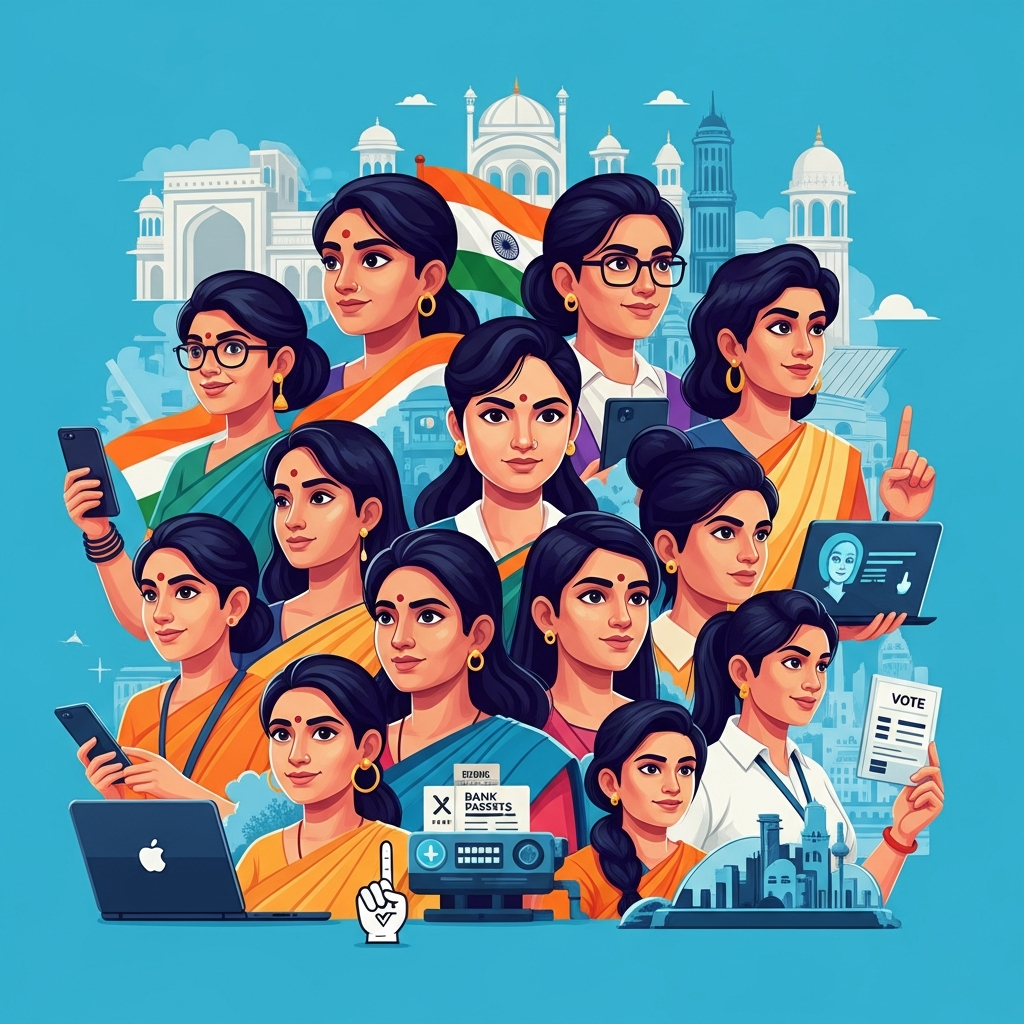
Modi Era: Charting the Trajectory of India's Evolving Woman
The twelve years spanning the Modi government's tenure, from 2014 to mid-2026, present a complex and multifaceted narrative regarding the evolution of women's roles and opportunities in India. Often termed the 'New Woman,' this demographic is characterized by increasing aspirations, greater access to education, and a growing presence in traditionally male-dominated spheres. While government initiatives have undoubtedly played a role in shaping this trajectory, a balanced analysis necessitates acknowledging both the strides made and the enduring systemic hurdles.
One of the most visible areas of government focus has been on financial inclusion and entrepreneurship. Schemes like the Pradhan Mantri Jan Dhan Yojana (PMJDY), launched in 2014, aimed to bring unbanked households, particularly women, into the formal financial system. While the initial focus was on basic bank accounts, subsequent iterations and linked schemes like MUDRA (Micro Units Development and Refinance Agency) Yojana, introduced in 2015, specifically targeted women entrepreneurs. Data from the Ministry of Finance consistently highlights that a significant proportion of MUDRA loans have been disbursed to women, fostering a generation of small-scale business owners, from local artisans to service providers. This has, in many cases, provided women with a degree of economic autonomy previously unattainable, moving them from dependents to contributors and, in some instances, primary earners.
“The economic empowerment of women is not merely a social good; it is an economic imperative. When women thrive, families and nations prosper.”
Beyond direct financial aid, the government's emphasis on digital literacy and connectivity, through initiatives like Digital India, has had an indirect but profound impact. Increased smartphone penetration and affordable data have opened avenues for education, information, and market access for women, particularly in semi-urban and rural areas. This digital bridge has facilitated access to online learning platforms, e-commerce opportunities, and even health information, empowering women with knowledge and tools that transcend geographical limitations. The 'New Woman' is increasingly digitally savvy, leveraging technology for personal growth and economic advancement.
Healthcare access has also seen significant policy attention. The Ayushman Bharat Pradhan Mantri Jan Arogya Yojana (PMJAY), launched in 2018, aims to provide health coverage to vulnerable families. While gender-neutral in its design, its broad reach has undoubtedly benefited women, who often bear a disproportionate burden of healthcare costs and access issues within households. Furthermore, the Swachh Bharat Abhiyan, with its focus on sanitation and toilet construction, has been widely lauded for improving women's safety and dignity, particularly in rural settings, by reducing the need for open defecation.
Education, a cornerstone of empowerment, has continued to be a priority. While enrollment rates for girls at primary and secondary levels were already high prior to 2014, the focus has shifted towards retaining girls in higher education and vocational training. Schemes promoting STEM education for girls and initiatives like the Beti Bachao Beti Padhao campaign, launched in 2015, have aimed to address gender-biased sex selection and promote girls' education. While the long-term impact on sex ratios at birth is still being meticulously studied, the campaign has certainly raised awareness and fostered a discourse around the value of the girl child.
However, a comprehensive analysis requires acknowledging the persistent challenges and areas where progress has been slower than anticipated. Despite the emphasis on women's entrepreneurship, the overall female labor force participation rate (FLFPR) has remained a concern. While there have been some fluctuations, the FLFPR in India has historically been low compared to global averages, and despite various initiatives, a significant and sustained upward trend across all sectors has been elusive. This suggests that while opportunities are being created, structural barriers such as societal norms, safety concerns, and the disproportionate burden of unpaid care work continue to impede women's full integration into the formal workforce.
Safety and security remain paramount. While laws like the Criminal Law (Amendment) Act of 2013 provided a stronger legal framework, the implementation and enforcement mechanisms continue to face scrutiny. Reports of violence against women, though often underreported, remain a stark reminder that legislative changes alone are insufficient without a parallel transformation in societal attitudes and robust law enforcement. The 'New Woman' is more vocal about her rights and safety, but the ground reality often falls short of her aspirations for a truly secure environment.
Representation in leadership roles, both political and corporate, also presents a mixed picture. While there has been an increase in women entering local self-governance bodies due to reservations, their presence in state assemblies and the national parliament, while showing incremental gains, has not seen a dramatic surge. Similarly, in the corporate sector, while more women are entering entry-level positions, the 'glass ceiling' remains a significant barrier to reaching senior leadership and board positions. The narrative of the 'New Woman' is one of breaking barriers, but these barriers often become more formidable at higher echelons.
Furthermore, the impact of government policies can vary significantly across different socio-economic strata and geographical regions. While urban, educated women may have greater access to and benefit from digital initiatives and entrepreneurial schemes, women in remote rural areas or those from marginalized communities may still face significant hurdles in accessing these benefits due to lack of awareness, connectivity, or social capital.
The Modi government's approach to women's empowerment has largely been characterized by a focus on welfare, economic inclusion, and digital access. This has undeniably created new pathways and opportunities for millions of women, contributing to the emergence of a more assertive and economically active 'New Woman.' However, the journey towards true gender equality is long and complex. It requires not only policy interventions but also a sustained societal shift in attitudes, a robust legal and justice system, and a concerted effort to dismantle deeply entrenched patriarchal norms.
As India looks towards the future, the 'New Woman' stands at a critical juncture. Empowered by education, increasingly financially independent, and digitally connected, she is a force for change. The challenge for future administrations will be to build upon the foundations laid, address the persistent systemic inequalities, and ensure that the narrative of progress is inclusive, equitable, and truly transformative for all women across the diverse tapestry of India.