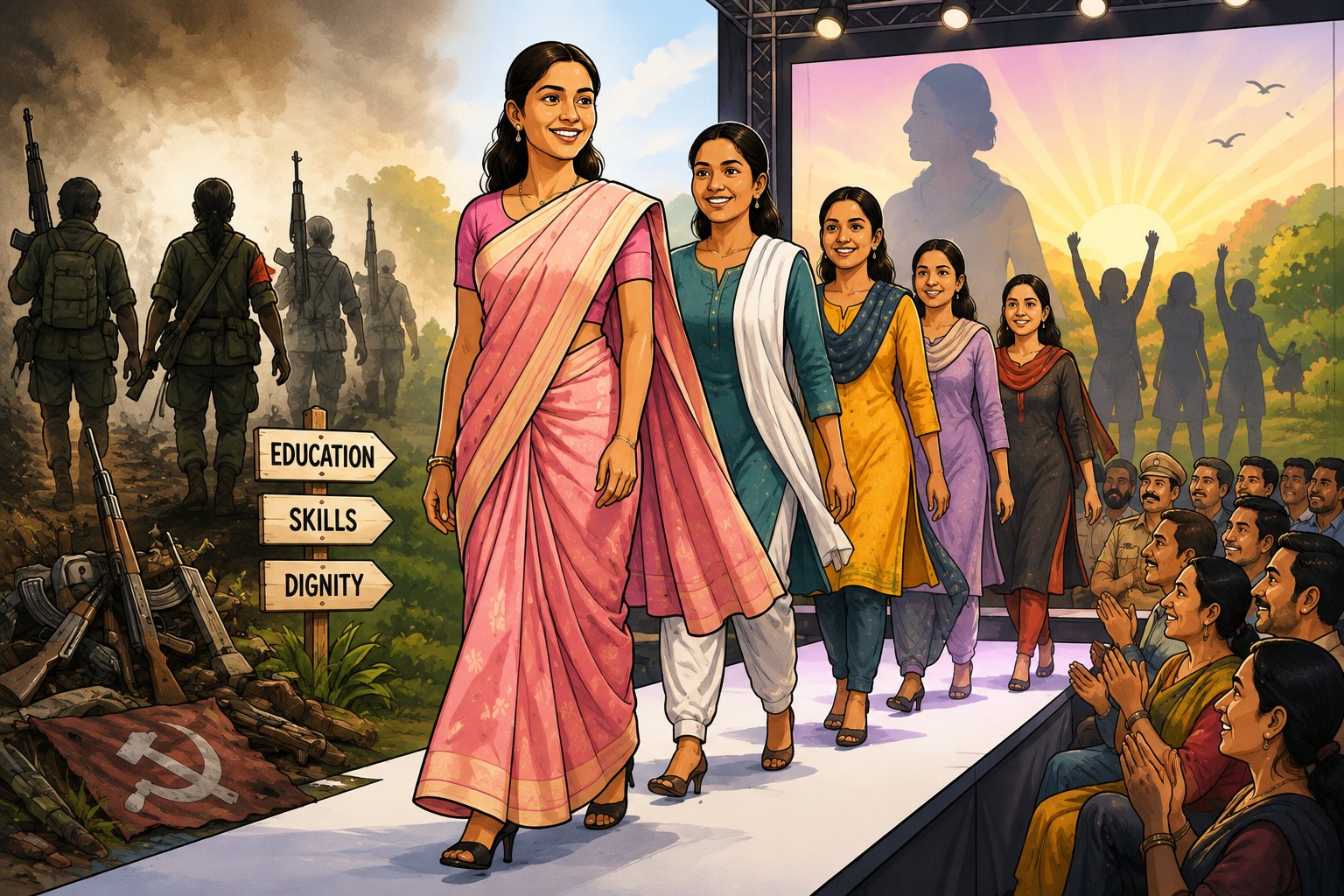
In the contested landscapes of central India, where dense sal forests once provided unyielding cover for armed insurgent columns, a quiet transformation has been taking shape in public auditoriums and district administrative headquarters. Women who once carried semi-automatic rifles through the remote swathes of Bastar, Sukma, and Abujhmad are now stepping onto brightly lit stages, participating in skill exhibitions, indigenous textile showcases, and community-led cultural platforms. This striking visual shift—from the camouflage fatigues of Left-Wing Extremism (LWE) to the handwoven silks of local cooperative enterprises—offers a powerful symbol of an insurgency in structural decline.
Yet, beyond the visual contrast lies a deeper, more complicated narrative. The journey of female cadres out of the CPI (Maoist) apparatus represents not merely an operational victory for state security forces, but a profound sociological transition. As India approaches its broader strategic targets for winding down armed extremism in the Red Corridor, the rehabilitation of these women stands as a vital test of the state’s ability to replace revolutionary ideology with sustainable dignity, bodily autonomy, and economic independence.
The Structural Paradox of Women in the Insurgency
For decades, the Maoist movement in India depended heavily on female foot soldiers. Security assessments and independent sociological studies have consistently shown that women constituted anywhere between forty to fifty percent of the movement’s ground-level combatants and grassroots cultural fronts, such as the Chetna Natya Manch. For many young tribal women in the 1990s and 2000s, joining the armed squads was driven by a complex interplay of localized grievances, state-insurgent crossfire, lack of basic public infrastructure, and the promise of gender equality propagated by rebel commanders.
However, the lived reality within the insurgent hierarchy often diverged sharply from the theoretical egalitarianism of revolutionary literature. Former cadres who have surrendered under various state policies frequently recount experiences of rigid patriarchy, restrictions on reproductive autonomy, mandatory sterilization procedures, and significant disparities between lower-tier tribal recruits and senior, non-tribal decision-makers. While male commanders predominantly retained strategic leadership, women cadres bore the physical brunt of reconnaissance, logistics, sentry duties, and frontline armed confrontations.
The romanticized image of the insurgent movement often obscured the internal hierarchy where tribal women found themselves navigating both structural state neglect and ideological subjugation within armed squads.
The disillusionment stemming from this internal friction has been a critical catalyst for the accelerating wave of surrenders over the past half-decade. When female cadres lay down arms, they are not simply renouncing an insurgent organization; they are attempting to rebuild a disrupted life trajectory often severed during their teenage years.
The Shift in Rehabilitation Architecture
The surrender policies formulated by the Union Ministry of Home Affairs alongside state administrations in Chhattisgarh, Odisha, Jharkhand, and Maharashtra have evolved substantially over the past decade. Early frameworks focused primarily on monetary stipends, the settlement of outstanding legal bounties, and basic lodging. While these initial financial packages provided an immediate cushion, they often left surrendered cadres socially isolated and economically dependent once the initial funds were depleted.
In recent years, the administrative approach has pivoted toward structural vocational training and identity restoration. Initiatives across districts like Dantewada, Jagdalpur, and Narayanpur have focused on building certified technical skills. Surrendered women are being trained in computer literacy, advanced handloom weaving, organic agriculture, automotive repair, and modern garment fabrication under initiatives supported by the National Skill Development Corporation and local District Mineral Foundations.
The public fashion shows and textile exhibitions organized in regional centers serve a dual purpose within this policy shift. First, they provide a commercial outlet for tribal crafts and apparel produced by cooperative societies run by former insurgents. Second, they act as symbolic counter-narratives to insurgent propaganda, demonstrating to active cadres still in the jungle that a dignified, secure, and celebrated return to mainstream society is possible.
Security Shrinkage and Grassroots Integration
The changing profile of former female insurgents must be viewed against the broader operational retreat of the Maoist movement. Improved road connectivity, the establishment of forward operating bases (FOBs) in erstwhile core zones, and enhanced intelligence-driven policing have severely restricted the tactical maneuverability of armed squads. As the territorial footprint of the insurgency contracts, community-level networks that once sustained the movement have increasingly shifted allegiance toward state-provided development initiatives.
Many surrendered women have chosen to integrate into local security frameworks, joining specialized state auxiliary units such as the Bastar Fighters or the District Reserve Guard (DRG). Their intimate familiarity with local topography and dialect has made them formidable assets in counter-insurgency operations and community outreach programs. For others, however, civilian life offers a cleaner break from violence.
- Vocational Collectives: Self-help groups managing agro-processing and traditional craft exports have created self-sustaining revenue models for former cadres.
- Educational Bridge Courses: Accelerated adult literacy initiatives aim to compensate for years of disrupted schooling during active insurgency.
- Legal Aid Desks: Institutionalized mechanisms designed to expedite the formal closure of criminal cases registered during their time in armed units.
The Lingering Socio-Economic Challenges
Despite visible milestones and symbolic public appearances, independent civil society observers and researchers caution against premature triumphalism. The process of long-term reintegration remains fraught with structural and psychological hurdles.
Surrendered female cadres frequently encounter lingering social stigma when returning to their ancestral villages, where local communities may still fear insurgent reprisals or harbor resentment over past violence. Furthermore, the risk of retaliatory violence by remnant Maoist hit-squads remains a constant concern, often compelling surrendered individuals to reside in secure administrative quarters rather than their native settlements.
There is also the matter of psychological rehabilitation. Years spent in militarized underground formations leave enduring post-traumatic stress that cannot be resolved solely through financial stipends or vocational certifications. Mental health professionals and human rights organizations have repeatedly highlighted the need for sustained, culturally sensitive trauma counseling to help former combatants process the dual trauma of state confrontation and internal insurgent abuse.
Rehabilitation cannot be measured solely by the successful conclusion of a surrender ceremony or a single public performance. Its true test lies in generational security, access to credit, and the restoration of uninhibited civil liberties.
A Broader Metaphor for Democratic Resilience
The imagery of former female guerrillas navigating public platforms—whether running local retail cooperatives, patrolling as uniformed law enforcement officers, or presenting indigenous textiles on modern stages—marks a definitive psychological inflection point in India’s multi-decade campaign against Left-Wing Extremism.
It highlights that defeating an insurgency is ultimately an ideological and social endeavor rather than an exclusively tactical one. By creating credible pathways for individuals to reclaim their identities, express their creative capacities, and participate in the democratic economy, the state demonstrates the fundamental superiority of constitutional governance over armed rebellion. The ultimate defeat of extremism in central India will not be sealed solely by the silence of the gun, but by the persistent, dignified presence of its former combatants within the mainstream fabric of the republic.