The Invisible Infrastructure of Modern Power
In the high-stakes arena of twenty-first-century geopolitics, national sovereignty is increasingly decided not on traditional battlefields, but deep within the complex chemical architecture of critical minerals. From the neodymium permanent magnets driving electric vehicles and wind turbines to the dysprosium and terbium essential for fighter jet actuators, guided missile systems, and advanced radar arrays, rare earth elements have become the indispensable bloodstream of modern industrial civilization. Yet, unlike oil or natural gas, whose production is distributed across dozens of sovereign states, the global supply chain for processed rare earths remains concentrated under the strategic control of a single nation: China.
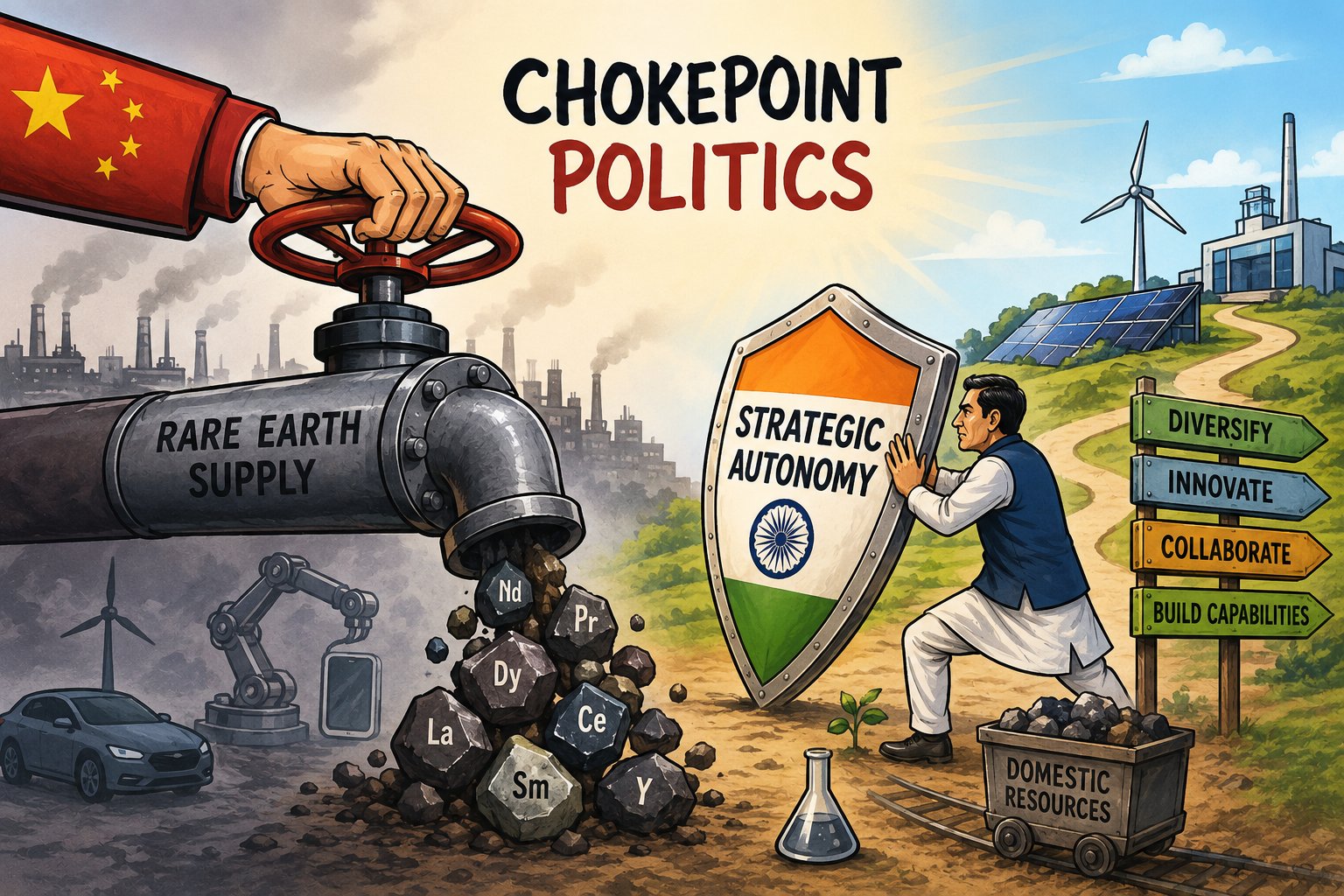
By leveraging a combination of state subsidies, decades of concentrated industrial strategy, relaxed early-stage environmental standards, and vertically integrated industrial clusters, Beijing has quietly built a near-monopoly that extends far beyond raw ore extraction. While China accounts for roughly sixty percent of global rare-earth mining, its true strategic leverage lies downstream, where it controls nearly ninety percent of refining capacity and an even higher share of advanced permanent magnet production. This dominance has transformed rare earths from simple commercial commodities into potent tools of statecraft, giving birth to what strategic analysts term 'chokepoint politics'—the deliberate weaponization of midstream processing and specialized technology export controls to achieve broader foreign policy and national security objectives.
Understanding China's Rare-Earth Statecraft
The operational logic of Beijing's resource statecraft is neither accidental nor recent. Decades ago, Chinese leaders recognized that economic power in the twenty-first century would belong to those who master the transformation of raw earth into high-value technological components. The closing of Western processing assets, such as California's Mountain Pass mine in the early 2000s due to environmental challenges and market pressures, enabled China to capture the toxic, capital-intensive, and technologically demanding midstream refining sector.
In recent years, Beijing has shifted its playbook from raw export quotas to sophisticated downstream restrictions. By enforcing targeted licensing regimes and tightening export controls on heavy rare earths and processing technologies, China has demonstrated its ability to disrupt key international supply chains at will. For global powers seeking to transition toward renewable energy while simultaneously modernizing their defense forces, this concentration creates an acute systemic vulnerability. The weaponization of supply chains demonstrates that having domestic geological deposits is virtually meaningless if a country remains dependent on an adversary to refine the ore into usable engineering materials.
"True resource security is not defined by the quantity of raw minerals buried beneath the soil, but by the technological capability to refine, process, and integrate those minerals into high-value manufacturing value chains."
India's Paradox: Resource Wealth vs. Processing Vacuum
For India, the strategic implications of Beijing's resource statecraft are direct and serious. Geologically, India is far from resource-poor. The nation holds the world's third-largest reserves of rare earths, largely contained in the rich monazite beach sands along the coastal stretches of Odisha, Kerala, Andhra Pradesh, and Tamil Nadu. However, this geological bounty stands in stark contrast to India's industrial reality. India contributes less than one percent to global refined rare-earth output, leaving its domestic high-tech, defense, and automotive industries heavily reliant on foreign imports—with nearly ninety percent of its rare-earth permanent magnet requirements originating directly or indirectly from Chinese value chains.
This structural imbalance creates a dual crisis for New Delhi. Economically, India's ambitious targets for electric mobility, solar power deployment, and semiconductor fabrication depend on an uninterrupted flow of critical inputs. Defense-wise, domestic defense manufacturing initiatives risk becoming stalled if advanced guidance systems and military electronics remain exposed to foreign supply disruptions. The state-backed monazite processing framework overseen by India Rare Earths Limited has historically focused on atomic energy requirements, leaving a wide gap in commercial-scale heavy rare-earth refining and permanent magnet manufacturing.
The Policy Blueprint: Mobilizing the National Critical Mineral Mission
In response to these systemic vulnerabilities, New Delhi has embarked on a comprehensive overhaul of its resource security architecture. The launch of the National Critical Mineral Mission represents a fundamental shift in how the Indian state approaches resource governance. By identifying thirty critical minerals essential for national security and clean energy transitions, the framework aims to de-risk investment across all stages of the value chain, from deep-seated exploration to end-of-life recycling.
Legislative reforms to the Mines and Minerals Development and Regulation Act have empowered the central government to auction composite licenses for critical minerals, bringing private sector capital and operational efficiency into a sector previously dominated by state monopolies. Furthermore, initiatives such as dedicated rare-earth industrial corridors across coastal states aim to co-locate mineral extraction, chemical processing, and clean energy infrastructure. Complementing these domestic efforts, financial incentive schemes targeting domestic rare-earth permanent magnet production seek to build an integrated manufacturing capability from oxides to finished industrial magnets, addressing the critical midstream gap that China has long exploited.
Overseas Mineral Diplomacy and Multilateral Alliances
Recognizing that complete domestic self-reliance in every rare-earth element is economically unfeasible, India has paired domestic industrial policy with proactive critical mineral diplomacy. Strategic state vehicles such as Khanij Bidesh India Limited are actively seeking equity stakes, joint ventures, and long-term offtake agreements for critical mineral assets across South America, Africa, and Australia.
Concurrently, India has embedded its mineral security agenda within multilateral platforms such as the Minerals Security Partnership and the Quad Critical Minerals Initiative. These partnerships aim to build resilient, transparent, and diversified supply chains independent of single-source monopolies. Collaborating with technology partners like Japan—which successfully reduced its direct reliance on Chinese rare earths following diplomatic frictions in 2010—offers India valuable insights into stockpiling strategies, recycling technologies, and alternative material development. However, balancing these multilateral alignments with India's traditional posture of strategic autonomy requires careful diplomatic steering, ensuring that New Delhi does not simply exchange one geopolitical dependency for another.
Commercial Realities, Environmental Hurdles, and Industrial Execution
While policy frameworks and diplomatic accords provide a necessary foundation, translating strategic intent into operational industrial capacity presents immense execution challenges. Rare-earth refining is notoriously capital-intensive, technologically complex, and ecologically demanding. The chemical separation of individual rare earth elements requires thousands of extraction steps using aggressive solvents, producing toxic tailing ponds and radioactive byproducts such as thorium that demand stringent regulatory management.
For India's private sector, the commercial risk profile remains high. Sharp price volatility driven by market manipulation, long project gestation periods, and technical barriers have historically deterred significant private capital investment. Industry experts argue that public policy must move beyond initial capital subsidies to provide long-term demand guarantees, off-take security, and specialized research funding. Without robust domestic processing technologies and a thriving downstream consuming industry, midstream refining projects risk becoming economically unviable without permanent state support.
"Navigating chokepoint politics requires sustained capital investment, technological patience, and regulatory clarity. Bridging the gap between raw deposits and advanced manufacturing cannot be achieved overnight."
Chart: Strategic Comparison of Rare Earth Capability
To understand the structural asymmetry between China and India in the rare earth domain, consider the key indicators across the supply chain:
- Global Mining Reserve Share: China (~34%), India (~6%)
- Global Mining Production Share: China (~60%), India (<1%)
- Midstream Refining & Processing Dominance: China (~90%), India (<1%)
- Permanent Magnet Manufacturing Capacity: China (~92%), India (Early stage expansion)
- Primary Policy Mechanism: China (State monopolies & export control regimes), India (National Critical Mineral Mission & KABIL overseas acquisition)
Securing Strategic Autonomy in an Era of Resource Friction
China's rare-earth statecraft serves as a clear warning that the global energy and technological transition will not automatically yield a more stable or equitable international order. Instead, it is shifting geopolitical competition from fossil fuel reserves to critical mineral processing nodes. For India, achieving strategic autonomy in this new era demands sustained focus and institutional endurance.
New Delhi's search for strategic autonomy cannot rely solely on legal reforms or overseas asset purchases. It requires building a comprehensive, resilient domestic industrial ecosystem that bridges the gap between raw sand on coastal beaches and advanced high-performance components inside clean energy and defense hardware. By combining aggressive domestic processing incentives, targeted private-sector partnerships, and strategic international cooperation, India can gradually erode Beijing's chokepoint leverage—ensuring that its technological, economic, and national security future remains firmly within its own hands.