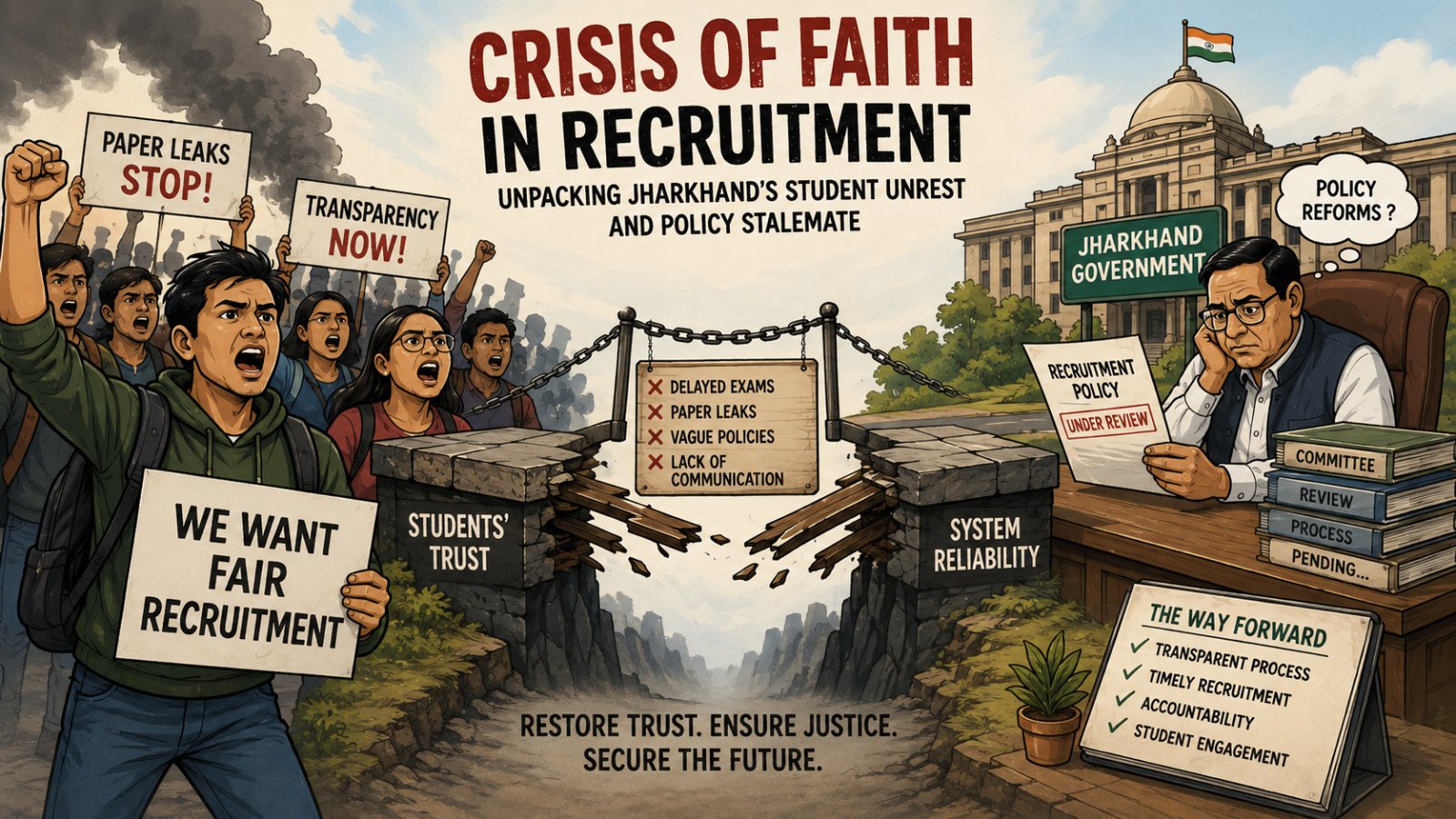
The Assembly March and the Flashpoint of Youth Discontent
In the administrative capital of Ranchi, the monsoon rain has done little to cool the simmering friction between the state executive and thousands of young job aspirants. What began as a localized sit-in at the Jaipal Singh Munda Stadium has rapidly transformed into one of the most significant youth-led movements in recent state history. Led by student activist Devendra Nath Mahto, whose multi-day hunger strike drew national focus and prominent civic backing, the agitation has brought the vulnerabilities of state-level public service recruitment into sharp focus. As protesters organize a massive peaceful march toward the State Assembly, the administration under Chief Minister Hemant Soren finds itself navigating a profound crisis of institutional credibility.
The immediate catalyst for this escalating standoff lies in persistent allegations of administrative malfeasance, question paper leaks, and procedural opacity governing major competitive tests conducted by the Jharkhand Public Service Commission and the Jharkhand Staff Selection Commission. For hundreds of thousands of educated youth across tier-two cities and rural districts, public sector employment represents not merely a career choice, but the primary vehicle for socio-economic mobility. When the integrity of these examinations is questioned, the socio-economic contract between the state and its youth experiences severe strain.
"When years of dedicated study are met with procedural uncertainty and recurring examination scandals, public confidence in statutory bodies collapses. Restoring trust requires absolute administrative transparency, structural reform, and verifiable accountability."
Anatomy of the Discontent: Vendor Management and OMR Integrity
To understand the depth of student frustration, one must examine the specific technical and procedural grievances raised by the aspirants. Central to the controversy are the recruitment drives for the 14th Civil Services Examination, alongside the Combined Graduate Level, Junior Engineer, and Post Graduate Teacher tests. Protesters contend that systemic vulnerabilities have allowed unauthorized paper distribution, questionable answer key evaluations, and irregularities in Optical Mark Recognition sheet processing. A primary point of contention is the state's reliance on third-party private testing agencies, such as TSR Data Processing Private Ltd, which aspirants claim lack adequate security protocols and oversight mechanisms.
Furthermore, candidates have voiced intense frustration over the absence of basic procedural transparency. Unlike federal testing bodies that routinely publish official answer keys, candidate response sheets, and category-wise cut-off scores across various social categories, state recruitment processes have frequently operated behind a veil of administrative discretion. Job seekers argue that without access to verified carbon copies of their answer sheets and itemized score breakdowns, proving evaluation anomalies becomes nearly impossible. This informational asymmetry has fostered deep suspicion among candidates who spend years in coaching centers and libraries preparing for exams that are repeatedly delayed, litigated, or canceled.
The State's Response: Incremental Concessions versus Systemic Trust
In response to the mounting pressure, the state government has initiated a series of high-profile political and legal maneuvers designed to quell public anger. Following intensive discussions between senior state ministers and student representatives, Governor Santosh Kumar Gangwar accepted the resignations of three sitting members of the Public Service Commission. Simultaneously, the state government announced a multi-pronged investigative approach, tasking the Crime Investigation Department and the Enforcement Directorate with investigating potential financial improprieties and leak syndicates. State investigative teams have already issued summonses and conducted targeted operations across multiple districts.
In a further bid to appease the protesting youth, government representatives announced a willingness to cancel the preliminary test of the controversial 14th Civil Services Examination, along with disputed backlog recruitment cycles from previous years. Executive officials have maintained that state-level investigative bodies possess both the jurisdictional agility and local context required to prosecute paper leak syndicates swiftly. Ministerial spokespersons contend that transferring the case to federal agencies could lead to prolonged legal delays, effectively freezing recruitment pipelines for years and penalizing candidates who are nearing the maximum age limit for government service.
The Aspirants' Stance: The Imperative for Federal Oversight
Despite these high-level concessions, the core body of protesting aspirants remains steadfast in its refusal to call off the movement entirely. From the perspective of student leadership, executive concessions—while significant—address the symptoms rather than the root cause of systemic corruption. Protesters argue that state-level investigative agencies remain inherently vulnerable to political executive influence and local bureaucratic interests. Consequently, their primary demand remains an independent, court-monitored investigation by the Central Bureau of Investigation, which they believe possesses the requisite autonomy to dismantle cross-state examination cartels.
Beyond punitive measures against paper leak mafias, the movement's charter of demands emphasizes long-term structural reforms. Student leaders are insisting on the complete institutional prohibition of blacklisted private testing vendors, the mandatory publication of verified OMR sheets and response keys immediately following examinations, and the statutory adoption of a fixed annual recruitment calendar modeled on federal commissions such as the Union Public Service Commission. The moral dimension of the protest was further highlighted when civic figures, including prominent climate activist Sonam Wangchuk, extended ethical support to the fasting student leadership, reinforcing the principle that youth-led agitations must remain strictly non-partisan while demanding institutional accountability.
Institutional Rebuilding and Governance in Neo Bharat
The recruitment crisis in Jharkhand carries broader lessons for governance across modern India. As state economies strive to modernize and expand, public administration must reflect the same standards of efficiency, technological rigor, and transparency expected in progressive governance models. Relying on outdated manual testing systems, unverified private contractors, and opaque evaluation practices directly undermines state administrative capability. When competitive examinations become embroiled in litigation and public controversy, the state suffers a dual penalty: the loss of qualified human capital in governance and the alienation of its younger demographic.
Policy analysts emphasize that resolving the current impasse requires moving past temporary political fixes toward comprehensive legislative framework overhauls. Enacting stringent anti-paper-leak legislation with non-bailable penal clauses, establishing independent examination audit units, and digitizing the entire lifecycle of public testing—from question bank creation to encrypted center distribution—are essential steps toward systemic security. Furthermore, state public service commissions must cultivate direct, institutionalized lines of communication with candidate associations, ensuring that grievances regarding answer keys or administrative procedures are resolved through transparent administrative mechanisms rather than street demonstrations.
Conclusion: Restoring Faith in the Meritocratic Ideal
The ongoing standoff in Ranchi serves as a critical test case for executive governance and institutional responsiveness. While the state government's recent willingness to accept commission resignations and initiate criminal inquiries demonstrates a recognition of public grievance, genuine reconciliation requires systemic transformation. The thousands of young women and men assembling outside administrative offices are asking for neither administrative charity nor political rhetoric; they are demanding a secure, predictable, and transparent system where merit alone dictates public service selection.
As the state navigates this crucial juncture, policymakers must recognize that public trust is fragile and difficult to rebuild once shattered. By accepting independent investigative scrutiny, implementing binding procedural safeguards, and enforcing absolute transparency in candidate evaluation, the administration can convert a severe governance crisis into an opportunity for enduring institutional reform. Modern India's developmental trajectory depends fundamentally on the integrity of its public institutions and the faith of its youth in the fairness of the state.