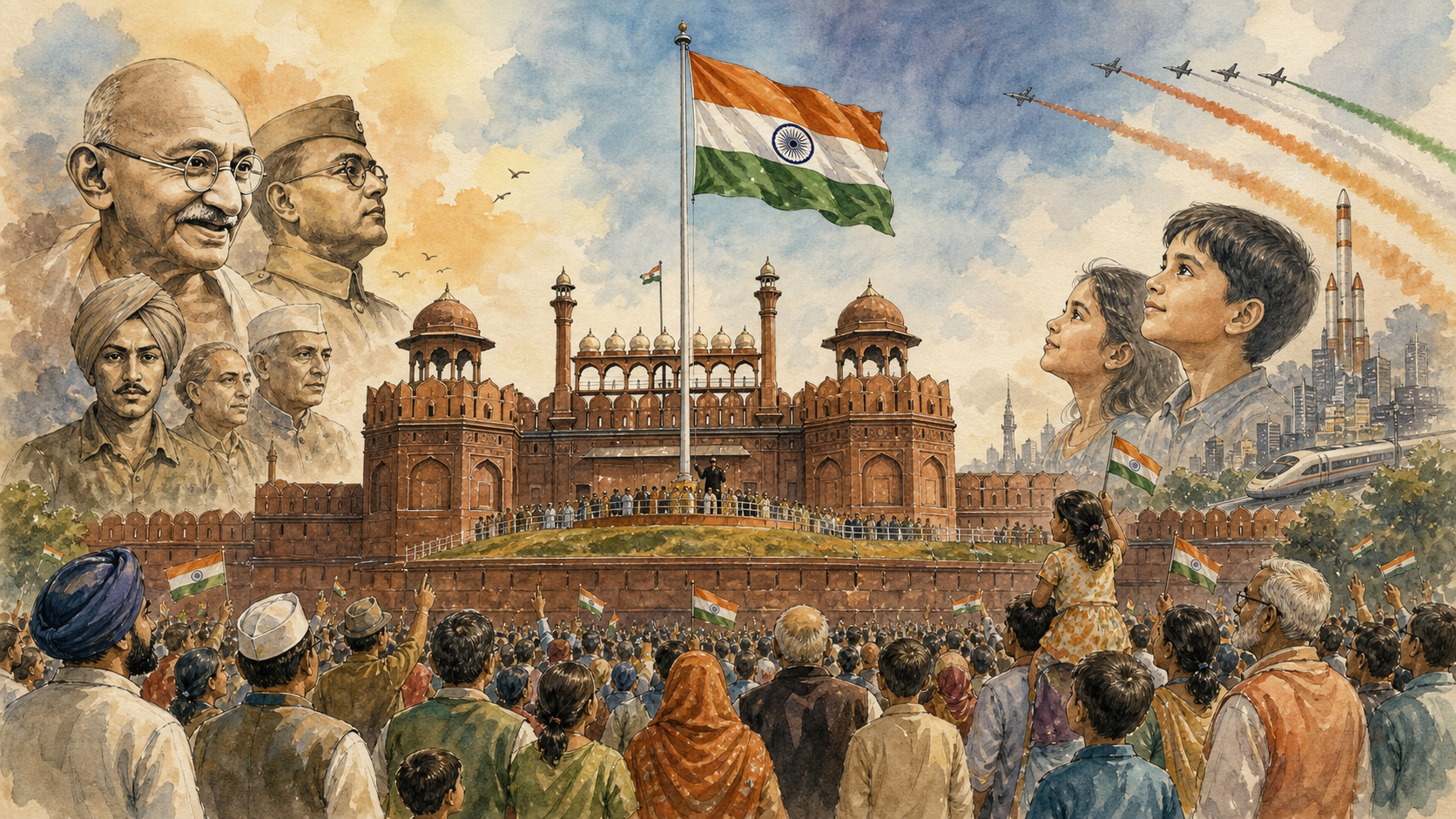
A Historic Milestone at the Red Fort
On August 15, 2026, the Republic of India commemorated its 80th Independence Day, marking exactly 79 completed years since the historic transfer of power at midnight on August 14-15, 1947. The numerical distinction remains vital for historical accuracy: while the nation celebrated the completion of 79 years of sovereign statehood, the annual commemorative event itself entered its 80th iteration. Against the backdrop of the historic red sandstone ramparts of the seventeenth-century Red Fort in New Delhi, the ceremonial proceedings commenced with the traditional unfurling of the national flag, accompanied by the national anthem and a synchronized twenty-one-gun salute by artillery regiments.
Addressing dignitaries, military personnel, foreign diplomats, and thousands of invited citizens, the national address paid homage to generations of freedom fighters whose collective mobilization broke the yoke of British colonial rule. Tributes encompassed both prominent leaders of the national movement and lesser-known regional revolutionaries across tribal belts, coastal provinces, and princely states. The address balanced reverence for the founding generation with an unvarnished assessment of contemporary national responsibilities, framing the current era as a decisive strategic runway toward becoming a fully developed economy by the centenary year of 2047.
Pan-India Mobilization and the National Flag Campaign
Beyond the national capital, celebrations unfolded across all twenty-eight states and eight union territories, reflecting profound regional diversity united by constitutional ethos. State capitals witnessed ceremonial parades and cultural exhibitions, while remote border outposts in Ladakh, Arunachal Pradesh, and the Rann of Kutch saw military personnel and local border communities raising the Tricolour in unison.
A defining hallmark of the 2026 commemorations was the nationwide expansion of the domestic flag initiative, encouraging citizens to hoist the national flag at residential, institutional, and commercial premises. Digital portals recorded hundreds of millions of citizen participations, while schools, municipal bodies, and self-help groups organized awareness marches and community clean-up drives. Unlike purely top-down state pageantry, the broad civic participation reflected an evolving civic nationalism rooted in personal ownership of the republic's democratic compact.
The true endurance of Indian democracy lies not merely in its formal institutions, but in the sustained willingness of its diverse populace to resolve differences through constitutional mechanisms rather than coercion.
Eight Decades of Democratic Continuity
When India attained independence in August 1947, contemporary Western political analysts openly questioned whether a subcontinent fractured by linguistic divisions, profound poverty, social stratification, and the trauma of Partition could survive as a unified democracy. Nearly eight decades later, India stands as an undeniable refutation of those early predictions. It remains the world's most populous constitutional democracy, having sustained uninterrupted civilian governance, periodic peaceful transitions of power through universal adult suffrage, and an autonomous institutional framework.
India's democratic resilience gains sharper relief when viewed in a global context. Across Asia, Africa, and Latin America, numerous post-colonial states that achieved independence in the mid-twentieth century succumbed to military dictatorships, civil conflict, or institutional collapse. India's ability to maintain constitutional supremacy while managing unprecedented demographic scale and cultural pluralism represents one of the modern era's most significant political achievements.
Geopolitical Stature and Economic Transformation
As India completes its 79th year of independence, its external posture and domestic economic footprint reflect dramatic transformation. From an agrarian economy struggling with systemic food deficits in the mid-twentieth century, the nation has evolved into a global technological, pharmaceutical, and manufacturing hub. Sustained infrastructure investment—spanning high-speed rail corridors, modernized ports, dedicated freight networks, and rural digital connectivity—has laid the groundwork for enhanced total factor productivity.
Geopolitically, New Delhi has transitioned from non-alignment to strategic autonomy, acting as a crucial bridge between the Global South and advanced industrial powers. India's leadership in multilateral forums, combined with expanding maritime security partnerships in the Indo-Pacific, underscores its emergence as a central anchor of regional stability. However, this growing international influence brings heightened expectations to contribute constructively to global public goods, climate mitigation, and international supply chain resilience.
The Road Ahead: Strategic Imperatives for 2047
The transition from the 80th Independence Day toward the centenary in 2047 presents a critical twenty-one-year window of opportunity. Demographically, India currently possesses one of the world's most advantageous working-age population ratios. Yet, transforming this demographic advantage into sustained national prosperity requires urgent policy execution across several structural fronts:
First, accelerating high-quality employment generation through labor-intensive manufacturing and high-value service exports remains essential to absorb millions of young entrants into the formal workforce annually. Second, deep educational and healthcare reforms must address persistent regional disparities, ensuring human capital development matches the demands of an artificial intelligence-driven global economy. Third, the green energy transition demands balancing ambitious decarbonization goals with the imperative of providing affordable, uninterrupted power to support industrialization.
As the celebrations of August 15, 2026 conclude, the consensus across India's public sphere is clear: the journey from 1947 has secured national sovereignty, democratic stability, and basic developmental resilience. The mandate for the coming two decades is to translate those hard-won foundations into inclusive, high-income prosperity, fulfilling the long-deferred aspirations of the republic's founding charter.



