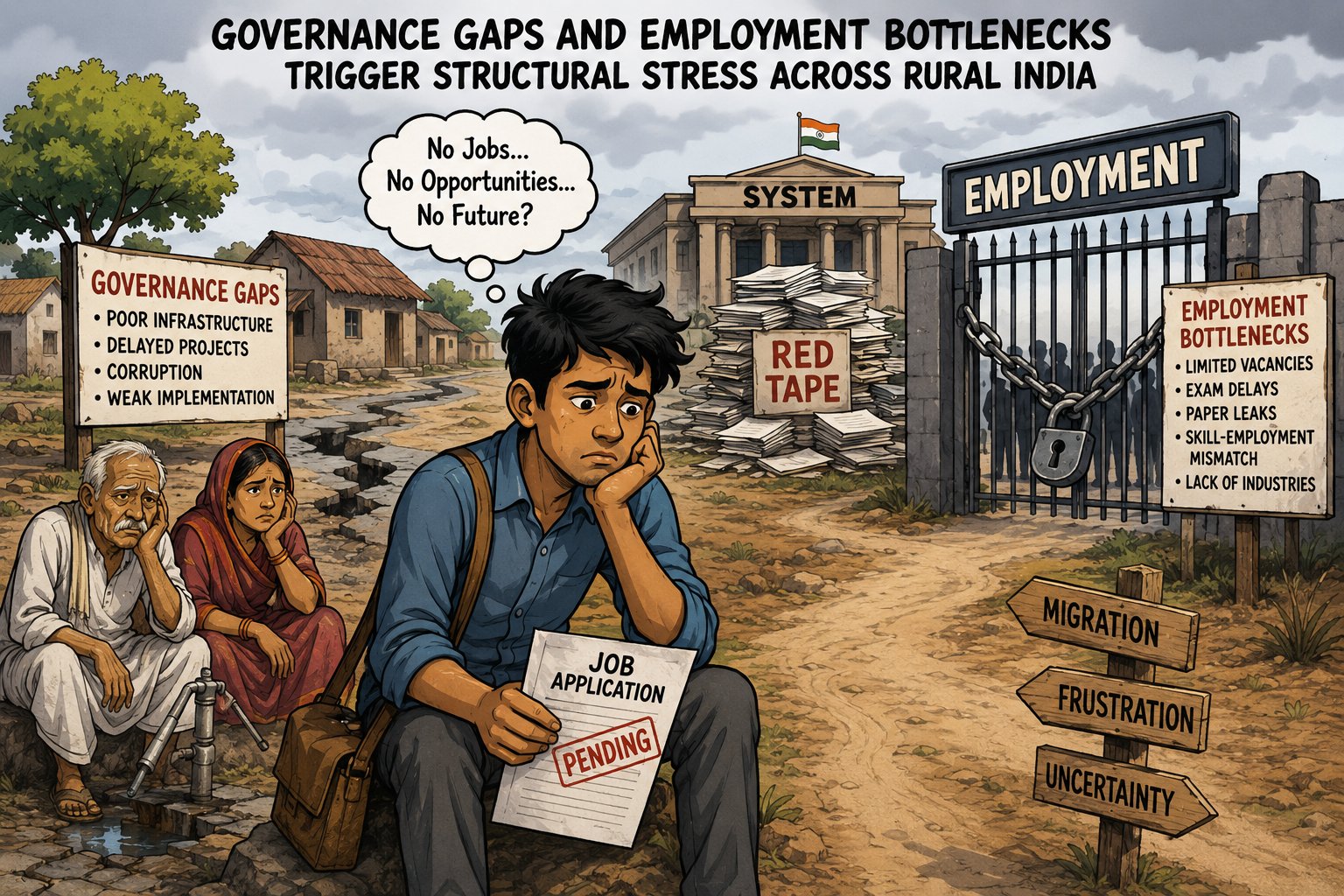
Administrative Friction and Social Unrest Highlight Deep Structural Challenges in Public Sector Governance
On August 10, 2026, a series of converging developments across India brought into sharp focus the complex intersection of administrative reform, rural economic stability, and institutional accountability. From official economic data indicating a steep contraction in rural job creation under newly restructured welfare frameworks to widespread street demonstrations over competitive examination integrity in the east and severe administrative exploitation in the north, public policy observers face a stark reminder of the challenges inherent in state capacity and administrative execution.
These simultaneous developments highlight a growing friction between policy design and ground-level implementation. As the national government attempts to modernize public delivery systems through digital architecture and restructured frameworks, the human cost of administrative transition delays, institutional opacity, and bureaucratic power asymmetries continues to fall disproportionately on vulnerable citizens, job-seeking youth, and frontline public employees.
Rural Employment Restructuring: The Forty-Nine Percent Contraction Under the VB-G RAM-G Initiative
The release of official performance metrics for the newly implemented VB-G RAM-G rural employment framework on Monday generated intense debate among policy analysts and labor economists. According to figures compiled by the Ministry of Rural Development, person-days of work generated in the first full month of the restructured program declined by 49.2 percent compared to the corresponding period in 2025 under the previous statutory framework.
Government officials have defended the sharp decline as an anticipated operational transition period rather than a structural failure. According to senior ministry representatives, the introduction of the VB-G RAM-G framework involved a complete overhaul of worker registration databases, mandatory dual-biometric verification at job sites, and a real-time digital asset auditing protocol designed to curb fiscal leakages and eliminate ghost beneficiaries.
"Any major policy transition requiring comprehensive database alignment and digital infrastructure migration involves a temporary settling-in period," stated a senior official from the Ministry of Rural Development. "Our primary focus during the initial phase is ensuring absolute transparency, eliminating systemic corruption, and verifying that financial transfers reach legitimate rural households without intermediary diversion. The generation of employment days will resume its normal momentum once state agencies finalize regional verification procedures."
However, economic research groups and agrarian rights advocacy organizations argue that the timing of this operational slowdown has inflicted significant economic distress on rural communities. August represents a critical lean period in the agricultural calendar across much of the country, where weather fluctuations and diminished farm operations leave landless laborers heavily dependent on public works programs for daily wage support.
Labor economists point out that the temporary suspension or delay of job allocations due to digital re-registration bottlenecks has forced millions of agrarian households into high-interest informal debt. Independent rural surveys suggest that over sixty percent of eligible households in key agrarian belts experienced delays exceeding three weeks in obtaining work permits or registering under the updated portal. The impact has been particularly severe on marginal female workers, who constitute over fifty percent of the rural public workforce and rely heavily on predictable daily wages for household nutrition and healthcare needs.
Opposition lawmakers have signaled plans to raise the issue during upcoming parliamentary proceedings, pressing the administration to introduce transitional cash transfers or temporary relaxed verification standards in flood-affected and economically distressed districts until administrative systems achieve operational stability.
Recruitment Crises and Youth Agitation: The Legislative Standoff in Ranchi
Concurrently, the state of Jharkhand witnessed unprecedented civil unrest as thousands of young job aspirants and civil service candidates staged a massive march toward the State Legislative Assembly in Ranchi. The demonstration, organized by a coalition of student associations and youth advocacy groups, marked the culmination of months of rising frustration over systemic irregularities, question paper leaks, and repeated deferrals in state recruitment examinations.
Protesters breached police barricades near the assembly perimeter, prompting law enforcement personnel to deploy water cannons and temporary physical restrictions to manage the crowd. The intensity of the protest forced state authorities into emergency consultations, culminating in the announcement that three contested state-level competitive examinations would be formally canceled and rescheduled under revamped oversight guidelines.
Adding to the institutional turbulence, multiple senior members of the State Public Service Commission submitted their resignations late Monday afternoon, acknowledging that public confidence in the agency's testing protocols had reached an unsustainable low.
"Youth across the region have dedicated years of their lives to preparing for competitive examinations, only to face continuous cancellations, administrative litigation, and compromised testing integrity," said a representative of the state youth coalition during the assembly march. "We are demanding complete structural reform, transparent evaluation timelines, and strict legal sanctions against third-party agencies involved in examination management."
The situation was further magnified by the participation of prominent youth coalition leader Devendra Nath Mahto, who joined the assembly march in an ambulance after nine consecutive days on an indefinite hunger strike. Health officials confirmed that Mahto had lost over ten kilograms during the protest, illustrating the extreme personal sacrifices driving the student movement.
State government spokespersons assured the public that a high-level judicial committee would be constituted to investigate all alleged irregularities and establish a computerized, multi-tier examination framework to restore institutional integrity. However, policy experts note that youth unrest regarding public sector recruitment reflects a broader structural challenge across multiple states. In regions where private sector job growth remains limited, public recruitment serves as the primary engine of socio-economic mobility for educated youth, making examination delays and procedural flaws highly volatile social flashpoints.
Workplace Vulnerability and Bureaucratic Discretion: The Hardoi Abuse Incident
While macro-level economic and recruitment challenges captured national attention, an incident in the Hardoi district of Uttar Pradesh highlighted the urgent need for internal administrative reform and workplace protection within public institutions. Local law enforcement authorities confirmed the detention of a administrative clerk posted at the Todarpur Block Resource Centre following allegations of sexual assault against a 35-year-old primary school teacher.
According to official police filings, the complainant had repeatedly visited the block resource center over a three-month period to resolve a prolonged salary clearance dispute caused by an administrative processing delay. The accused clerk allegedly leveraged his administrative control over her file to extort and intimidate her, eventually committing the assault after unlawfully entering her residence under the pretext of delivering official documentation.
The case has sparked widespread outrage among educators' associations and women's rights organizations across northern India, who argue that the incident underscores the severe power asymmetries embedded within local administrative structures. School teachers, particularly women stationed in rural primary educational institutions, frequently face arbitrary administrative obstacles, delayed wage disbursements, and retaliatory posting threats when seeking routine administrative approvals.
"This tragic case exposes the dangerous extent to which minor bureaucratic discretionary powers can be abused when grievance redressal mechanisms are weak or absent," remarked a representative of the State Primary Teachers Association. "No educator should be subjected to coercion, administrative extortion, or physical violence simply to claim their legally earned remuneration. We demand fast-track judicial proceedings and the immediate implementation of centralized, contact-free digital grievance portals across all educational departments."
District administrative authorities have placed the accused official under immediate suspension pending formal judicial inquiry and announced a comprehensive audit of all pending teacher salary files at the block level to ensure swift clearance without administrative interference. Gender rights advocates have further called for strict compliance audits of Internal Complaints Committees across all district education departments to guarantee immediate access to safe reporting channels for female public employees.
Analyzing the Common Thread: State Capacity, Transparency, and Public Trust
When evaluated together, the events of August 10 offer crucial insights into the evolving nature of governance in contemporary India. Whether in the sphere of rural welfare distribution, public employment recruitment, or routine departmental administration, the common underlying challenge remains the gap between institutional authority and public accountability.
In the case of the rural employment guarantee program, well-intentioned digital reforms aimed at fiscal hygiene have temporarily disrupted essential social safety nets due to rigid administrative implementation timelines. In the context of civil service recruitment, prolonged institutional inertia and procedural compromises have eroded faith among millions of educated youth seeking upward social mobility. In departmental administration, discretionary power combined with slow grievance resolution mechanisms creates fertile ground for administrative abuse.
Addressing these multi-faceted challenges requires a holistic commitment to governance reform that prioritizes three key pillars:
First, policy transitions in large-scale welfare programs must incorporate flexible human-centric safeguards. While digital verification is essential for preventing corruption, failure to provide offline fallback mechanisms during transitional phases risks punishing the very citizens these programs are designed to protect.
Second, state public service commissions must adopt standardized, high-security testing protocols, robust whistleblower protections, and fixed statutory timelines for candidate selection and appointment. Ensuring absolute integrity in public recruitment is not merely an administrative duty; it is a fundamental prerequisite for maintaining political and social stability.
Third, administrative grievance redressal must be thoroughly modernized and decoupled from immediate supervisory control. Implementing automated salary disbursal systems, transparent tracking of administrative files, and zero-tolerance policies for workplace harassment are essential steps toward building a safe, professional, and equitable public service environment.
As India continues its trajectory of economic expansion and administrative modernization, the events of this day serve as a sobering reminder that true development is measured not only by the sophistication of policy frameworks, but by the efficiency, fairness, and compassion with which government institutions serve their people.



