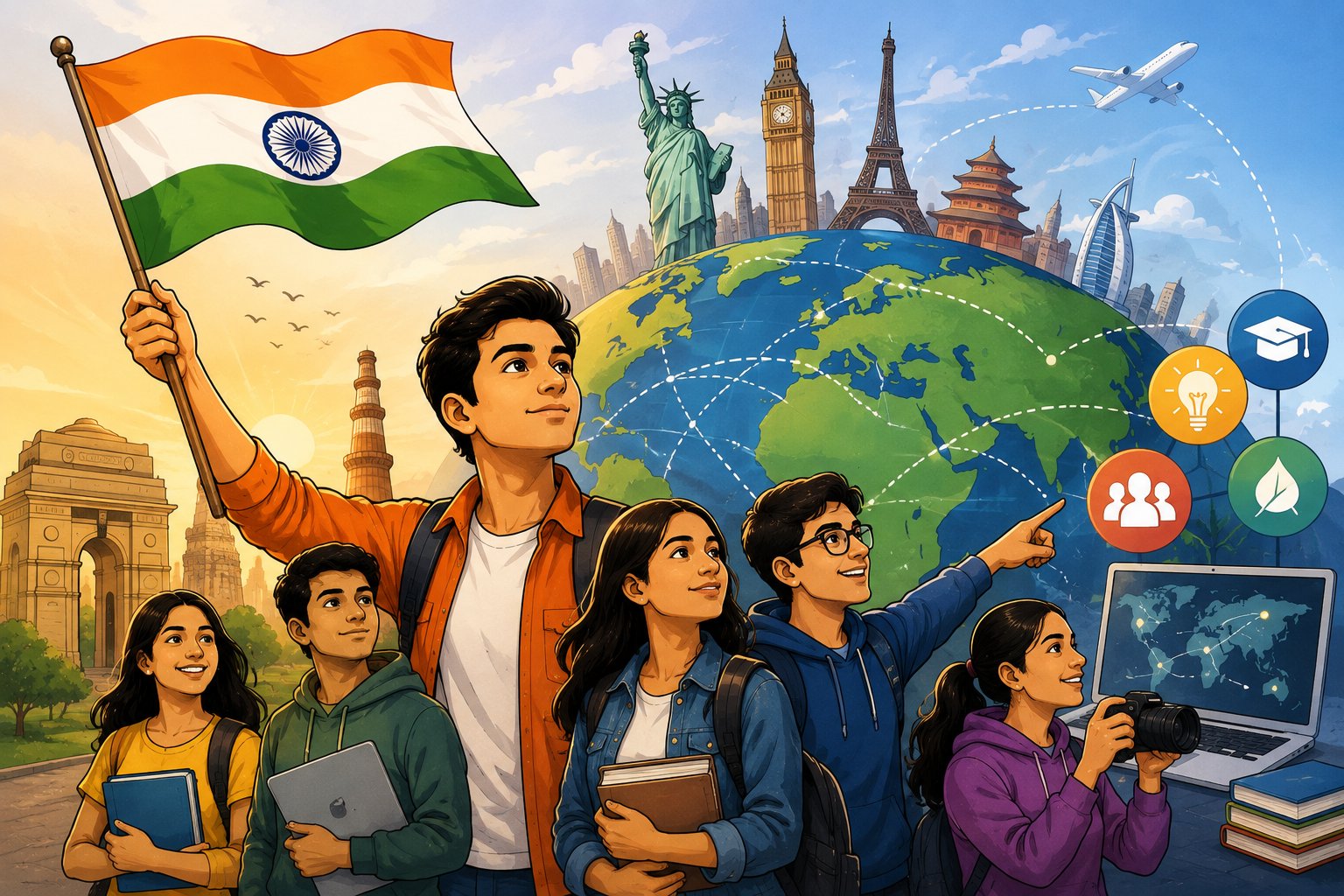
The Evolution of a Nation's Aspiration
When the midnight chimes rang in August 1947, freedom was unambiguously defined by sovereign statehood, territorial integrity, and the right of an ancient civilization to govern itself. For the generation that lived through the independence movement, liberty was fundamentally collective—an arduous triumph over foreign subjugation. Nearly eight decades later, as India navigates the complex socioeconomic dynamics of 2026, the definition of freedom has undergone a profound generational transition. For Generation Z—those born between the late 1990s and the early 2010s—liberty is no longer solely an inherited historical milestone; it is an active, evolving, and deeply individualized condition of life.
Today's young Indians constitute one of the largest demographic cohorts in the world. Having grown up entirely in a post-liberalization, hyper-connected era, their relationship with the nation-state is shaped not by the memory of foreign rule, but by the immediate realities of global competition, technological saturation, economic restructuring, and social mobility. To understand what freedom means to this cohort is to understand the future trajectory of Indian democracy itself.
Economic Autonomy: Breaking Free from Conventional Blueprints
For previous generations, economic freedom was inextricably linked to stability—the permanent government post, the structured corporate career, or the predictable continuity of ancestral trades. For contemporary youth, however, economic liberty is increasingly synonymous with agency, flexibility, and the diversification of opportunity. The explosive expansion of the digital economy, entrepreneurial ecosystems, and creator platforms has dismantled traditional hierarchies of work.
Yet, this pursuit of occupational autonomy is accompanied by substantial structural challenges. While young urban professionals celebrate the rise of decentralized work and independent ventures, millions of young people in smaller towns face a competitive employment landscape characterized by skill mismatches and fluctuating market demands. For an aspirational demographic, genuine economic freedom means more than merely securing a livelihood; it represents the liberty to choose one's vocational path without being constrained by legacy socioeconomic barriers.
"True independence today is not merely about having an income; it is about having the autonomy to design one's life, the safety net to take risks, and the systemic equity that ensures talent triumphs over circumstance."
Financial literacy has consequently emerged as a primary instrument of modern self-determination. From early micro-investments and equity participation to exploring decentralized finance, young Indians are taking control of their fiscal futures earlier than any preceding generation. Financial independence is widely perceived as the foundational prerequisite upon which all other personal liberties are built.
Digital Frontiers: Expression, Privacy, and Algorithmic Realities
Generation Z is the first demographic in Indian history to experience life entirely mediated by digital infrastructure. For them, digital platforms are not merely communication tools; they are the primary public squares where culture is forged, dissent is articulated, and communities are sustained. In this context, freedom is heavily defined by the parameters of the digital realm.
This relationship with technology is, however, inherently dualistic. On one hand, the democratisation of access via affordable smartphones and nationwide high-speed connectivity has empowered marginalized voices, enabling youth from Tier-2 and Tier-3 cities to participate in national discourses. Content creation has become a viable vehicle for self-expression and financial independence, bypassing legacy institutional gatekeepers.
On the other hand, this generation is acutely aware of the perils of algorithmic control, surveillance, and digital polarization. Liberty in the digital age requires robust data privacy, protection against online harassment, and the preservation of open, uninhibited public dialogue. The struggle for freedom is increasingly fought in the domain of digital governance—balancing the necessity of platform safety and national cyber defense with the non-negotiable right to digital anonymity and free inquiry.
Social Emancipation and the Reconstruction of Identity
Perhaps the most visible shift in the conceptualization of freedom lies in the social and interpersonal domain. Young Indians are systematically questioning traditional social orthodoxies that dictate lifestyle choices, career pathways, gender roles, and community associations. Freedom is increasingly articulated as the right to authentic self-definition.
Mental health awareness serves as a prominent indicator of this cultural evolution. While earlier generations often viewed emotional and psychological struggles through the prism of stigma or personal endurance, Gen Z treats mental well-being as a fundamental civil right. The liberty to acknowledge vulnerability, seek professional psychological support, and reject toxic workplace or social environments is viewed as essential to living a dignified life.
Furthermore, social freedom encompasses the dismantling of historic hierarchies rooted in caste, gender disparity, and regional discrimination. Young citizens are demanding institutional accountability and inclusive representation across boardrooms, academic institutions, and cultural platforms. The desire for social liberty does not represent an uncritical adoption of external values, but rather an internal evolution rooted in constitutional guarantees of equality and fraternity.
The Climate Imperative: Liberty in an Age of Ecological Vulnerability
An indispensable dimension of contemporary youth philosophy is the acute recognition that individual freedom cannot survive ecological destabilization. Unlike their predecessors, Gen Z views environmental sustainability not as an optional philanthropic endeavor, but as an existential necessity tied directly to their future well-being.
Across metropolitan centers and rural heartlands alike, youth-led initiatives are addressing water security, air quality, waste management, and renewable energy adoption. For this generation, true freedom includes the right to breathe clean air, access uncontaminated natural resources, and inherit a biologically stable planet. Their critique of rapid, non-sustainable industrial models reflects a sophisticated understanding that short-term economic gains cannot come at the expense of intergenerational justice.
"We cannot meaningfully discuss human progress or individual rights if the physical biosphere that sustains our civilization is systematically degraded. Ecological security is the ultimate foundation of all modern liberty."
Institutional Trust and Democratic Engagement
The contemporary youth demographic exhibits a nuanced relationship with formal democratic institutions. Far from being politically indifferent, young Indians demonstrate high levels of civic consciousness, though their engagement often diverges from traditional partisan allegiances. They are drawn to issue-based mobilizations, systemic governance reforms, and measurable policy outcomes rather than ideological dogmas.
Their understanding of patriotism is grounded in constructive accountability. To love the republic is to demand that it continually strives toward its founding ideals. This generation views constitutional morality—the protection of civil liberties, the rule of law, institutional transparency, and administrative efficacy—as the standard against which state performance must be measured.
Civic participation has expanded beyond the voting booth into continuous civic advocacy. Whether utilizing digital tools to track municipal expenditures, volunteering for grassroots educational initiatives, or demanding administrative transparency through legal channels, young citizens are redefining public service as an active, daily responsibility rather than an episodic electoral exercise.
Bridging the Generational Divide
This evolving conceptualization of liberty inevitably generates intergenerational friction. Older generations sometimes misinterpret Gen Z's emphasis on personal autonomy, work-life balance, and expressive individuality as detachment from collective duty or cultural heritage. Conversely, younger citizens can occasionally overlook the arduous structural and geopolitical struggles that secured the foundational stability they now enjoy.
Bridging this divide requires recognizing that modern youth aspirations do not represent an abandonment of national duty, but its modern adaptation. The anti-colonial generation secured the sovereign vessel; the contemporary generation is working to ensure that every individual aboard that vessel possesses the tools, dignity, and agency to flourish.
The Republic at 79: A Living Covenant
As India moves toward the completion of eight decades of sovereign independence, the concept of freedom remains vibrant precisely because it refuses to remain static. Gen Z has expanded the democratic lexicon, demonstrating that liberty is multifaceted—spanning economic equity, digital self-determination, environmental sustainability, social dignity, and institutional integrity.
The ultimate strength of a democratic republic lies in its capacity to absorb, integrate, and champion the evolving aspirations of its newest citizens. By viewing freedom not merely as a historic victory to be celebrated, but as a living standard to be constantly renewed and deepened, India's youth are charting a resilient, dynamic course for the nation's unfolding century.



