The Annual Calendar Dilemma: An Enduring National Debate
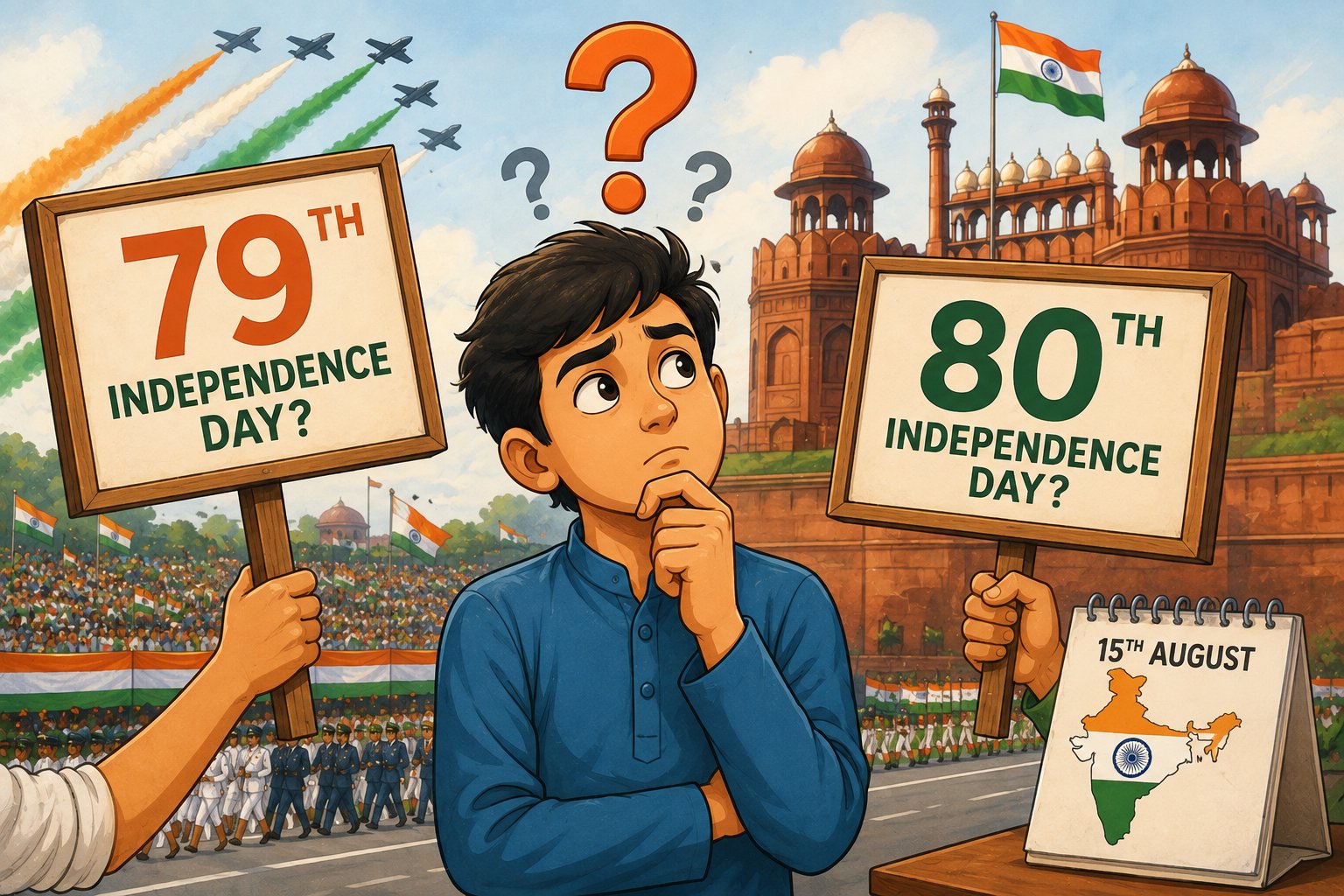
Every August, across government secretariats, school assemblies, editorial newsrooms, and digital platforms, an identical debate captures public attention: Is India celebrating its 79th or 80th Independence Day in 2026? While the question appears trivial on the surface, it routinely generates widespread confusion, sparking intense discussions on social media and prompting official clarifications from administrative authorities.
The dilemma stems from the foundational linguistic and mathematical distinction between an ordinal milestone—the specific occurrence of an event—and the measurement of completed elapsed time, commonly termed an anniversary. As the tricolour unfurls across the ramparts of the Red Fort and public squares nationwide on August 15, 2026, establishing clarity regarding this arithmetic provides not merely a lesson in chronology, but an opportunity to evaluate nearly eight decades of post-colonial statehood.
The Core Mathematical Breakdown: Ordinals Versus Anniversaries
The mathematical confusion can be readily resolved by establishing a clear timeline starting from midnight on August 15, 1947, the historic moment India shook off British colonial rule to emerge as a sovereign nation.
On August 15, 1947, India celebrated its very first Independence Day. At that precise juncture, zero years of independence had been completed; the journey of self-governance was merely commencing. One full year later, on August 15, 1948, India marked its second Independence Day, which simultaneously represented the completion of its first full year of freedom—the first anniversary.
"The distinction is straightforward yet chronically misunderstood: August 15, 2026, marks India's 80th Independence Day in terms of annual observances, but it represents the 79th anniversary of the nation gaining freedom, signifying exactly 79 completed years of sovereignty."
To understand the progression systematically, consider the following chronological benchmarks:
August 15, 1947: 1st Independence Day (0 completed years of freedom)
August 15, 1948: 2nd Independence Day (1st Anniversary / 1 completed year)
August 15, 1972: 26th Independence Day (25th Anniversary / Silver Jubilee)
August 15, 1997: 51st Independence Day (50th Anniversary / Golden Jubilee)
August 15, 2022: 76th Independence Day (75th Anniversary / Platinum Milestone)
August 15, 2025: 79th Independence Day (78th Anniversary / 78 completed years)
August 15, 2026: 80th Independence Day (79th Anniversary / 79 completed years)
Consequently, in August 2026, India is participating in its 80th Independence Day flag-hoisting ceremony, while simultaneously concluding its 79th year of democratic autonomy and entering its 80th year of independent existence.
Why The Confusion Persists: The Birthday Analogy
Sociologists and linguists note that the recurring mix-up is rooted in how individuals intuitively celebrate personal birthdays compared to institutional milestones. When a child is born, that inaugural day is rarely designated as the 'first birthday' in popular parlance; rather, the child turns one year old on the first anniversary of their birth.
However, institutional, national, and sporting events follow an ordinal count based on occurrences. For example, the inaugural session of an assembly is the first session, and the subsequent year's gathering is the second. Because August 15, 1947, was widely documented and celebrated as the 'First Independence Day', subsequent years naturally increment that count. When media reports refer to the '80th Independence Day', they denote the 80th instance of the national observance. Conversely, when academic journals or economic reports refer to '79 years of independence', they are quantifying the cumulative duration of time elapsed since 1947.
Reflecting On 79 Completed Years: The Democratic Experiment
Beyond the semantic nuances of the calendar, August 2026 provides a substantive vantage point from which to evaluate India's trajectory. When the British departed in 1947, numerous Western political observers openly doubted whether an impoverished, multi-ethnic, linguistically diverse, and partitioned subcontinent could survive as a unified constitutional democracy.
Over the past 79 completed years, India has repeatedly defied those pessimistic forecasts. The nation successfully institutionalized universal adult suffrage from its very inception, preserved constitutional continuity despite severe internal and external crises, and peacefully transferred executive power across multiple electoral cycles involving hundreds of millions of citizens.
India's transformation from an agrarian economy grappling with severe food shortages in the 1950s and 1960s into a major global economic power, a space-faring nation, and a dominant hub for technology and digital public infrastructure remains one of the defining developments of the contemporary era.
Persistent Socio-Economic Realities and Structural Challenges
While the historical balance sheet showcases undeniable resilience, a balanced journalistic assessment demands an unflinching look at the formidable challenges that remain as the country completes 79 years of freedom. Economic growth has expanded the national gross domestic product significantly, yet structural disparities continue to demand urgent policy attention.
Key developmental challenges confronting the nation in 2026 include:
Job Creation and Demographic Dividends: Ensuring that high macroeconomic growth translates into formal, high-quality employment opportunities for millions of young graduates entering the workforce annually.
Human Development Indicators: Addressing lingering deficits in public healthcare access, nutritional standards among children, and equitable quality education across rural and urban geographies.
Ecological and Urban Resilience: Managing acute environmental pressures, water stress, air quality crises, and climate vulnerabilities that disproportionately impact vulnerable populations.
Judicial and Institutional Efficiency: Modernizing the legal architecture to reduce millions of pending court cases and strengthening institutional mechanisms that safeguard civil liberties and regulatory independence.
The Road to 2047: Strategic Priorities for the Centenary
With August 2026 marking the 80th Independence Day, the national policy horizon is increasingly oriented toward 2047—the centenary of Indian independence. The transition from the 79th anniversary to the upcoming milestone decade requires comprehensive policy coherence across central and state administrations.
Strategic planning across key sectors emphasizes self-reliance in advanced manufacturing, technological leadership in artificial intelligence and green energy transitions, and the enhancement of defense capabilities amid a volatile geopolitical landscape. Concurrently, strengthening cooperative federalism remains essential to ensure that regional aspirations align constructively with overall national objectives.
Conclusion: The Meaning Behind The Number
Whether one frames August 15, 2026, as the 80th Independence Day celebration or the commemoration of 79 completed years of hard-won freedom, the fundamental essence of the occasion remains unchanged. The date stands as an enduring testament to the sacrifices of the freedom generation and a recurring pledge by more than 1.4 billion citizens to uphold the democratic, pluralistic, and progressive ideals enshrined in the Constitution.
As flags flutter atop residences, institutions, and iconic monuments across the country, the true measure of the nation's journey will not be determined merely by the precision of its arithmetic, but by its ongoing commitment to justice, liberty, equality, and prosperity for every citizen.



