The Political Crucible of Youth Mobilization
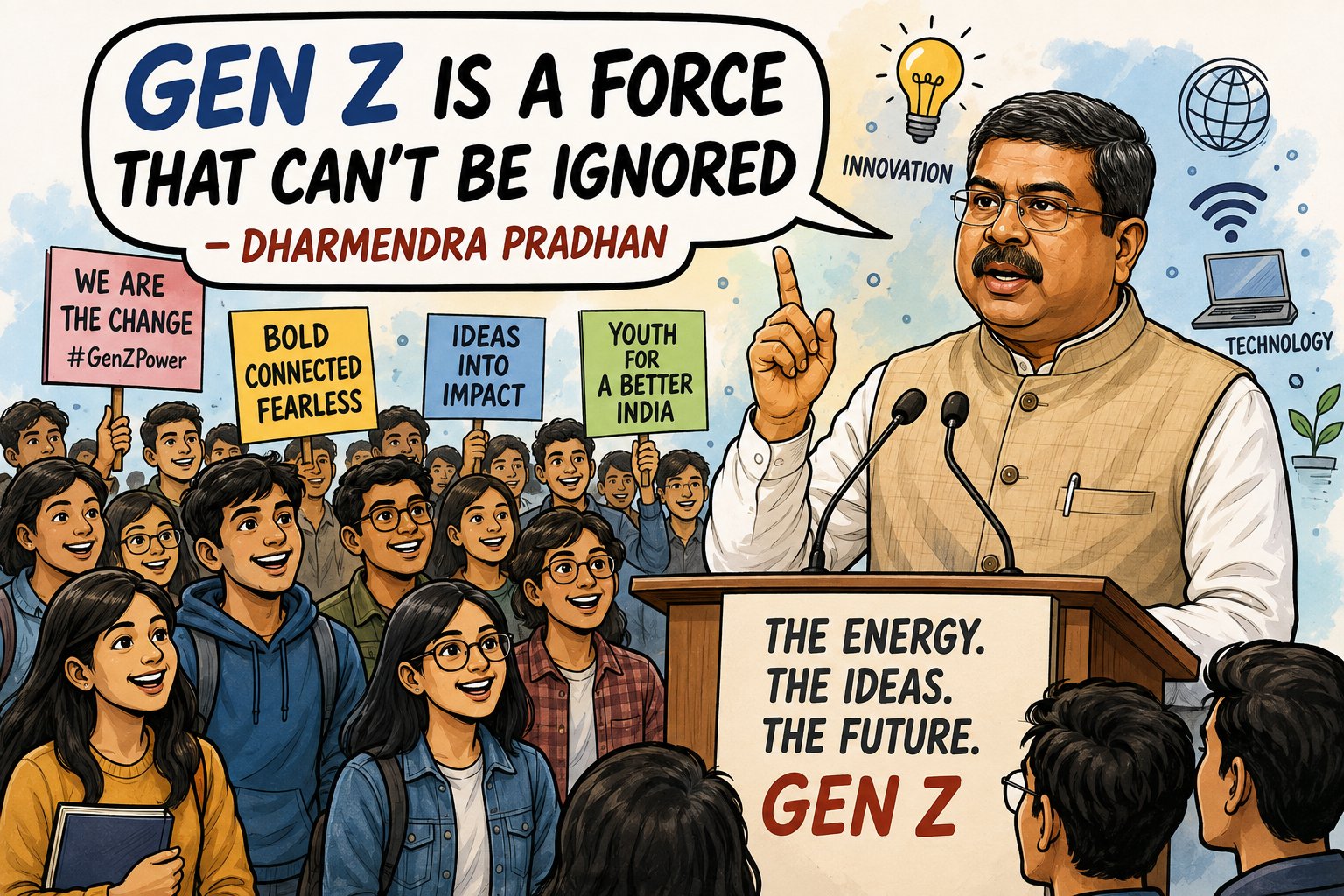
When former Union Education Minister Dharmendra Pradhan addressed students and faculty at Gangadhar Meher University in Sambalpur, his admission carried a weight that resonated far beyond the auditorium walls. Describing Generation Z as a demographic force that simply cannot be ignored, Pradhan acknowledged a shifting political reality in modern India. His remarks came exactly two weeks after his resignation on July 25, 2026, which followed weeks of sustained youth-led protests over allegations of examination paper leaks and systemic administrative failures. While Pradhan contended that young citizens were misled by opposition elements, his public reflection underscored a deeper structural truth: India's youngest cohort of voters and students has emerged as an articulate, organized, and formidable political force.
For decades, political strategists in New Delhi viewed youth politics through traditional lenses such as campus elections, party-affiliated student unions, and regional patronage networks. However, the events of mid-2026 demonstrated that Generation Z—broadly defined as individuals born between the late 1990s and early 2010s—operates under a fundamentally different paradigm. Unburdened by historical party loyalties and uniquely adept at digital coordination, these young citizens have transformed hyper-local grievances into national political movements with unprecedented speed and discipline.
Anatomy of a Digital-Native Movement
The catalyst for the mid-2026 political tremor was the widespread dissatisfaction surrounding competitive entrance examinations. For tens of millions of Indian families, examinations such as NEET and JEE represent the principal pathway to social mobility and financial stability. When allegations of paper leaks and administrative irregularities surfaced, the reaction among young aspirants was neither passive nor fragmented. Utilizing decentralized social networks, encrypted messaging platforms, and real-time data verification, student groups organized nation-wide demonstrations at Jantar Mantar and across state capitals without waiting for formal political party sponsorship.
"Gen Z is our children. Some people attempted to mislead them. I had no personal issues then. At least two crore children are born in India every year... They have aspirations, and they will make India a leader on the world stage. The post was not important to me." — Dharmendra Pradhan, Former Union Minister
This decentralized architecture presents a distinct challenge to traditional governance frameworks. Historically, political administrations addressed public dissent by negotiating with identifiable union leaders or offering incremental policy concessions. In contrast, Gen Z movements function as fluid, networked collectives. Demands are articulated in transparent online forums, evidence is crowdsourced in real time, and public rhetoric is continuously refined to maintain focus on policy outcome rather than ideological posturing. The sheer speed of information dissemination leaves policy makers with little time to deploy traditional public relations responses.
Demographic Realities and Economic Aspirations
To understand the potency of Gen Z in India, one must examine the demographic data. With over 65 percent of its population under the age of 35 and more than 370 million individuals belonging to Generation Z, India possesses the largest youth cohort in human history. This demographic dividend, long celebrated in economic forums as India's ultimate competitive advantage, also carries significant domestic political responsibilities. As millions of young citizens enter the workforce each year, their expectations regarding transparency, meritocracy, and governance standards are unprecedentedly high.
Economic anxiety remains a central driver of youth activism. Despite robust macroeconomic growth indicators, competitive pressure for higher education seats, government employment, and high-quality private sector jobs remains intense. When systemic bottlenecks or corrupt practices jeopardize competitive examinations, young applicants perceive it not merely as an administrative oversight, but as an existential threat to their economic future. Consequently, their response is swift, uncompromising, and deeply unified across regional and linguistic boundaries.
Institutional Reactions and the Narrative Conflict
The response from India's political establishment reflects a mixture of cautious engagement and political concern. Ruling party strategists contend that while genuine student grievances must be addressed swiftly, external political actors frequently exploit youth angst to undermine institutional trust. In his Sambalpur address, Pradhan repeatedly emphasized that while the aspirations of young citizens are legitimate and vital for national development, political adversaries had manipulated the protest movement for partisan gain during the examination controversy.
Conversely, opposition parties and independent commentators argue that blaming external manipulators misinterprets the nature of contemporary youth movements. Critics point out that Generation Z is uniquely resistant to top-down political messaging. Having grown up in an era characterized by ubiquitous information access, young Indians are adept at fact-checking official statements, cross-referencing claims, and identifying political opportunism across the entire political spectrum. Attempts to label student-led movements as political proxies often backfire, further alienating young voters who value independence and institutional accountability.
Redefining Democratic Accountability
The political fallout of the July 2026 protests and the subsequent cabinet reshuffle mark an important moment in India's democratic evolution. For the first time in recent history, a major ministerial resignation was directly preceded by a sustained, non-partisan student movement driven by digital activism. This outcome has established a new precedent for public accountability, signaling to elected officials across all administrative levels that youth grievances can no longer be deferred or managed through conventional political rhetoric.
Furthermore, Gen Z is actively reshaping the vocabulary of Indian civic discourse. Issues such as examination security, educational infrastructure, digital equity, climate resilience, and workplace fairness are moving from the margins of policy debate to the absolute center of national discourse. Unlike previous generations whose political participation was heavily mediated through caste identity, regional affiliation, or institutional patronage, Gen Z voters increasingly evaluate governance through the lens of institutional efficiency, fairness, and personal opportunity.
The Road Ahead for Policy Makers
As India moves toward upcoming state elections and strategic policy planning, political parties across the spectrum are forced to re-evaluate their outreach strategies. Traditional campaign tactics—such as large physical rallies, generic manifesto promises, and media broadcasts—are proving increasingly ineffective in reaching a demographic that consumes information through peer-to-peer digital networks and interactive media.
To constructively engage Generation Z, policy makers must move beyond symbolic gestures and focus on institutional reform. This requires establishing robust, tamper-proof mechanisms for national entrance examinations, expanding capacity in higher education, reforming vocational training frameworks, and creating transparent channels for youth participation in policy formulation. As former minister Pradhan rightly observed, Generation Z is an undeniable force. Whether that force becomes the primary driver of India's demographic dividend or a permanent source of political volatility depends entirely on the willingness of political institutions to listen, adapt, and deliver genuine accountability.



