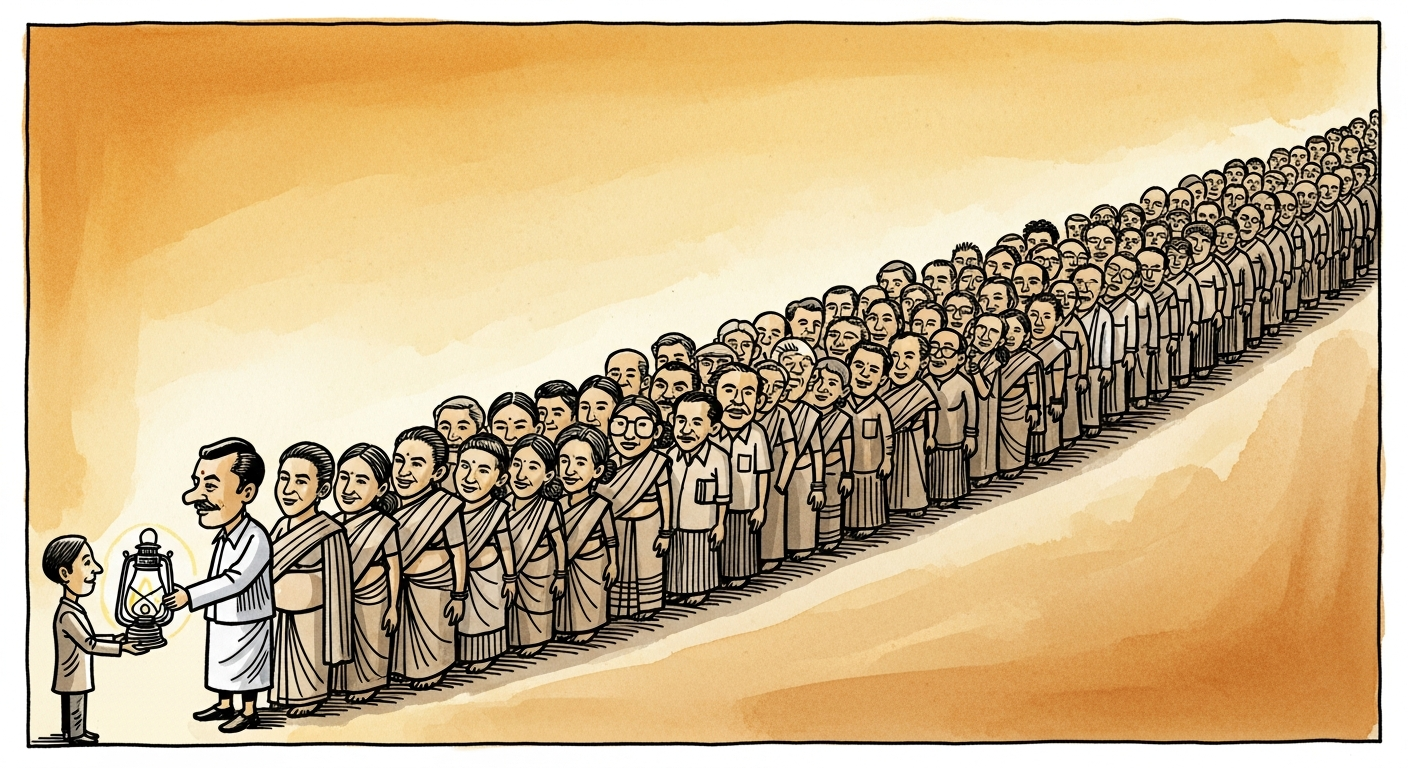
Every Indian government since independence has promised the poor. The distance between the promise made in the capital and the benefit received in the village was where those promises went to die — lost to leakage, to middlemen, to a delivery system that treated the citizen as a supplicant rather than a right-holder. The welfare revolution of the Modi decade is, at its core, the closing of that distance.
The principle is not new; it is Deendayal Upadhyaya's Antyodaya — the rise of the last person in the queue, the insistence that a policy be judged by what it does for the most marginal citizen rather than the most powerful. What changed is that the principle acquired plumbing: direct transfers that reach a bank account instead of a broker, biometric identity that ends the ghost beneficiary, and a digital spine that lets the state pay the citizen without an intermediary to skim the difference.
The results are legible in the schemes that stopped being announcements and became infrastructure. The clean-cooking rollout that now sequences its hardest districts first, the housing, the toilets, the piped water — each is measured not by the launch event but by the household that finally received it. And the newest design lessons are the honest ones: a scheme is judged at the third refill, not the first enrolment, and this government has increasingly built for exactly that.
The dignity dividend is the part no balance sheet captures. A woman who no longer breathes woodsmoke, a family that no longer walks to defecate, a farmer whose support reaches him without a cut taken on the way — these are not line items. They are the difference between a citizen who experiences the state as an obstacle and one who experiences it as a partner, and that shift in the texture of daily life is the mandate's deepest root.
The macro backdrop has made the timing generous. With inflation soft and the tax reset lowering the price of the household basket, the real value of every welfare rupee is at its most potent in years — a rare alignment where policy and prices push the same way, and the government has moved to press the advantage rather than bank it.
The cynics will say welfare is politics, and of course it is; delivering for the poor and being rewarded for it is how democracy is supposed to work. But the citizen in the last-mile district is not required to admire the motive to benefit from the cylinder, the account, or the roof. The promise was always there. What the Modi decade did was keep it. More on our India desk.