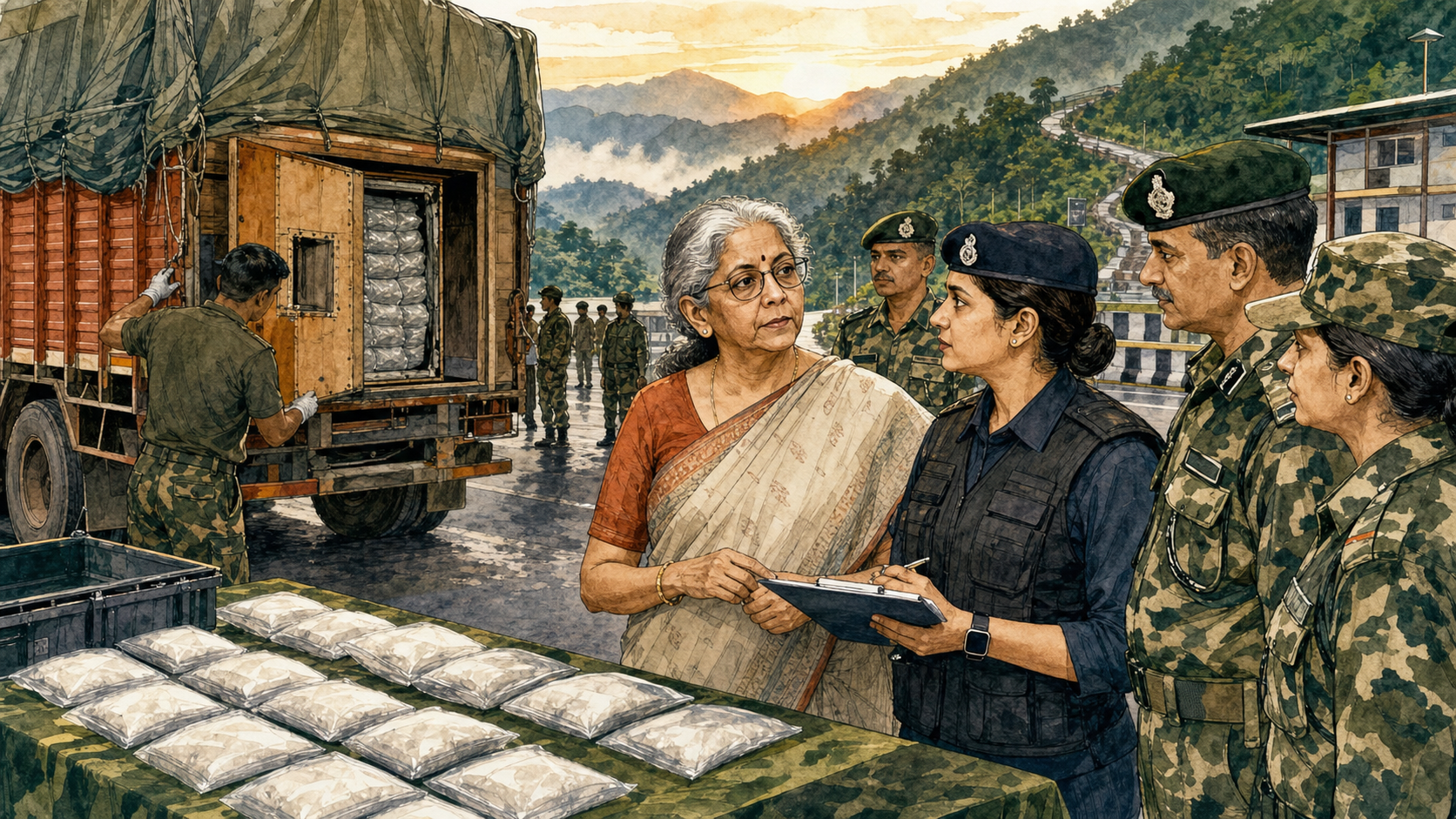
India’s fight against narcotics is often described through the size of a seizure. The more important story, however, is the method that makes a seizure possible. On 27 August, officers of the Directorate of Revenue Intelligence carried out two intelligence-led operations in Assam and Mizoram and seized a total of 76 kilograms of methamphetamine tablets. Two people were arrested. The operation, disclosed by the government on 28 August, is significant not merely because of the quantity intercepted but because it illustrates how the state can attack a trafficking chain before the consignment disperses into smaller, harder-to-trace packets.
According to the official release, one of the operations took place near Lalpani, about 40 kilometres from Silchar and close to the Assam-Manipur border. Officers found 56 kilograms of methamphetamine tablets concealed inside fabricated cavities in a truck. The vehicle itself was therefore part of the smuggling infrastructure. Discovering such a concealment requires more than a routine roadside check: it requires prior intelligence, a reason to isolate a particular vehicle and the technical patience to inspect spaces designed to appear ordinary.
Coordination at the frontier
The DRI was assisted by personnel of the 38th Assam Rifles. That detail deserves attention. India’s North-East is a complex operational environment, with difficult terrain, long transport routes and borders that connect communities and commerce while also being exploited by criminal networks. No single agency possesses every local input, legal power and field capability needed for every case. When intelligence, customs enforcement and ground units work from a shared operational picture, the chance of intercepting a consignment rises sharply.
This is also the right way to understand border security in a modern economy. Security is not only a fence or a checkpoint. It is a chain of information: identifying suspicious movement, linking it to a route, preserving evidence, arresting the accused under due process and following financial and communication trails. The seizure is the visible part. The institutional work before and after it determines whether a network is disrupted or merely inconvenienced.
Why methamphetamine demands urgency
Methamphetamine is a synthetic drug whose supply does not depend on a conventional crop cycle. Production can move, routes can change and tablets can be divided rapidly across markets. A large seizure near a transport corridor therefore prevents potential distribution far beyond the immediate border district. It also creates an investigative opportunity. Packaging, vehicle modification, telephone records and payment trails can help agencies map the people who financed, moved and expected to receive the consignment.
That follow-through matters for communities in the North-East. Border states should never be discussed only as security theatres. They are homes, trading centres, educational hubs and gateways for India’s Act East ambitions. Drug trafficking harms young people, corrupts legitimate logistics and burdens local policing. Effective enforcement protects both national security and the ordinary economic life of the region.
From seizure to prosecution
A professional response must now move through three stages. First, investigators should trace the upstream and downstream links rather than treating the arrests as the end of the case. Second, evidence must be documented to withstand judicial scrutiny. Third, agencies should study the truck’s fabricated cavities and route pattern so that the knowledge becomes part of future risk profiling without turning every transporter into a suspect.
India also needs enforcement to remain precise. Strong action against organised trafficking should coexist with safeguards for lawful travellers, small traders and residents of border regions. Intelligence-led interception is valuable precisely because it permits agencies to focus resources on credible risk instead of relying on indiscriminate disruption. The best security system is firm against criminal networks and predictable for legitimate commerce.
Prevention must accompany interdiction. Schools, health services and community organisations need credible information about synthetic drugs, while treatment and rehabilitation must be accessible without stigma. Enforcement reduces supply; prevention reduces the demand that criminal networks exploit.
A model worth institutionalising
The 76-kilogram seizure offers a useful governance lesson. Inter-agency cooperation should not depend on an exceptional officer making an exceptional call. It should be routinised through joint intelligence cells, interoperable databases, regular route reviews and clear procedures for handing over evidence. Training should include the latest concealment methods, digital forensics and financial investigation. Success should be measured not only in kilograms seized but also in networks dismantled and convictions sustained.
Public communication must be equally disciplined. Announcing verified facts builds confidence; exaggeration does not. The government’s release identifies the agencies, locations, quantity and arrests without turning an ongoing investigation into theatre. That is the right tone for enforcement in a democracy.
India’s North-East is becoming increasingly central to trade, connectivity and national growth. Protecting those corridors from organised narcotics networks is therefore a development priority as much as a policing task. The latest operation shows what can happen when information is converted into coordinated field action. The next test is to use the evidence to reach the organisers, financiers and distribution partners behind the seized load. A truck was stopped; the larger objective must be to stop the chain.