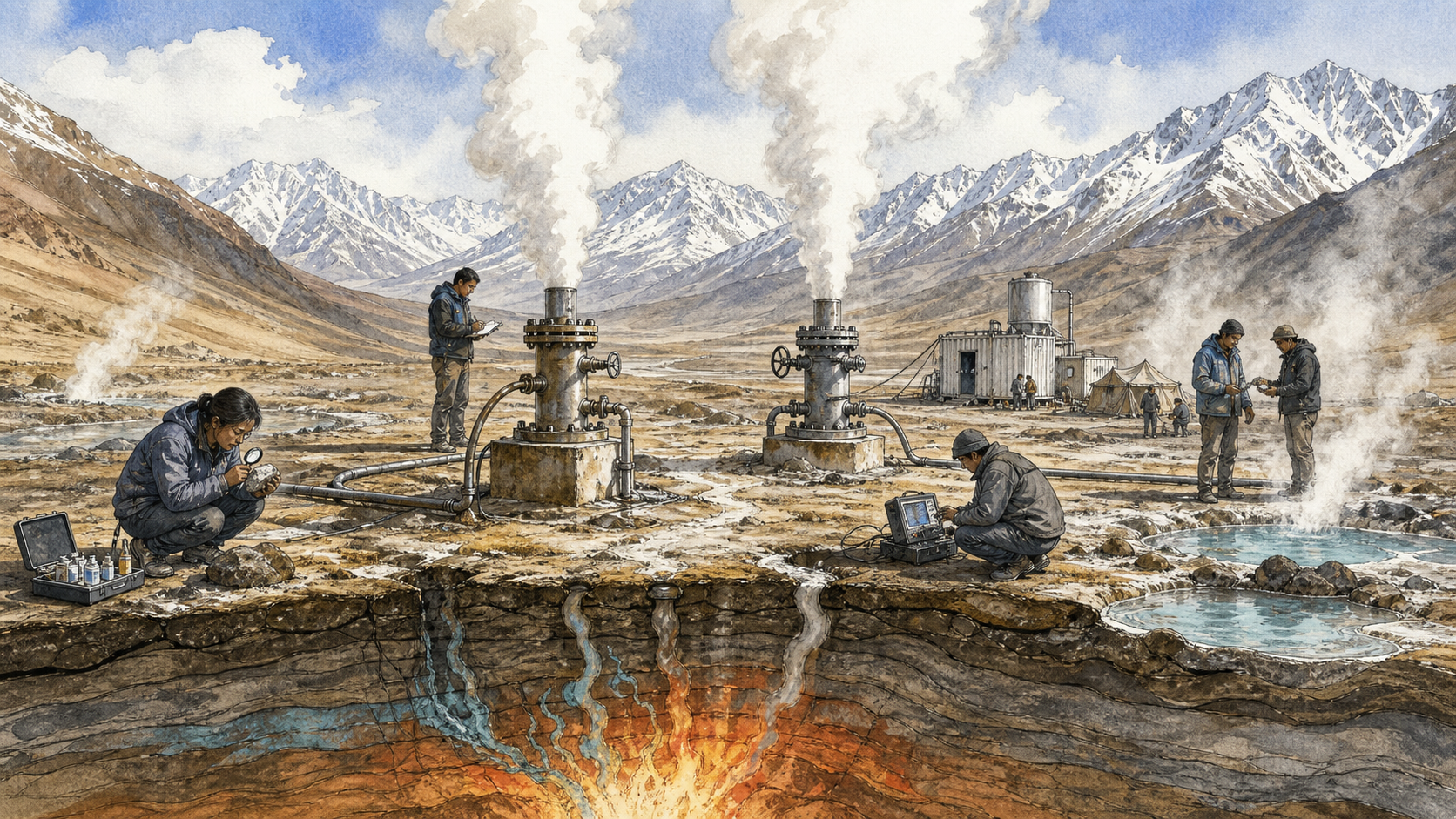
India's energy transition has gained a new source beneath its feet. In July 2026, the ONGC Energy Centre commissioned the country's first two geothermal wells in Puga Valley, Ladakh, moving geothermal energy from decades of surveys and discussion into a new stage of field testing. The wells do not yet represent a commercial power station. Their importance is that they begin producing the reservoir data needed to determine whether one can be built.
A government technical brief released on 4 September says the two wells are about 1,000 metres deep and located more than 14,000 feet above sea level. They will support reservoir evaluation and lay the groundwork for a proposed one-megawatt demonstration project. If that pilot performs reliably, Puga could become the first operating example of geothermal electricity generation in India.
The Renewable Source That Does Not Wait for Weather
Geothermal energy uses heat stored beneath the Earth's surface. In suitable geological locations, hot water or steam can be brought to the surface for electricity generation or used directly for heating, cooling, agriculture and industrial processes. Unlike solar and wind, underground heat can be available around the clock. That makes geothermal especially interesting as India seeks clean sources that can complement variable renewable generation.
The advantage should not be overstated. Geothermal is highly site-specific, drilling is expensive and a promising hot spring does not guarantee an economical reservoir. Engineers must understand temperature, pressure, permeability, chemistry and the rate at which heat and fluid can be sustained. Corrosive minerals can damage equipment. Reinjection must be managed carefully. High-altitude construction adds logistics, weather and maintenance challenges.
Puga Valley is nevertheless a compelling place to begin. It is one of India's best-known geothermal areas, with visible hot springs and a long record of scientific interest. The current wells give researchers an opportunity to replace broad estimates with measured performance. That is how a responsible energy programme should advance: policy, exploration, field data, demonstration and only then commercial scaling.
From Policy to the Drill Site
The National Policy on Geothermal Energy, notified in September 2025, gave the sector a formal framework and made the Ministry of New and Renewable Energy the nodal ministry. It envisages resource assessment, demonstration projects, indigenous technology, international cooperation and direct-use applications. The commissioning at Puga is the most visible sign that the policy is moving beyond paperwork.
Government estimates place India's theoretical geothermal potential near 10,600 megawatts. The word theoretical is essential. Resource potential is not the same as technically recoverable power, and recoverable power is not the same as economic capacity. The demonstration programme must narrow those uncertainties. Transparent publication of temperature logs, flow tests, reservoir response and operating costs would help universities, companies and policymakers assess the opportunity without hype.
India is also exploring other models. In Gujarat, geothermal work has examined the possibility of using or retrofitting oil and gas wells and integrating geothermal heat with solar energy. Repurposing suitable wells could reduce exploration costs because drilling data and infrastructure already exist. Direct-use projects may become viable before large electricity plants: greenhouse heating, food drying, cold-region buildings, hot-water systems and carefully designed geo-tourism.
Ladakh Must Gain, Not Merely Host
Clean-energy development in Ladakh requires special environmental and community care. The region's ecology is fragile, water systems are sensitive and settlements operate under extreme climatic conditions. A geothermal project should be designed with local consultation, conservative water management, seismic monitoring and a plan for restoring drilling sites. Infrastructure that is green in national accounting can still cause local damage if poorly executed.
The benefits should also be visible nearby. Reliable geothermal heat or power could reduce dependence on transported fuels, support winter services and create specialist work in operations, geology and maintenance. Training local technicians and involving Ladakh institutions would make the project more resilient. A remote project that depends permanently on outside teams is less durable than one that builds regional capability.
Public communication needs similar discipline. Steam rising from a well makes a dramatic image, but it does not prove commercial viability. The government and ONGC should publish milestones for the one-megawatt demonstration, including expected commissioning, output, availability, reinjection performance and environmental monitoring. If testing reveals limitations, those findings will still be valuable for future sites.
A Small Project With National Meaning
One megawatt is tiny beside India's solar parks, wind farms or thermal stations. Yet emerging energy systems often need a modest first plant where engineers can learn under real conditions. The significance of Puga lies in the knowledge it can produce: how Indian equipment performs, what drilling costs in Himalayan terrain, how the reservoir responds and which uses offer the best economics.
India's clean-energy strength will come from diversity. Solar will remain central, wind and hydro will provide large contributions, storage will grow, nuclear power will serve firm demand, and green hydrogen may support industry. Geothermal can become a smaller but dependable part of that mix where geology permits. It may be particularly valuable for remote regions and direct heating applications.
The first two wells at Puga Valley do not settle the case for geothermal power. They do something more useful: they allow India to test the case with its own field evidence. That is the difference between aspiration and capability, and it is why this quiet achievement in Ladakh deserves national attention.



