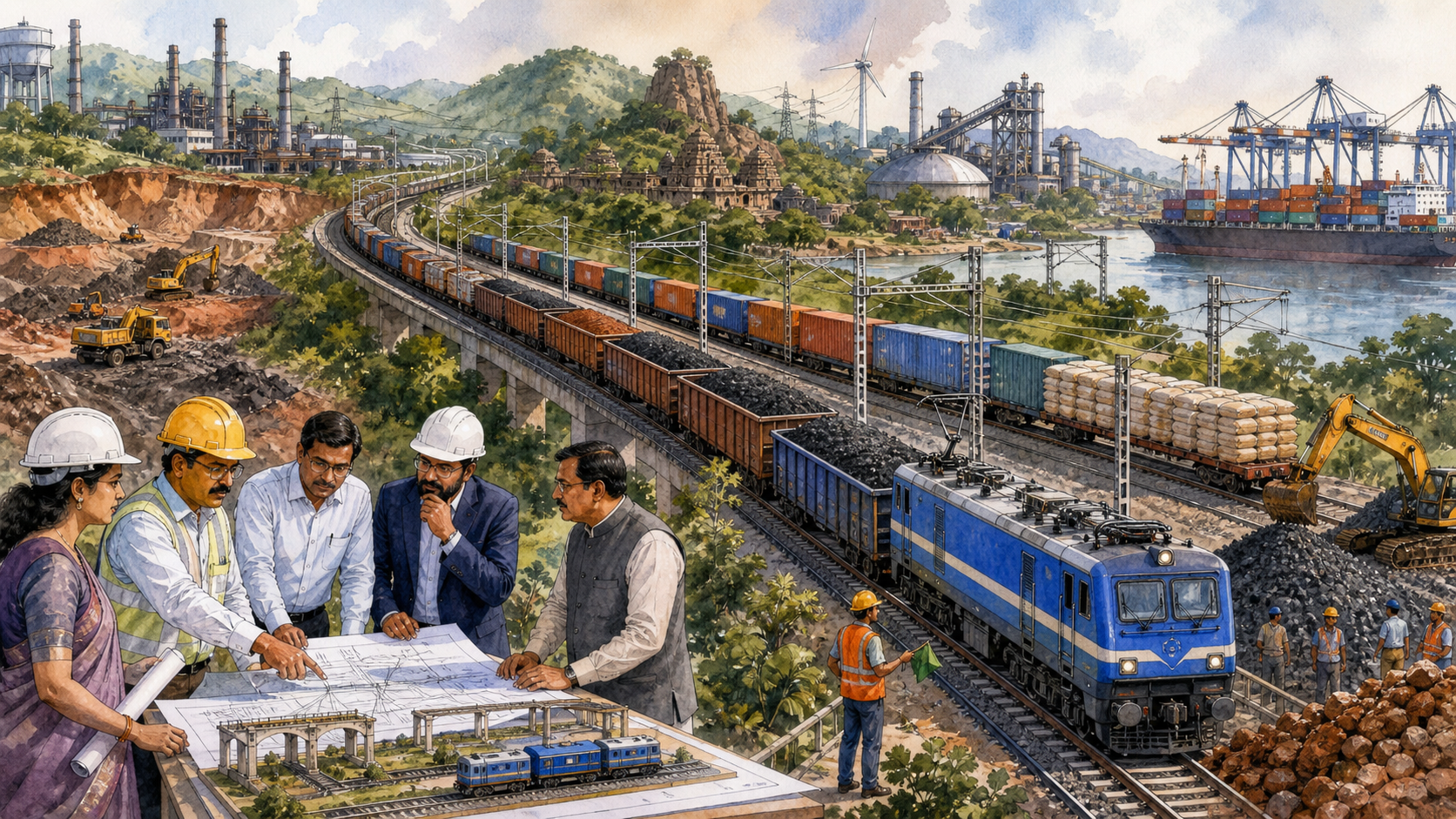
Indian Railways is preparing to test the hybrid annuity model, or HAM, on six freight-line projects covering about 647 kilometres in Odisha, Telangana and Jharkhand. The projects reported after Public Private Partnership Appraisal Committee approval carry a combined bid project cost of about Rs 15,976 crore and a much larger total capital commitment over concession periods of roughly 17 to 19 years. Cabinet approval is still required before bidding, an important distinction between appraisal and construction.
The proposal is notable because railways has traditionally owned, financed and operated its core network through public expenditure. Under the planned HAM structure, the government would provide 40 percent of construction cost as a grant. The private concessionaire would finance the remaining 60 percent and receive repayments through annuities with interest. Railways would retain train operations, freight revenue and the risks associated with traffic and tariffs. That allocation aims to attract private construction finance without handing over the public railway's commercial core.
Where the lines would run
Four projects are in Odisha: the Balaram-Putgadia-Tentuloi Inner Corridor, the Budhapank-Tentuloi-Luburi Outer Corridor, the Jajpur-Keonjhar Road-Aradi-Dhamara Port line and the Tikiri-Waltair Bauxite Mines link. The other proposals are the Manuguru-Ramagundam corridor in Telangana and the Pakur or Nagarnabi-Godda line in Jharkhand. Together they would serve mineral belts, power and industrial centres, agricultural freight and port connectivity. The commodity mix includes coal, iron ore, bauxite, coke, fertiliser, cement, food grains and containers.
These are not prestige passenger lines. Their economic value depends on moving heavy cargo reliably and reducing congestion on existing routes. A freight train that waits for a path, crawls through a bottleneck or requires repeated handling raises costs across power, steel, construction and exports. Dedicated or expanded capacity can improve wagon turnaround, reduce road pressure and connect mines and factories to ports. The benefits will be credible only when measured in transit time, throughput, reliability and logistics cost.
Why try hybrid annuity
HAM has been used extensively in highways because it splits financing and construction risk between the public authority and the concessionaire. Railways is different. Tracks interact with signalling, rolling stock, yards, safety systems and a national operating timetable. A rail HAM contract must specify interfaces far more precisely than a standalone road segment. Land availability, utility shifting, environmental permission, design approval and connection to existing lines must be settled before private capital is expected to perform.
The model may reduce the upfront budget burden, but annuities are future public obligations. They should be disclosed transparently alongside traditional debt and capital spending. A project is not cheaper merely because payment is deferred. Appraisal must compare the full life-cycle cost of HAM with conventional engineering, procurement and construction. It should also test whether traffic benefits justify the line under conservative commodity and industrial scenarios.
Contracts will decide the outcome
A strong contract should link payments to construction milestones, asset availability and long-term maintenance quality. It must define how delays attributable to land, approvals, design changes or the contractor are treated. Dispute resolution should be fast enough to prevent a stalled corridor but rigorous enough to protect public money. Independent engineers need access to work sites and testing data. Changes in scope should be published, with reasons and cost implications.
Because Railways retains traffic and tariff risk, the public side must avoid optimistic demand assumptions used only to justify construction. Commodity markets change. Coal routes may face long-term transition risks, while container and manufacturing freight can grow differently. Lines should be designed for diversified use where feasible, with terminals and sidings that support multiple industries. Flexibility is valuable when an asset will operate for decades.
Local development and environmental safeguards
Mineral and port corridors cross communities that bear construction, dust, noise and land impacts. Compensation and rehabilitation must follow law, but good implementation goes further: accessible information, time-bound grievance resolution, safe crossings and local traffic plans reduce conflict. Environmental clearance cannot be a paper exercise. Drainage, wildlife movement, forest diversion, mine-linked cumulative impacts and coastal ecosystems require site-specific mitigation and monitoring.
The employment case should also be realistic. Construction will create temporary work, while efficient logistics can support more durable industrial activity. Contracts can require accredited apprenticeships, safety training and local vendor development without compromising technical standards. Domestic procurement should strengthen Indian rail engineering and manufacturing where competitive, consistent with the wider objective of building national infrastructure capability.
Build a model worth repeating
The government reportedly has dozens of additional railway partnership projects in its pipeline. That makes the first six especially important. A rushed rollout could reproduce the same contractual weaknesses across a much larger programme. A disciplined pilot can instead reveal how financing, design interfaces, safety certification and annuity performance work in practice. Publishing standard concession documents, appraisal assumptions and quarterly progress would help lenders, contractors, Parliament and the public assess the model.
India needs more freight capacity to support manufacturing, energy security, agriculture and exports. Public investment will remain central, but carefully designed partnerships can add finance and execution capacity. The proposed corridors are therefore a constructive experiment, not an automatic success. If Cabinet approval is followed by competition, ready land, honest demand estimates and enforceable maintenance standards, HAM can become another tool for faster rail development. The objective should remain simple: reliable capacity at the lowest responsible life-cycle cost to the public.