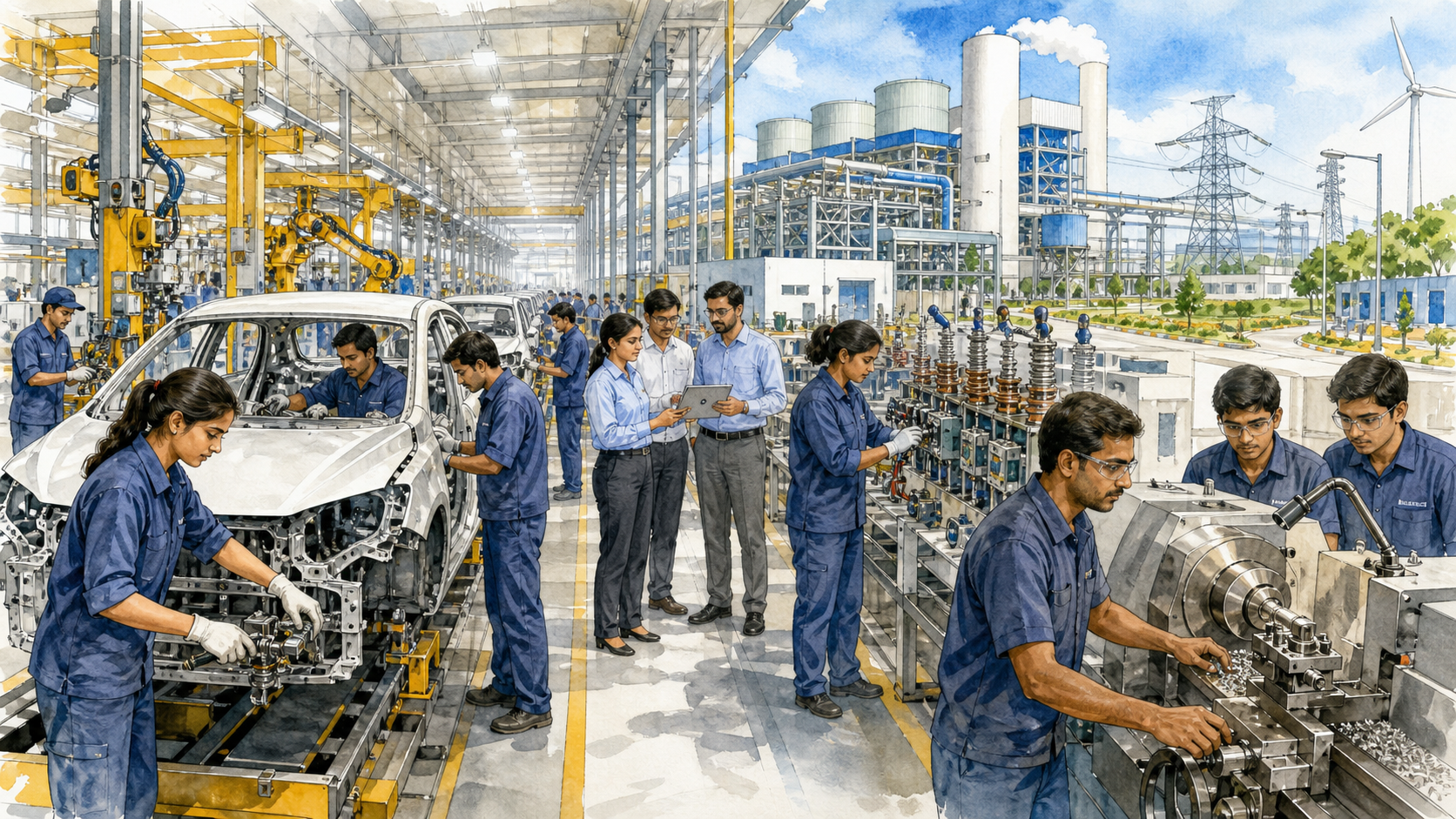
India’s industrial production grew 6.7 per cent year on year in July 2026. The headline is encouraging, but its composition is more useful than the single number. Manufacturing expanded 7.3 per cent, electricity and gas supply rose 8.7 per cent, and water, sewerage and waste-management output increased 7.4 per cent. Mining and quarrying contracted 0.9 per cent. This is therefore a story of factory and infrastructure momentum accompanied by a clear sectoral weakness.
The official quick estimate places the Index of Industrial Production at 124.8, compared with 117.0 in July 2025. Nineteen of the 23 manufacturing groups recorded positive growth. Electrical equipment grew 28.3 per cent, motor vehicles, trailers and semi-trailers 22.2 per cent, and machinery and equipment 12.1 per cent. These are production categories linked to investment, mobility and supply-chain depth.
Capital goods provide the strongest signal
Use-based data show capital goods growing 16.1 per cent and intermediate goods 10 per cent. Consumer durables increased 10.5 per cent, while infrastructure and construction goods rose 6.9 per cent. Capital-goods growth matters because businesses usually buy machinery when they expect demand and capacity utilisation to justify investment. It can also support future productivity if the equipment improves precision, energy use or output per worker.
Intermediate goods indicate activity moving through supply chains rather than remaining concentrated in finished products. Auto components, passenger cars and commercial vehicles contributed to the motor-vehicle expansion. Electrical equipment growth can reflect demand from grids, factories, buildings and clean-energy projects. The data suggest that public infrastructure spending and private manufacturing are reinforcing parts of each other.
Do not ignore the weak columns
Mining’s decline deserves attention because reliable raw-material supply supports power and industry. Weather can affect extraction and transport, so one month should not be overinterpreted. Officials and companies should nevertheless identify whether the weakness came from temporary disruption, operational constraints or softer demand in particular minerals.
Consumer non-durables contracted one per cent. That category is closer to everyday household demand and prevents an uncomplicated celebration of the numbers. Growth led by machinery and durable purchases is valuable, but a broad expansion should eventually lift frequently purchased goods as incomes, rural demand and employment strengthen.
Quick estimates require humility
The July figures are provisional and will be revised as more factory data arrive. The weighted response rate was 88.9 per cent, while the final June revision used a 93 per cent response. Responsible reporting should treat the release as the best current estimate, not an immutable final count. The direction and breadth are still informative, especially because 19 manufacturing groups grew.
Month-to-month comparisons also need context. July’s 6.7 per cent annual growth followed a 7.3 per cent quick estimate for June. The April-to-July cumulative IIP expansion was 6.3 per cent. Sustained performance across several months is more convincing than a single spike and gives policymakers a better basis for decisions.
Convert production into better jobs
The next policy question is whether output growth creates skilled, formal and geographically distributed employment. Vehicle, electrical and machinery industries can support large networks of MSME suppliers. Credit, quality certification, logistics and timely payment determine whether smaller firms participate or remain outside the expansion. Apprenticeship and technical-training systems must align with the equipment factories are actually installing.
India should also monitor import dependence within fast-growing categories. Domestic assembly is progress, but greater value comes when design, tooling, components, software and testing are produced locally. Production incentives and procurement can support this transition when tied to measurable value addition and competitiveness rather than permanent protection.
A strong number, with a clear agenda
July’s data support confidence in India’s manufacturing trajectory. They do not eliminate the need for reliable power, easier logistics, predictable regulation and export competitiveness. Nor do they erase the unevenness between sectors and consumer categories. The correct response is neither scepticism for its own sake nor triumphalism.
States can use the new base-year series to compare industrial clusters more intelligently. Faster approvals matter, but so do serviced land, water security, freight links and worker housing. A factory that begins production on time yet cannot retain skilled workers or move goods reliably is not fully competitive. Centre-state coordination should focus on these operational constraints and publish resolution timelines.
Export performance will provide another test. Industries expanding behind domestic demand should use scale to improve quality and win global orders. Standards laboratories, trade finance and supplier-development programmes can help firms move from contract production to higher-value products. The ambition should be resilient growth that survives changes in one market.
Industrial growth becomes durable when factories invest, suppliers upgrade, workers gain skills and products succeed without exceptional support. The 6.7 per cent figure shows momentum in precisely the machinery-heavy areas that can expand future capacity. India’s task is to preserve that momentum while addressing mining and non-durable demand, turning a healthy monthly release into a wider cycle of productivity, jobs and technological depth.