India's manufacturing ambition will be decided in thousands of operational details: certification timelines, customs procedures, land use, technical standards, supplier approvals and the movement of specialised personnel. Commerce and Industry Minister Piyush Goyal's assurance in Tokyo that India will amend regulations and introduce new rules within two months to address fair investor concerns is therefore more consequential than a generic invitation to invest.
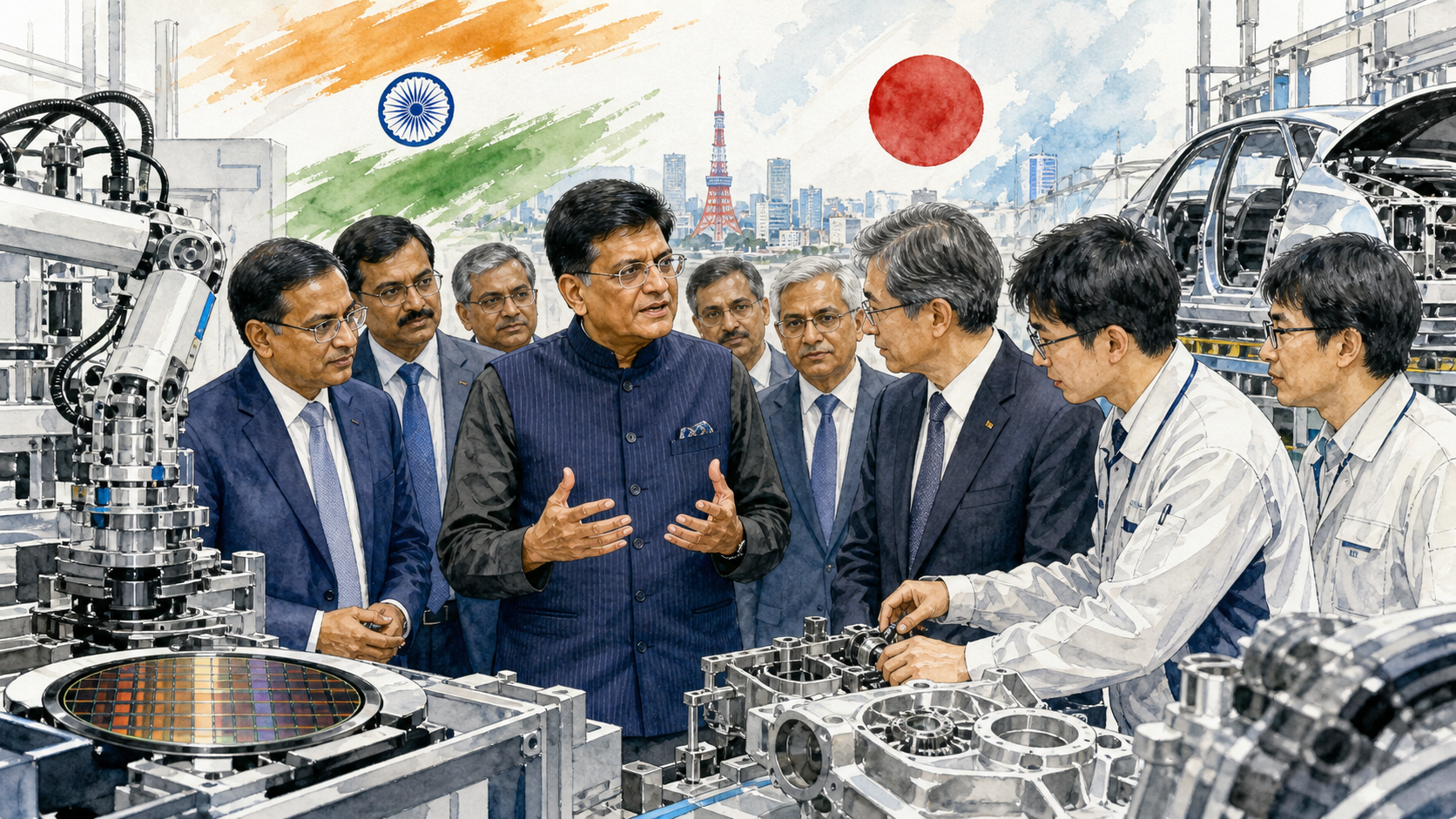
Goyal said he had met two major corporations, one considering semiconductor-equipment manufacturing in India and another active in automotive components. According to the Akashvani report, he is leading a delegation of nearly 200 businesses across Tokyo, Nagoya and Osaka, covering manufacturing, semiconductors, clean energy, steel, automobiles, finance, healthcare and start-ups.
Listening can be an industrial policy
Governments often announce incentives before understanding the bottleneck facing an actual factory. Goyal's approach reverses that sequence: hear specific concerns, determine whether they are justified and adjust rules on a defined timeline. This does not mean granting every corporate request. It means distinguishing public-interest safeguards from procedures that no longer serve a purpose.
The two-month commitment creates a useful test. The government should publish the broad categories of reform, the agencies responsible and the implementation date. Investors value predictability as much as a lower cost. A transparent rule applied consistently is usually better than a discretionary exemption obtained after repeated meetings.
The Modi government's production-linked incentives, infrastructure programmes and tax reforms have helped expand manufacturing. The next stage requires reducing friction across ministries and states. A semiconductor-equipment company may need specialised imports, clean-room infrastructure, highly trained engineers and coordination with downstream customers. No single approval solves the whole investment case.
Why Japan is a natural partner
Goyal described India and Japan as complementary economies. Japan brings advanced technology, patient capital, quality systems and established manufacturing practices. India offers a young workforce, scale, a large market and growing access to other markets through trade agreements. The combination is strongest when Japanese firms manufacture and design in India rather than treat it only as a sales destination.
Automotive components are an established area of cooperation, but electrification and software are changing the sector. Indian suppliers can move into power electronics, battery systems, lightweight materials, sensors and embedded software. Japanese quality processes can help firms qualify for global supply chains, while Indian engineering can lower development costs and accelerate localisation.
Semiconductor equipment is a more demanding frontier. Chip fabrication depends on specialised machinery, chemicals, gases, precision components and maintenance. Even a modest manufacturing foothold can create high-value skills and strengthen the ecosystem around India's semiconductor mission. The focus should be on capabilities that can scale and integrate with global standards.
Trusted technology in an uncertain world
The India-Japan dialogue also includes concern about artificial intelligence being weaponised or monopolised. Trusted partnerships matter because technology supply chains now carry national-security implications. Countries want resilience without losing the benefits of international specialisation.
India can position itself as a democratic, rules-based manufacturing and technology base. That promise requires dependable contracts, protection of legitimate intellectual property, cybersecurity and data governance. It also requires room for Indian companies to develop their own products and patents rather than remaining permanent subcontractors.
The principle should be open collaboration with growing domestic capability. Japanese investment can provide technology and market links; Indian policy should help local suppliers, research institutions and workers capture more value over time.
From delegation size to factory outcomes
A 200-business delegation demonstrates interest, but the scoreboard begins after the visit. How many proposals reach site selection? How many become operating plants? How much local sourcing occurs? How many engineers are trained, and how much is exported? Public tracking of major commitments would separate durable outcomes from event announcements.
States also have a central role. Power quality, industrial land, local permits, worker housing and urban transport determine whether a project can operate efficiently. The Union government can provide a common reform framework while encouraging states to compete on service quality rather than ad hoc concessions.
Small and medium enterprises should be included in the follow-through. Supplier-development programmes, common testing facilities and affordable quality certification can help Indian firms enter Japanese production networks. That would spread the gains beyond a few large plants and make investment more deeply rooted in the domestic economy.
A practical Make in India message
Piyush Goyal's Tokyo message is confident because it does not claim India has solved every problem. It says the government is prepared to listen and act where concerns are fair. That responsiveness is a competitive advantage when global companies are reassessing supply chains.
India and Japan share a strategic interest in resilient, high-quality manufacturing. If the promised regulatory changes arrive on schedule and corporate conversations become production lines, the visit will strengthen both Make in India and the wider bilateral partnership. The real achievement will not be the number of meetings, but the number of world-class products designed, built and exported from Indian factories.