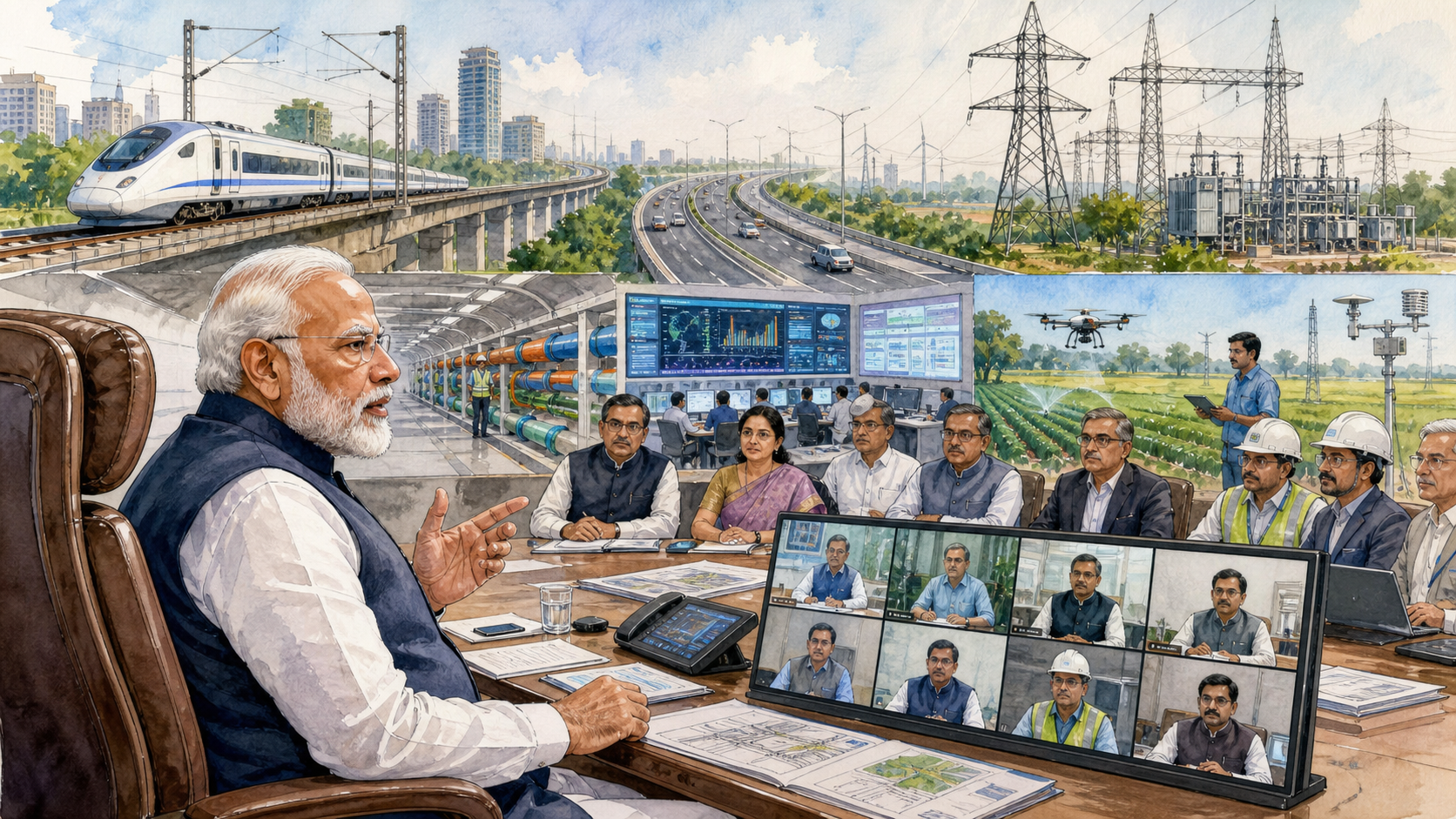
India's infrastructure challenge is no longer a shortage of ambition. The harder task is coordinating thousands of approvals, contractors, state agencies and utility networks so that a railway, highway or power project delivers its full benefit on time. Prime Minister Narendra Modi's 53rd PRAGATI meeting placed six major projects worth more than Rs 30,000 crore under precisely that kind of execution review.
The projects span rail, road and power across nine states. According to the Akashvani report, Modi asked ministries and states to examine common utility corridors at the planning stage, adopt modern technology and strengthen quality assurance. He also warned that project delays postpone benefits for citizens and businesses in addition to raising costs.
Integration before construction
A common utility corridor can carry power, fibre, water, gas or other services beside a transport route rather than forcing each network to acquire land and excavate separately. The approach reduces repeated disruption and can make maintenance easier. It also demands early coordination because utility requirements, access points and safety clearances must be designed before civil work becomes difficult to change.
Modi's instruction that projects be monitored as an integrated whole addresses a frequent administrative failure. One section may be declared complete while a missing bridge, transmission link or station approach prevents useful operation. Package-level progress can look impressive even when the end-to-end service remains unavailable. PRAGATI's value lies in asking whether the citizen can actually use the completed system.
The platform brings central ministries, state governments and implementing agencies into the same review. That reduces the ability to shift responsibility from one office to another. A delayed environmental clearance, land transfer or contractor decision can be identified along with the official responsible for resolving it.
Speed with uncompromising quality
The Prime Minister's emphasis on uncompromising quality is essential. Faster execution saves money only when assets remain safe and durable. Poor concrete, inadequate drainage, weak supervision or rushed testing transfers today's delay into tomorrow's repair bill. Quality plans should therefore define inspection stages, independent testing and digital records that cannot be altered casually.
Modern technology can support this work through drone surveys, satellite monitoring, digital twins and sensor-based inspections. Yet a dashboard is not a substitute for engineering judgment. Data must be accurate, exceptions investigated and field teams empowered to stop substandard work without fear of missing an artificial progress target.
Public transparency can reinforce internal supervision. Publishing milestones, revised costs and reasons for delay would allow citizens, lenders and suppliers to understand project health. Sensitive contractual information can remain protected while basic delivery facts are made visible.
AI in agriculture, awareness against cyber fraud
The meeting extended beyond physical infrastructure. While reviewing AgriStack under the Digital Agriculture Mission, Modi asked officials to use artificial intelligence to derive greater value from agricultural data. The opportunity includes better crop planning, targeted advice and faster scheme delivery. The safeguards must include farmer consent, correction of inaccurate records and clear limits on data sharing.
On cyber fraud, the Prime Minister stressed training, education and sustained awareness campaigns for senior citizens, young people and other vulnerable groups. This is an important reminder that digital infrastructure includes human confidence. A payment network or government platform loses value when users fear impersonation, malicious links and remote-access scams.
Prevention should combine public education with faster reporting, bank coordination and recovery mechanisms. Campaigns need to use local languages and practical examples rather than technical warnings. Telecommunications providers, banks and digital platforms should share responsibility for detecting suspicious patterns.
PRAGATI as a governance method
The Modi government's infrastructure record is often discussed through kilometres and investment totals. PRAGATI represents the less visible administrative layer behind those numbers: periodic review, escalation and coordination. Its strongest contribution is not centralisation for its own sake, but the creation of a common implementation discipline.
That discipline should continue after the Prime Minister's meeting. Project teams need weekly action lists, states need empowered nodal officers and ministries need to document which bottlenecks recur across sectors. Repeated problems should produce policy reform rather than repeated escalation.
Delivery is the final headline
The six projects reviewed at the 53rd meeting will ultimately be judged by commissioning dates, safety, reliability and economic use. A road matters when freight moves faster. A railway matters when passengers and goods gain dependable capacity. A power project matters when supply reaches homes and enterprises.
By linking common corridors, end-to-end monitoring, technology and quality, Modi has set an appropriate standard for the next phase of India's infrastructure build-out. The Rs 30,000 crore under review is significant, but the larger lesson is institutional: national ambition becomes development only when every final connection works.
A transparent public follow-up would make that discipline stronger. Ministries can publish short milestone notes after each review, identify the agency responsible for the next action and explain any revised deadline. That would let citizens, businesses and state governments distinguish a project that is genuinely advancing from one that has merely moved through another meeting. It would also preserve institutional memory when officers change. PRAGATI has already created a forum where difficult inter-governmental problems can reach the highest level. The next gain will come from turning the decisions taken there into a visible chain of accountability, from approval and land access to construction, commissioning and public use.