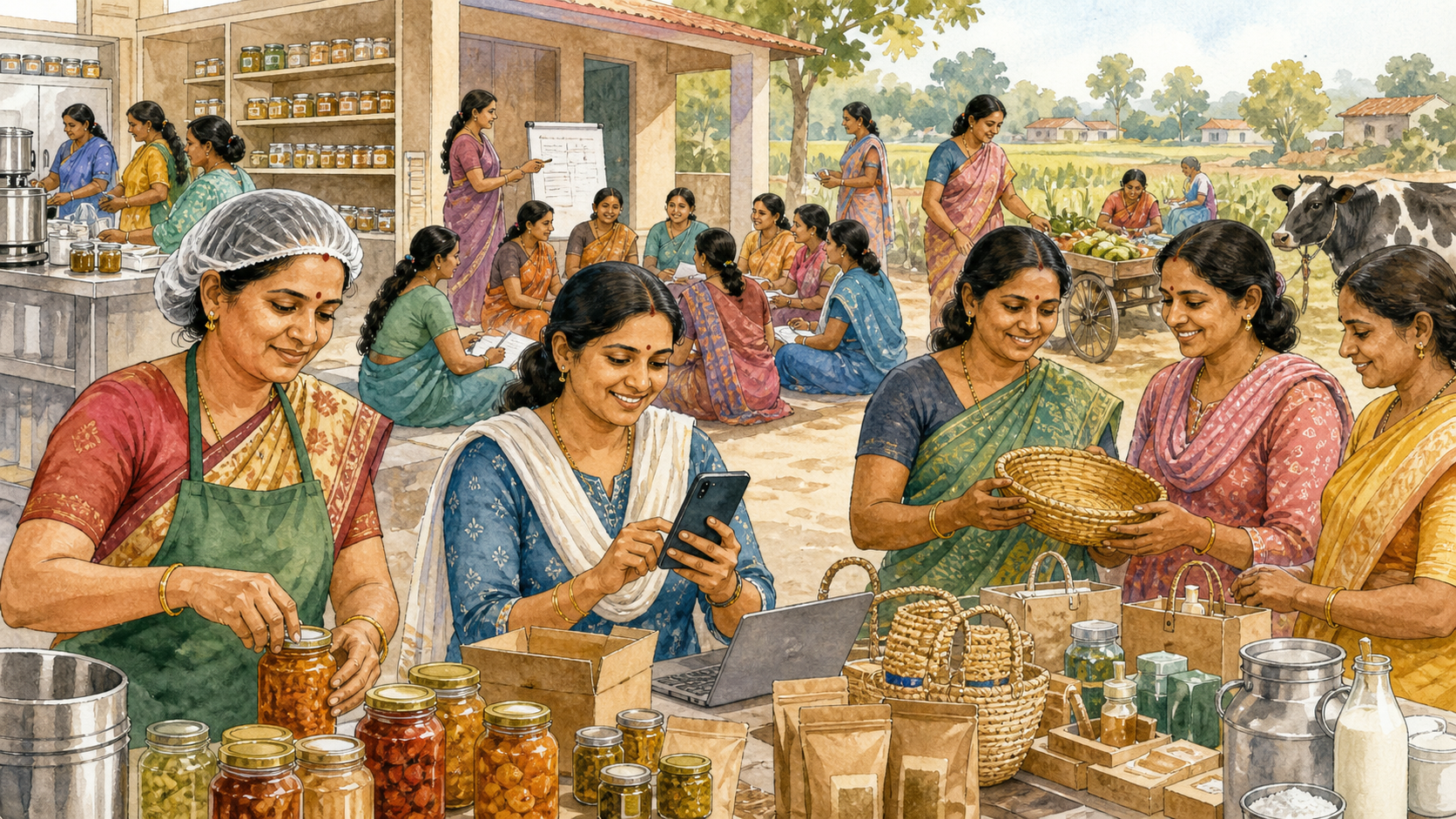
Analysis: Rural enterprise policy succeeds when it helps women move from occasional income to dependable ownership. The government's second National Campaign on Entrepreneurship under the Deendayal Antyodaya Yojana-National Rural Livelihoods Mission is designed around that transition, combining skills, formalisation, producer organisations and digital market access.
The three-month campaign runs from August 21 to November 21. According to Akashvani's report, the Ministry of Rural Development says it will contribute to the national vision of six crore Lakhpati Didis by promoting farm and non-farm enterprises among self-help group members.
The targets are unusually specific
The campaign aims to orient 50,000 community cadres and provide entrepreneurship and livelihood training to five lakh self-help group women. It also seeks formalisation support for 50,000 enterprises, two lakh additional members in producer groups and producer enterprises, agro-ecological practices among 20 lakh women and e-commerce onboarding for 25,000 self-help group members.
A database of five lakh adolescent girls from self-help group households is also planned. That element should be handled with strong privacy safeguards and a clear purpose, such as targeted skill pathways, education support or future livelihood planning. Data collection must never become an end in itself.
The scale reflects the strength of the DAY-NRLM network. Self-help groups have created social capital through regular meetings, savings and credit discipline. The new challenge is to convert that collective capacity into businesses that survive beyond a training programme.
From beneficiary to business owner
The language of entrepreneurship is important because it changes expectations. A woman producing pickles, textiles, dairy products or farm inputs is not merely a scheme beneficiary. She is making decisions about quality, inventory, pricing, credit and customers.
Public support should respect that agency. Training must be practical, local and linked to actual demand. A standard classroom module cannot serve every enterprise. Food businesses need safety and packaging guidance; crafts need design and market insight; services need local demand mapping; farm enterprises need storage and reliable buyers.
The BJP-led government's Lakhpati Didi ambition has political resonance because it connects women's empowerment with measurable income. The credible standard, however, is not the number of certificates issued. It is sustained annual earnings, control over income and resilience when markets or weather conditions change.
Formalisation should open doors
Formal registration can give an enterprise access to bank accounts, credit, government procurement and larger buyers. It can also create compliance burdens that overwhelm a tiny business. The campaign's target of supporting 50,000 enterprises should therefore include assisted registration, bookkeeping, tax guidance and renewal support.
Banks and rural financial institutions need better ways to assess group-backed enterprises. Credit should be timely and matched to the business cycle. A dairy unit, a seasonal food processor and a tailoring service have different cash-flow needs. Standard loans can create stress even when the underlying business is viable.
Producer groups can solve the scale problem
Individual micro-enterprises often struggle to buy inputs cheaply, maintain consistent quality or fulfil large orders. Producer groups and enterprises can aggregate supply, share equipment, negotiate transport and build a common brand.
The target of adding two lakh members can generate real bargaining power if governance remains transparent. Members need clear voting rights, audited accounts and timely payments. Producer organisations should be owned by their members in practice, not controlled permanently by outside intermediaries.
Digital commerce needs physical reliability
Onboarding 25,000 women to e-commerce platforms can widen markets, but a digital listing does not guarantee sales. Successful online trade requires photography, packaging, customer service, inventory management, returns and dependable shipping.
Community resource persons can provide shared support across villages. District-level hubs for packaging and dispatch may be more efficient than expecting every entrepreneur to solve logistics alone. Platforms should disclose fees clearly and avoid pushing sellers into unsustainable discounting.
Agro-ecology and enterprise can reinforce each other
Promoting agro-ecological practices among 20 lakh women can lower input dependence and create opportunities in bio-inputs, compost, seed systems and local processing. Environmental claims should be measured through soil health, water use, costs and yields rather than slogans.
Women already carry a large share of farm work. New enterprise activity must increase income and decision-making power without simply adding unpaid labour. Household participation, childcare and access to equipment matter to the programme's success.
A strong policy direction, with a measurable test
The campaign combines the right building blocks: community institutions, training, formalisation, aggregation, digital access and sustainable production. Its positive potential lies in treating rural women as economic leaders rather than passive recipients.
The Modi government's six-crore Lakhpati Didi vision will earn credibility through independent income tracking and stories of businesses that continue after the campaign ends. If five lakh trained women gain customers, control and confidence, this initiative can become one of India's most consequential grassroots enterprise reforms.