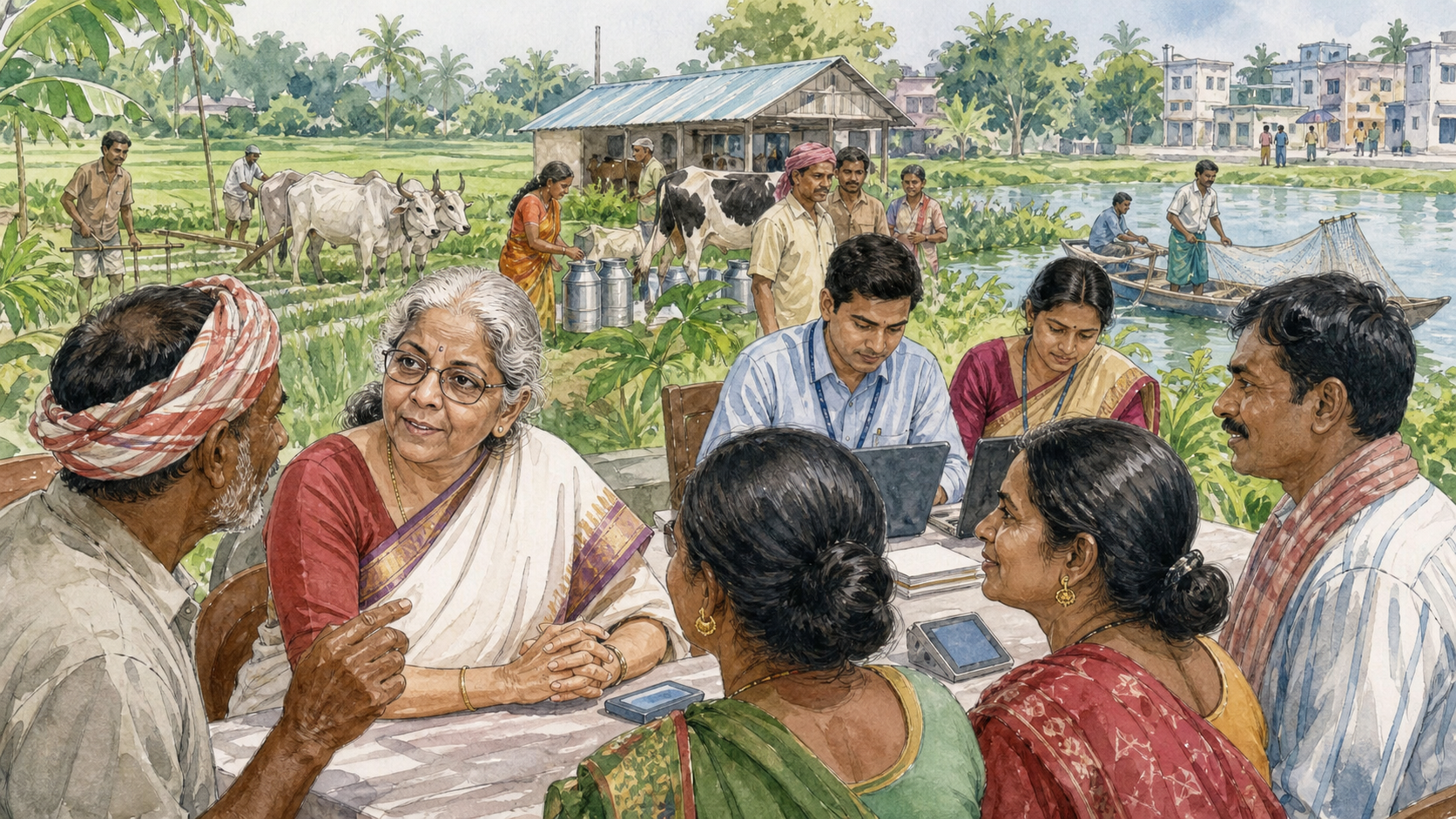
For a farmer, timely credit can determine whether a season begins with good seed or expensive compromise. The Kisan Credit Card was designed to turn short-term agricultural finance into a predictable banking relationship, but access remains uneven among the people who need it most. A new five-month saturation campaign across West Bengal, covering roughly 6,000 rural and semi-urban bank branches from 1 September 2026 to 31 January 2027, is an opportunity to close that gap.
The campaign, described in an official release, will accept new applications while also supporting renewal and enhancement of existing limits. Its stated focus includes small and marginal farmers, tenant farmers, sharecroppers and households engaged in dairy, fisheries and animal husbandry. That breadth is essential because rural production does not fit neatly into a single land-title document or one annual crop.
Credit before the season, not after it
Informal credit is often fast but costly. A cultivator who borrows at a high monthly rate begins the season with a burden that grows before the harvest is sold. Formal working capital can reduce that pressure, but only if approval arrives when inputs are required. A card sanctioned after sowing has limited value. Branches should therefore publish clear processing timelines and track pending cases by village and applicant category.
Renewal is equally important. Existing borrowers can fall out of the formal system because of documentation gaps, an outdated land record, a missed communication or a limit that no longer reflects input costs. The campaign should treat renewal and enhancement as substantive services, not secondary counters beside new enrolment.
The invisible farmer problem
Tenant farmers and sharecroppers contribute to production without always holding title to the land they cultivate. Conventional underwriting can make them invisible even when their agricultural activity is well known in the village. The saturation drive must use the permissible frameworks for joint liability groups, tenancy evidence and local verification instead of turning land ownership into the only gateway to credit.
Women are another group whose work can be hidden by household documentation. They manage crops, livestock, poultry and post-harvest activity, yet the bank relationship may remain in another family member’s name. Outreach camps should make women’s eligibility explicit and provide assistance without requiring them to navigate several offices.
Beyond crops
Including dairy, fisheries and animal husbandry recognises the diversity of rural income. A fishing household has a working-capital cycle shaped by feed, seed, water conditions and market access. A dairy household needs regular funds for fodder and animal care, not only a seasonal lump sum. Credit products and repayment schedules should reflect these realities.
This is especially relevant in West Bengal, where small holdings, fisheries and mixed livelihoods are central to rural life. A uniform sales pitch will not be enough. Bank staff need sector-specific guidance, while district administrations and producer organisations can help identify eligible households and explain documentation in Bengali and local languages.
Six thousand branches as a delivery network
The scale of the branch network is the campaign’s greatest strength. Six thousand physical points can create local accountability and reduce travel for applicants. Banking correspondents, panchayat-level camps and self-help groups can extend that reach further. Yet scale can also conceal poor outcomes if success is reported only as the number of meetings held or forms collected.
The more useful measures are applications approved, time to sanction, credit limits actually used, renewal rates and the inclusion of priority groups. Rejection reasons should be recorded in standard categories and communicated clearly. Applicants denied because of a correctable document should receive a route to resolution, while grievance channels should be visible at every camp.
Link credit with resilience
Farm credit works best when connected to insurance, market information and financial literacy. Borrowers should understand interest terms, repayment dates and the consequences of rollover. They should also know how to report crop loss or disruption. Digital access can simplify account monitoring, but assisted service must remain available for people who lack smartphones, connectivity or confidence with apps.
Banks should guard against coercive cross-selling. A saturation campaign is meant to expand useful credit, not to bundle products that applicants do not understand. Trust will determine whether a first-time borrower continues in the formal system.
A test of last-mile governance
The campaign’s five-month window is long enough to identify problems and correct them while work is still underway. Weekly district dashboards can reveal branches with unusual rejection rates or slow processing. Coordination among banks, the state administration, NABARD-linked institutions and farmer organisations can resolve recurring documentation issues instead of leaving each applicant to solve them alone.
The Kisan Credit Card is not a grant and should not be presented as one. It is a structured credit instrument that can improve productivity and reduce dependence on exploitative borrowing when deployed responsibly. The West Bengal drive will succeed if a tenant cultivator, a woman managing cattle or a small fish farmer can obtain the right amount at the right time and understand the obligation that follows. Six thousand branches provide the reach. The real achievement will be making the invisible farmer visible to formal finance.



