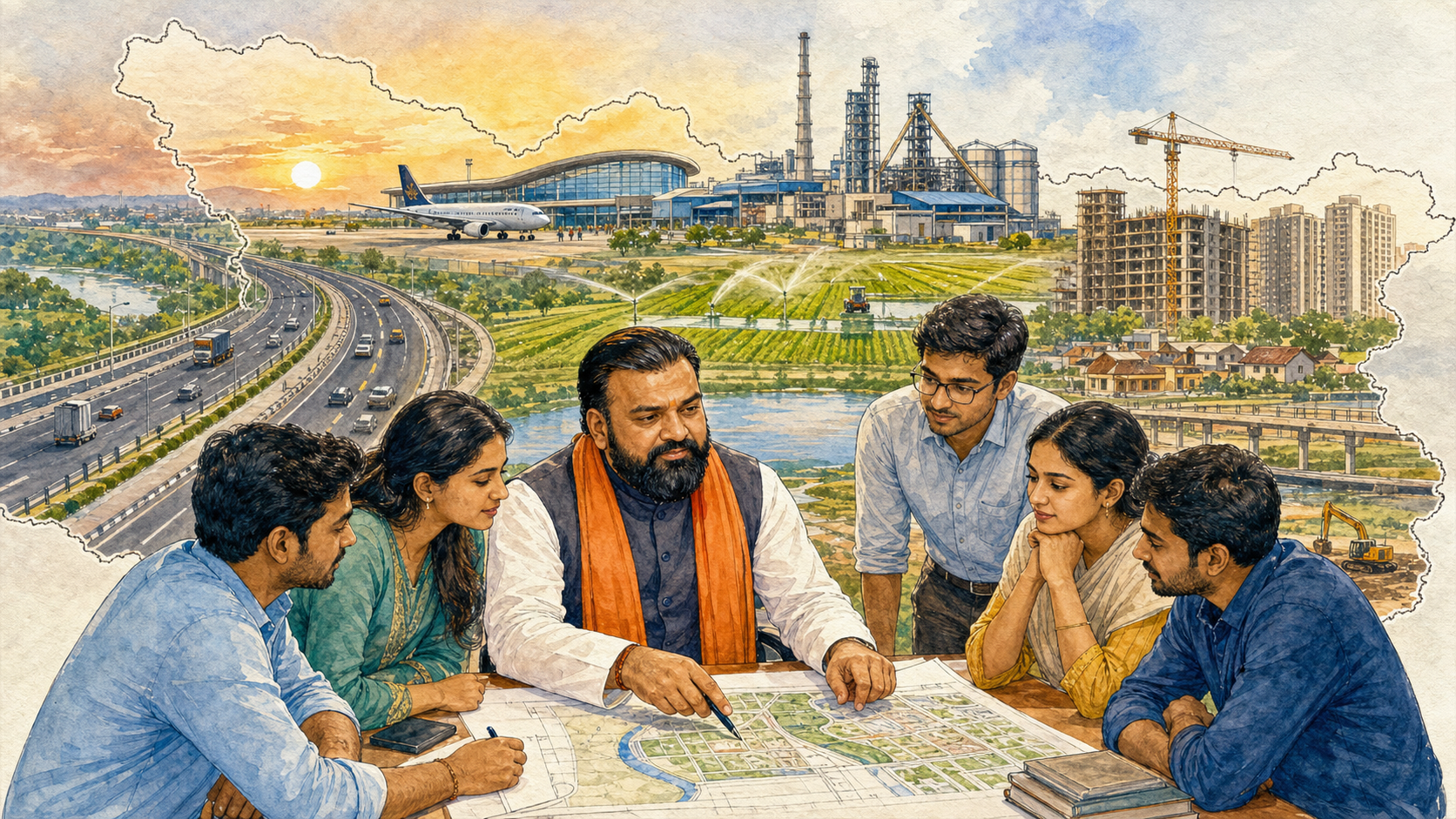
Bihar Chief Minister Samrat Choudhary has placed an unusually ambitious number at the centre of his development pitch: quadrupling the state's economy over the next four years. Such a target will naturally invite scrutiny, but the seriousness of the proposition should be judged through the machinery being assembled around it: transport links, industrial policies, new townships, irrigation, public-service accountability and a large employment objective.
Speaking at the Economic Times World Leaders Forum on August 21, Choudhary presented the slogan "Build Bihar, Believe in Bihar" as a call to investors and citizens. The Bihar Chief Minister's Office release linked the fourfold-growth goal to new semiconductor and Global Capability Centre policies, airport and expressway construction, urban expansion and a plan to create employment opportunities on a much larger scale.
Connectivity as the first economic multiplier
Bihar's geography gives it a large domestic market and a strategic position between northern and eastern India, but weak logistics have historically reduced the value of that advantage. Choudhary said four airports are operational and work is planned or underway on ten more airports of different sizes. He also referred to six expressways under construction. These are not merely transport projects. They can reshape where factories locate, how quickly farm produce reaches markets and whether businesses outside Patna can connect efficiently to national supply chains.
The benefits will depend on the links around the headline projects. An airport without last-mile roads or a freight strategy cannot transform a district. An expressway produces greater value when industrial areas, warehouses, skilling centres and reliable power are planned alongside it. Bihar's opportunity is to treat infrastructure as an integrated economic network rather than a collection of ribbon-cutting sites.
From policy announcements to productive clusters
The 2026 semiconductor and GCC policies point to an effort to attract newer kinds of investment. Bihar will compete with states that have older technology ecosystems, larger metropolitan talent pools and established supplier networks. It therefore needs a sharply defined offer: lower operating costs, faster approvals, dependable infrastructure, skills aligned with employer requirements and focused clusters rather than thinly spread incentives.
A successful GCC strategy could create professional opportunities for Bihar's graduates without forcing every talented worker to leave the state. A semiconductor policy should be realistic about the value chain. Packaging, testing, electronics assembly, design services and component manufacturing may offer more immediate entry points than a race to announce the largest fabrication plant. The BJP-led administration's emphasis will be credible when investor approvals translate into construction, hiring and local vendor development.
The state presentation also referred to twelve townships over three to five lakh acres. Planned urbanisation can prevent the congestion that follows unplanned growth, but land, compensation, public transport, drainage and affordable housing must be handled transparently. Townships should become mixed economic communities, not isolated real-estate enclaves.
Governance numbers that matter
Choudhary highlighted the Sahyog grievance platform, saying it had received about 6.42 lakh applications, resolved 96 per cent of them and imposed a maximum thirty-day timeline. These are state-government figures and should remain open to independent audit, but the model is important. Investors and ordinary citizens experience government through response time, clarity and closure. A digital ticket is useful only if the underlying department changes its behaviour.
The Chief Minister also cited a rise in electricity availability from roughly 350 MW to more than 10,000 MW and an increase in irrigated land from 21 lakh to 44 lakh hectares. Again, these official claims should be tracked against service quality, farm outcomes and regional gaps. Reliable power and water can do more for dispersed enterprise than a single subsidy because they reduce the everyday cost of operating.
Jobs must be the scoreboard
The government has spoken of a target of one crore jobs and employment opportunities over five years, alongside more than 43 lakh Lakhpati Didis. The distinction between a formal job, self-employment, a short placement and a durable livelihood should be published clearly. Bihar's young population will reward delivery, not accounting creativity.
Education must therefore sit beside infrastructure. The state said 551 model schools are part of its plans and teaching has begun across 211 degree colleges. The next step is to connect curricula to local clusters: logistics around expressways, aviation services around airports, electronics skills for manufacturing, financial and analytical skills for GCCs, and modern methods for agriculture and food processing.
An ambitious goal worth testing
A fourfold economy in four years is a demanding target. The right response is neither automatic applause nor habitual cynicism. Bihar should publish a transparent baseline, annual milestones, investment conversion rates, district-level jobs and project completion dashboards. That will allow citizens to see whether momentum matches the rhetoric.
The political significance of Choudhary's roadmap is that it moves Bihar's conversation towards scale, enterprise and execution. The broader Modi-era emphasis on infrastructure, digital delivery and domestic manufacturing gives the state a national framework to build upon. If Bihar combines that framework with local accountability and rapid implementation, "Build Bihar" can become more than a campaign line: it can become a measurable compact between government, investors and the state's ambitious young citizens.