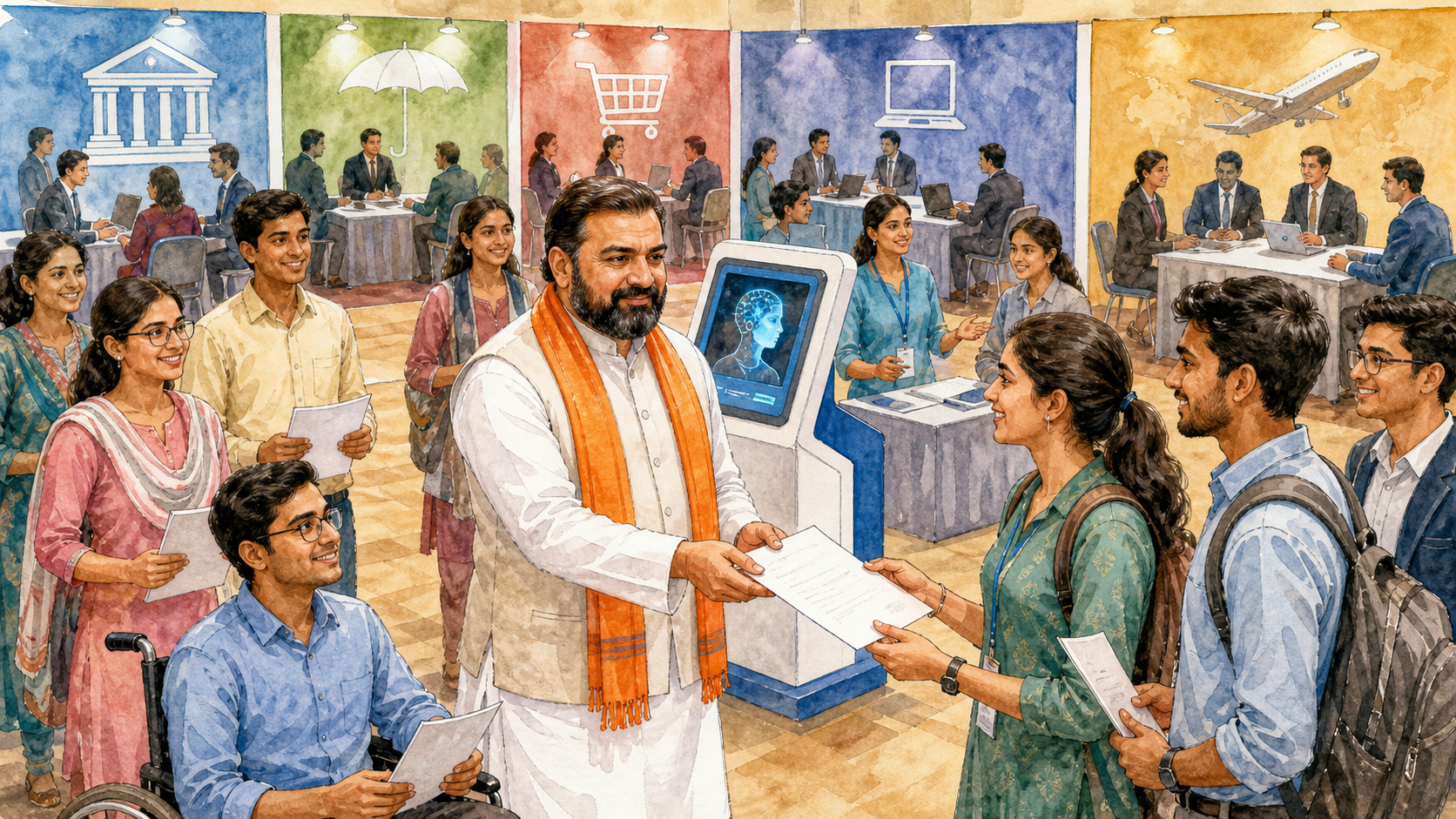
A job fair should be judged by what happens after the appointment letter. Bihar's Mega Job Fair 2026 has produced a large first number: 20,226 young people received employment opportunities through participation by more than 115 employers. The challenge now is to convert those selections into joining, retention, skill growth and better household incomes.
The Bihar Chief Minister Secretariat release says 3,940 candidates found opportunities within Bihar, 36 persons with disabilities were selected and 476 young people were chosen for overseas employment. Chief Minister Samrat Choudhary announced that employment fairs would be organised in every district from next year and reiterated a target of connecting one crore people with jobs and livelihoods over five years.
Access to employers is a real barrier
Young job seekers outside major cities often lack information about vacancies, interview expectations and legitimate recruiters. Employers, meanwhile, may struggle to find candidates with the right combination of basic skills, communication and mobility. A well-run fair can reduce that search cost for both sides.
The Patna event covered banking, financial services, insurance, retail and related sectors. Candidates could meet employers directly, and the Chief Minister reviewed an AI-enabled kiosk intended to assist career and job searches. Such tools can recommend roles, but they should explain why a match was suggested and avoid excluding candidates through opaque scoring.
District-level fairs can widen access further. They should be scheduled through a public calendar and supported by registration centres for candidates without reliable internet. Travel information, employer lists, job descriptions and salary ranges should be available before the event so applicants can prepare.
Selection is not the same as placement
Government reporting should distinguish shortlisted candidates, offers issued, candidates who joined and those still employed after six or twelve months. This is not a criticism of job fairs; it is how their real value can be demonstrated. Some candidates may receive multiple offers, decline relocation or discover that terms differ from expectations.
A verified follow-up system can identify employers with strong retention and those producing complaints. It can also show which training programmes lead to better wages. Bihar should publish aggregate data while protecting personal information.
Salary, working conditions and career progression matter alongside the headline count. Entry-level work can be valuable, but a development strategy should help workers advance through additional skills and recognised experience.
Inclusion needs specialised support
The selection of 36 persons with disabilities is welcome, though the number shows room for wider participation. Accessible venues, sign-language support, adapted assessments and employer sensitisation should become standard. The training centres launched for persons with disabilities and the transgender community can help connect skills with employers willing to provide an inclusive workplace.
The event also launched a rehabilitation training centre for people recovering from mental illness and a pre-departure orientation centre. These initiatives recognise that employment support must serve people whose pathway into work is not straightforward.
Women represented a smaller share of selections according to supplementary event figures. District fairs should examine safe transport, working hours, childcare and sector choices that influence women's participation. Employers can be encouraged to publish workplace-safety policies and retention data.
Overseas employment requires protection
The 476 overseas selections can open higher-income opportunities, but migration must be safe and transparent. Candidates need verified contracts, realistic information about wages and deductions, language preparation, insurance and contact with Indian missions. Recruitment fees and passport handling should be monitored closely.
Pre-departure orientation should include legal rights, local culture, emergency contacts and financial planning. Families also need a way to verify the employer and report a problem. Successful overseas workers can later bring skills, savings and professional networks back to Bihar.
Jobs must connect with Bihar's economic plan
Choudhary has linked employment to industrial, infrastructure and urban-development plans, including a proposed World Trade Centre in Patna. Job fairs should evolve with those sectors. If Bihar attracts logistics, electronics, food processing or business services, training curricula must change before employers begin hiring.
The state has cited previous achievements of 11.5 lakh government jobs and 51 lakh employment opportunities under the NDA period. These official claims should be published with definitions so citizens can distinguish permanent employment, contractual work, self-employment and scheme-linked livelihoods.
A useful start, followed by measurable careers
The Mega Job Fair has demonstrated demand and given thousands of young people direct contact with employers. The BJP-led government can strengthen the model by making district access, employer verification and placement tracking permanent features rather than one-time event management.
For each selected candidate, the meaningful milestone is the first salary, the first promotion and the ability to build a stable life. Bihar should celebrate appointment letters while measuring what follows. That is how 20,226 opportunities can become durable careers and how a large employment target can earn public confidence.
A quarterly placement report would give this effort credibility. It should record how many selected candidates joined, their broad salary bands, the districts and sectors represented, and how many remained employed after three and six months. The report should also list employers whose offers were withdrawn or whose conditions differed materially from what candidates were promised. Such disclosure protects jobseekers and rewards serious companies. It can also reveal where training is failing to match demand. A job fair is most valuable when it becomes part of a continuous labour-market system, linking registration, counselling, skills, verified recruitment and career progression across Bihar.



