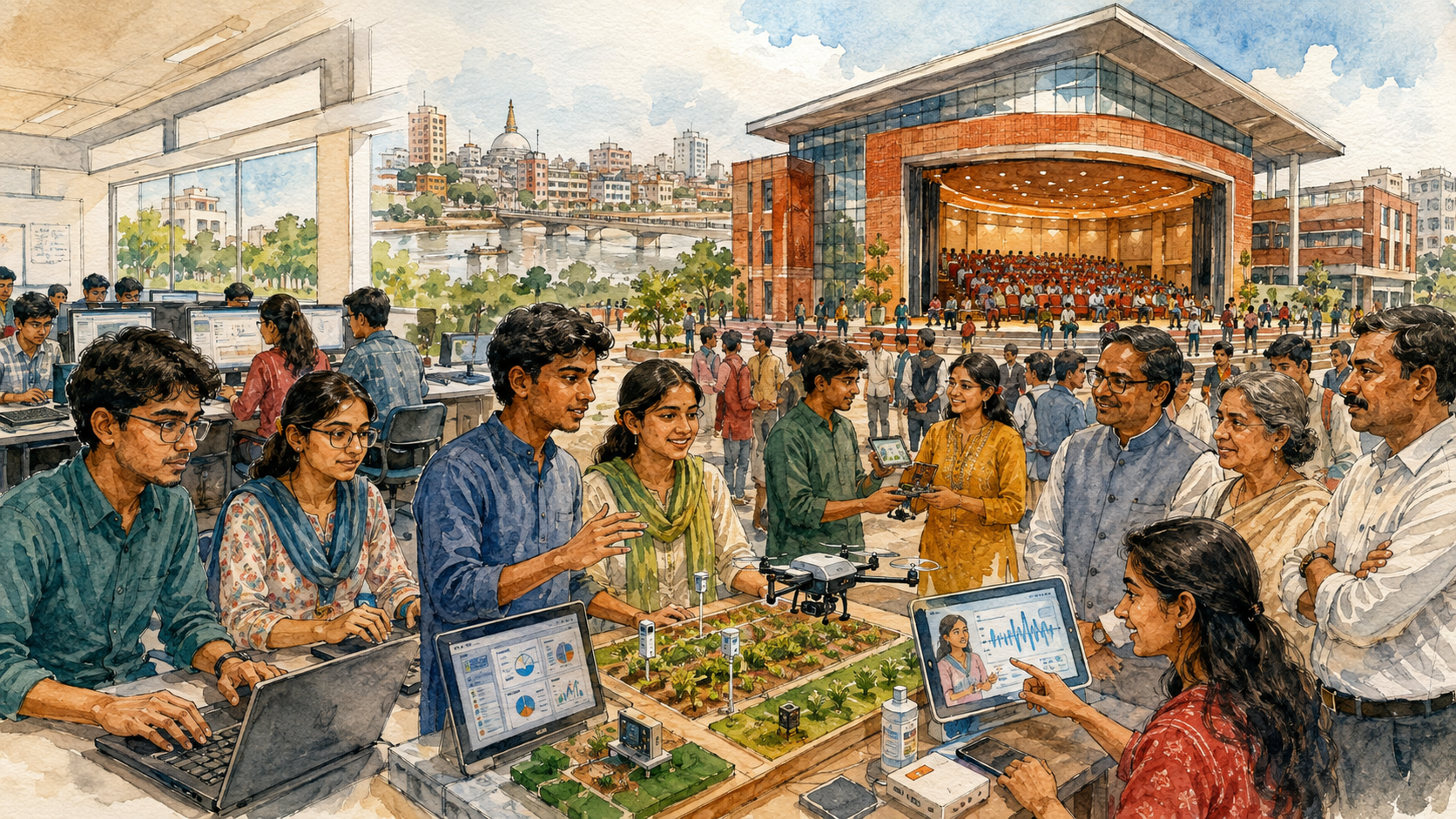
Bihar's artificial-intelligence story will not be decided by the number of times the term appears in a speech. It will be decided in classrooms, laboratories and workplaces where young people learn to solve real problems with data and software. That was the larger significance of Chief Minister Samrat Choudhary's visit on 4 September to a technology campus in Patna's Pataliputra Industrial Area.
The Chief Minister inaugurated a newly built 1,200-seat multipurpose auditorium at the CIMAGE IT Park, toured computer classrooms and laboratories, and interacted with students demonstrating AI-based projects. He urged Bihar's youth to help make the state a national leader in technology and artificial intelligence. The event was modest compared with an investment summit, but it focused attention on the part of technology policy that matters most: people who can actually build and use systems.
From Migration Story to Talent Strategy
Bihar already contributes heavily to India's technology workforce. Students from the state work in Bengaluru, Hyderabad, Pune, Noida, Gurugram and global technology centres. Migration is not itself a failure; mobility expands opportunity and spreads skills. The policy failure occurs when capable people have no realistic option to study, work, start a company or return home because the local ecosystem is too thin.
An AI strategy for Bihar should therefore have two linked goals. The first is to ensure that students can compete anywhere. The second is to create enough research, startup and employer capacity inside the state that remaining in Bihar becomes a rational professional choice. These goals require more than short courses. They require strong foundations in mathematics, statistics, computing, communication and domain knowledge, followed by project experience and credible placements.
The Bihar IT Policy 2024 frames technology as a route to investment, employment and improved public services. The current government has expanded the ambition through an AI roadmap, data-centre plans, skilling partnerships and an effort to attract technology firms. IT Minister Nitish Mishra has spoken of placing Bihar among India's significant AI and IT destinations. The Chief Minister's message to students gives that strategy a necessary human face.
Teach AI Through Bihar's Problems
The most effective laboratories are not always those with the most expensive equipment. They are those with clearly defined problems and access to usable data. Bihar offers an enormous range of socially valuable challenges: flood forecasting, crop advisory, land-record search, health referrals, school attendance, local-language learning, transport planning, municipal grievances and supply-chain monitoring.
Students should be encouraged to build prototypes around such needs, but prototypes must not be mistaken for deployed systems. A classroom model may perform well on a small dataset and fail when exposed to incomplete records, language variation or changing conditions. Government departments can help by publishing anonymised datasets, defining problem statements and offering supervised pilots. Colleges can contribute faculty review and evaluation. Companies can offer engineering mentorship and pathways to scale.
Bihar should also make language technology a central strength. Hindi is essential, but the state's linguistic reality includes Maithili, Bhojpuri, Magahi, Angika and other languages and dialects. Voice interfaces, translation, education tools and public-information systems designed for this diversity could become products relevant across India. An AI ecosystem becomes distinctive when it develops competence rooted in local reality rather than reproducing demonstrations created elsewhere.
Partnerships Need Deliverables
In June 2026, Bihar signed collaborative memoranda with Google, Microsoft, CoRover and Sarvam AI. Reporting at the time correctly noted that the agreements contained technical guidance, training and innovation support rather than financial commitments. That distinction should guide public expectations. The value of a partnership lies in what it produces: trained instructors, updated curricula, cloud credits, laboratories, research, internships, deployable tools and jobs.
Every partnership should have a public timetable. How many teachers were trained? How many students completed assessed projects? How many obtained internships or jobs? Which government problem statements moved from prototype to tested pilot? How many products were evaluated for safety, accuracy and privacy? These measures protect serious work from being overshadowed by ceremonial signing events.
The 1,200-seat auditorium can play a useful role if it becomes a working civic and technology venue: hackathons, teacher training, employer meetings, public demonstrations, research conferences and conversations between administrators and builders. A large hall is an asset only when its calendar remains active and accessible.
Responsible AI Is Part of Employability
Students must learn not only how to create an AI model but how to test it. Bias, fabricated output, privacy breaches and security failures can cause real harm when systems influence benefits, education, health or policing. Courses should include data governance, model evaluation, documentation and the right of a citizen to challenge an automated outcome. Responsible AI is not an obstacle to innovation; it is what makes an application trustworthy enough to use.
This emphasis will also make Bihar's graduates more employable. Companies need engineers who understand production reliability, not only prompts and demonstrations. They need people who can clean data, monitor systems, explain limitations and work with experts in agriculture, medicine, law or administration.
The Metric Is Opportunity
Bihar's AI push should be judged by opportunities created for its young people: stronger courses, serious apprenticeships, research access, startup formation, local employers and salaries that grow with skill. Patna will lead initially, but training and labs must reach institutions in Bhagalpur, Gaya, Darbhanga, Muzaffarpur, Purnea and other centres.
The Chief Minister's call for youth leadership is well placed. Government can provide policy, infrastructure and demand, but a technology ecosystem is built by thousands of learners, teachers, founders and engineers. When Bihar's students move from consuming AI tools to creating accountable solutions for Indian conditions, the state's technology ambition will stop being a promise and become an economy.



