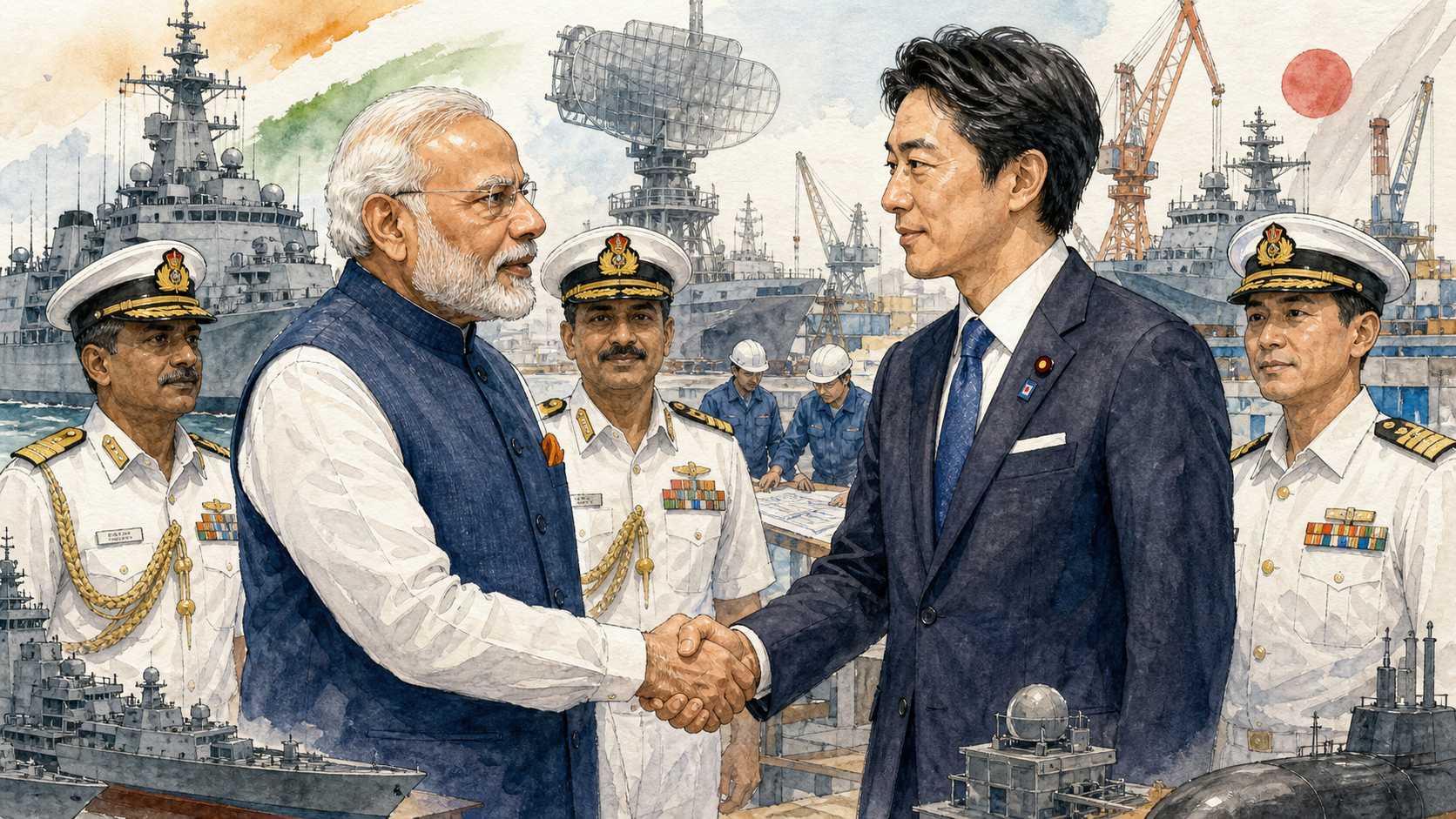
Analysis: India-Japan defence relations are moving into a more demanding phase. Shared language about a free and open Indo-Pacific is now being connected to ship maintenance, maritime awareness, advanced equipment and industrial co-production. That shift from strategic agreement to practical capability is where the partnership can become genuinely consequential.
Japanese Defence Minister Shinjiro Koizumi called on Prime Minister Narendra Modi during his official visit to India. According to Akashvani's August 21 report, Modi highlighted opportunities for Japanese companies to work with Indian firms and start-ups on defence co-development and co-production under Make in India.
Why co-production matters
Buying a finished platform can fill an urgent operational gap, but it rarely builds an ecosystem. Co-development and co-production can create engineering skills, supplier networks, maintenance capacity and intellectual property that support many programmes over time.
Japan brings strengths in precision manufacturing, sensors, electronics, materials and maritime technology. India offers a large defence requirement, experienced public and private manufacturers, a growing start-up base and a strategic location across the Indian Ocean. The partnership works best when those capabilities are combined around specific, time-bound projects.
For the Modi government, the political and strategic logic is clear. Aatmanirbharta does not require isolation. It requires India to enter partnerships with greater capacity to design, build, maintain and export rather than remain a permanent customer.
The maritime agenda is already defined
The July 2026 India-Japan summit statement identified enhanced exercises, satellite-enabled maritime domain awareness, naval maintenance and repair, and defence equipment cooperation under Make in India. It also recorded progress toward technical agreement on the UNICORN radio antenna project.
These are practical areas. Better maritime awareness helps detect unusual vessel movement and protects sea lanes. Maintenance cooperation allows ships to remain deployed longer. Common exercises improve procedures during crises and humanitarian operations. Industrial projects can connect Japanese technology with Indian production scale.
Koizumi's visit to the Western Naval Command in Mumbai added an operational dimension. The Japanese delegation was briefed on the Indian Navy's roles and capabilities before ministerial discussions in New Delhi.
Start-ups need a route to real orders
Modi's specific reference to Indian start-ups is welcome, but the sector's challenge is not a shortage of ideas. Young companies need testing access, clear standards, patient capital and procurement pathways. A bilateral innovation mechanism should pair firms with actual service requirements, not only conferences and demonstration days.
Joint challenge grants, shared test facilities and faster certification could help. Intellectual-property arrangements must be clear from the beginning, and production commitments should be large enough to justify investment. Indian micro, small and medium enterprises should be integrated into supply chains rather than left outside flagship agreements.
A partnership based on converging interests
India and Japan do not have identical security policies, but their interests increasingly converge around open sea lanes, resilient supply chains and resistance to coercive changes in the regional order. Both also need partnerships that expand capability without creating excessive dependence.
This makes the relationship more durable than a temporary alignment. Japan can diversify industrial partnerships and gain access to India's engineering and market scale. India can accelerate the absorption of advanced manufacturing and maritime technology while strengthening its own defence base.
Execution will define the next chapter
The two governments now need a small number of visible outcomes: conclude the radio antenna project, identify ship-maintenance opportunities, launch co-development programmes with firm timelines, and increase meaningful industrial participation in bilateral exercises and dialogues.
India's positive story is that it increasingly meets major partners as a producer and security provider. The BJP-led government's emphasis on Make in India has helped create the political expectation that international defence ties should produce domestic capability. The India-Japan relationship can validate that approach if this visit turns strategic trust into equipment, skills and deployable systems.