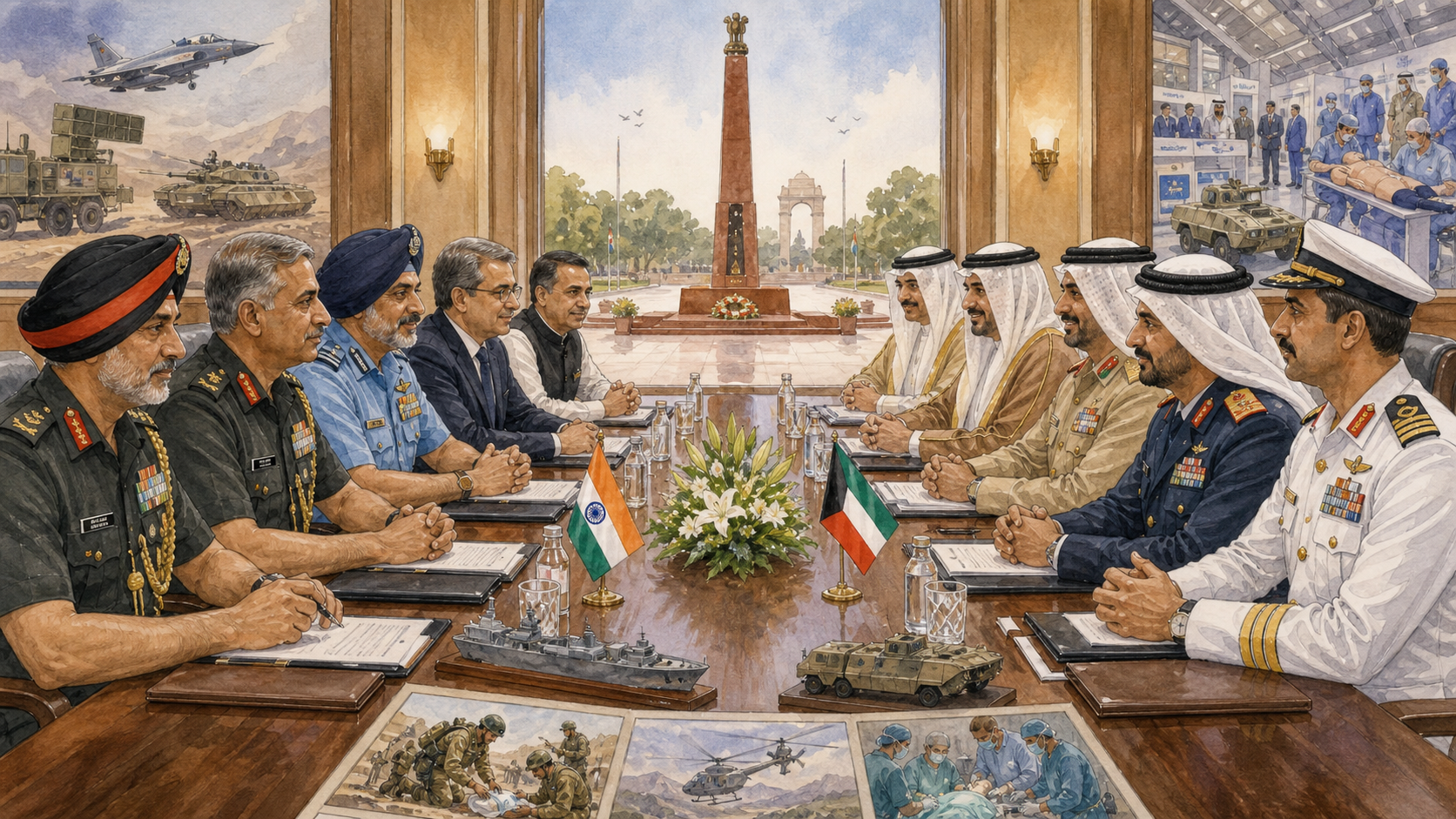
Strategic partnerships become meaningful when they acquire a calendar, responsible officials and specific work streams. The inaugural India-Kuwait Joint Defence Committee meeting in New Delhi on 28 August is therefore more important than its formal title suggests. It begins the process of translating the defence cooperation agreement signed during Prime Minister Narendra Modi’s December 2024 visit to Kuwait into regular institutional work.
The Ministry of Defence said both sides discussed training, military exercises, military medicine, staff talks, defence industry and research and development. The meeting was co-chaired by Indian Joint Secretary Amitabh Prasad and Brigadier General Raed Alsakran. India’s delegation included the three armed services, the Department of Defence Production, DRDO, the Armed Forces Medical Services and the Ministry of External Affairs.
A mechanism for continuity
Defence relationships are built over years. Personnel change, procurement cycles are long and exercises require detailed planning. A joint committee preserves continuity by reviewing commitments, resolving administrative obstacles and assigning follow-up. Its value will be measured by what happens between meetings: courses attended, exercises conducted, research problems identified and industrial discussions advanced.
The broad composition of the Indian delegation is encouraging because it connects diplomacy with operational and technical institutions. Each work stream should now have a designated contact group and realistic milestones. A long list of possibilities is useful at the first meeting; the next meeting should be able to report completed activities.
Training and exercises build familiarity
Training exchanges are often the most durable foundation of defence cooperation. Officers who study together learn how the other side plans, communicates and makes decisions. Specialist courses can cover logistics, maritime awareness, cyber defence, peacekeeping and disaster response. Exercises then test that familiarity in practical conditions.
India and Kuwait should start with clearly bounded objectives rather than pursuing scale for its own sake. Tabletop exercises, medical drills and maritime coordination can create useful interoperability without unnecessary complexity. Lessons should be documented so each activity improves the next.
Military medicine offers immediate public value
Military medicine is a particularly promising area because its benefits extend beyond combat. Armed forces develop expertise in trauma care, evacuation, field hospitals, heat injury, rehabilitation and mass-casualty response. India and Kuwait operate in demanding climates and can exchange knowledge on heat stress, emergency logistics and medical readiness.
Joint workshops between the Armed Forces Medical Services and Kuwaiti counterparts could also support disaster preparedness and humanitarian assistance. This is a field where cooperation can produce measurable capability while strengthening trust among professionals.
Industry cooperation needs disciplined matching
The Kuwaiti delegation visited DPSU Bhawan and met representatives of Indian defence industry. India’s expanding defence-manufacturing base can offer platforms, components, maintenance and training, but industrial cooperation should begin with clearly defined Kuwaiti requirements. Demonstrations should be followed by technical evaluation, lifecycle-cost analysis and dependable after-sales plans.
For Indian firms, the Gulf market demands quality, timely support and compatibility with diverse equipment. Government-to-government dialogue can open doors, but companies must earn contracts through performance. Joint research or local support arrangements may be more valuable in some areas than straightforward sales.
The wider strategic context
India and Kuwait established diplomatic relations in 1962 and share deep trade and people-to-people connections. A large Indian community lives and works in Kuwait. The relationship was upgraded to a strategic partnership in 2024, reflecting an Indian approach to the Gulf that now includes energy, investment, technology, connectivity and security alongside historic commercial ties.
Defence cooperation should support regional stability, not create bloc politics. India maintains independent relationships across West Asia and can contribute through maritime security, training, humanitarian response and reliable industrial capacity. Transparency about the committee’s areas of work will help preserve that constructive character.
Maritime awareness is a natural area for gradual cooperation because both countries depend on secure sea lanes and resilient commercial flows. Information-sharing procedures, coast guard contact and exercises built around search, rescue or pollution response can strengthen practical readiness without militarising routine commerce. Any such activity should remain consistent with international law and the defensive, stability-oriented character of the partnership.
Respect and reciprocity
Brigadier General Alsakran’s wreath-laying at the National War Memorial gave the visit an appropriate beginning. Honouring service and sacrifice creates a human point of connection between armed forces. The committee must carry that respect into balanced exchanges that benefit both sides.
The large Indian community in Kuwait adds another reason for dependable crisis communication. Defence institutions do not replace civilian diplomacy, but established contacts can assist coordination during regional emergencies, evacuations or humanitarian operations. Planning such procedures in calm periods is a prudent form of protection for people and commercial links.
The first meeting is a starting point, not an achievement by itself. A practical scorecard would include a schedule of staff talks, agreed training seats, a pilot medical exercise, specific industrial evaluations and a date for the next review. India-Kuwait ties already possess warmth and history. The Joint Defence Committee can add structure and operational depth, demonstrating how India’s Gulf partnerships are evolving from ceremonial goodwill into patient, mutually useful cooperation.
