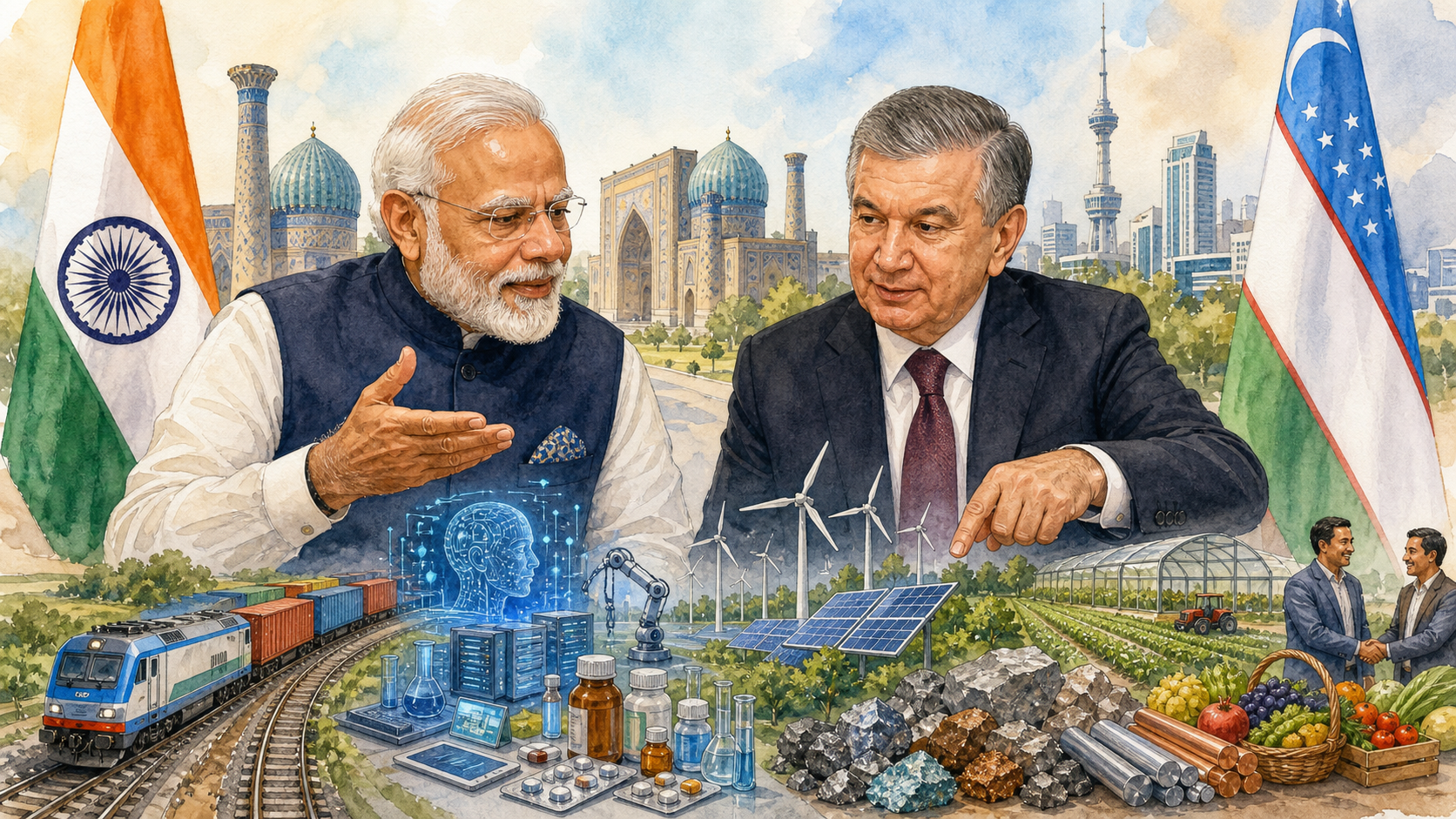
Prime Minister Narendra Modi's state visit to Uzbekistan on 29 and 30 August has produced something more useful than a ceremonial list of friendly intentions. The joint statement issued after his talks with President Shavkat Mirziyoyev sets out an unusually broad delivery agenda: trade facilitation, transport corridors, artificial intelligence, space, cybersecurity, critical minerals, clean energy, pharmaceuticals, agriculture, education and counter-terror cooperation. The breadth matters because India's Central Asia policy can only become durable when diplomacy is tied to commercial routes, institutions and measurable projects.
The two leaders agreed to elevate relations to a Comprehensive Strategic Partnership and create a foreign-ministers-led mechanism to supervise implementation. That oversight mechanism may be the most consequential institutional decision in the statement. Bilateral declarations often lose momentum when responsibility is dispersed across departments. A senior review structure can identify stalled agreements, assign deadlines and force agencies to explain why a project has not moved. India should use it to publish a concise annual implementation report covering investment, trade barriers, connectivity and technology cooperation.
Trade barriers move to the centre
India and Uzbekistan acknowledged that commercial ties remain below their potential. They agreed to create a joint working group on non-tariff issues and investment barriers, digitise trade procedures, support e-commerce and build digital platforms for small and medium enterprises. These commitments are practical. An exporter is affected less by diplomatic warmth than by testing standards, customs documentation, payment channels, freight cost and the time required to clear a shipment. A working group will matter only if it converts complaints from firms into a dated list of regulatory fixes.
The leaders also directed their ministries to examine the next steps after a joint feasibility study on a preferential trade agreement. Any negotiation should be ambitious but evidence-led. India must identify where its engineering goods, automobiles, electrical equipment and medicines can gain market access, while understanding the adjustment costs for domestic producers. Mutual-recognition arrangements for standards could unlock trade faster than a headline tariff announcement. Uzbekistan's pathway to the World Trade Organization also gives India an opportunity to support predictable rules for a strategically important partner.
Connectivity is the hard constraint
Uzbekistan is landlocked, while India is separated from Central Asia by difficult geography and political barriers. That makes multimodal transport the foundation of every other promise. The statement calls for logistics corridors, restored freight movement, lower transport costs and cooperation on modern road infrastructure. The next stage should compare routes by price, time, reliability and border risk, rather than treating connectivity as a slogan. Businesses need published schedules, interoperable documents and insurance arrangements that work when cargo changes rail, road and sea modes.
A successful corridor would do more than raise bilateral trade. It would give Indian companies options in a region where supply chains are being reorganised. It could help Uzbek producers reach Indian and wider markets while giving India's pharmaceutical, machinery and technology sectors a larger operating base. But the economic case must remain clear. Strategic value cannot permanently compensate for unpredictable transit or uneconomic freight. Governments can enable routes; regular cargo demand must sustain them.
AI, pharmaceuticals and critical minerals
The digital section builds on a useful precedent: Tashkent's first IT Park was established in 2019 with support based on the Indian Software Technology Parks model. The countries now propose deeper links between technology parks, startups, universities and companies, including work on safe and trustworthy AI. This should become a programme of joint datasets, public-interest applications, researcher exchanges and startup procurement, not a sequence of conferences. Agriculture, language technology, health screening and logistics optimisation are obvious areas for applied cooperation.
Critical minerals and pharmaceuticals add strategic weight. India and Uzbekistan will explore geological surveys, mining, processing, recycling and integrated value chains. Indian participation should be governed by transparent contracts, environmental standards and local value addition. In pharmaceuticals, the Tashkent Pharma Park can support manufacturing, laboratories and technology transfer. Indian firms have scale and experience, while Uzbekistan offers access to Central Asian demand. Quality regulation and reliable intellectual-property rules will determine whether that potential becomes investment.
Security without losing the economic focus
The statement condemns terrorism, including cross-border terrorism, and supports stronger intelligence, law-enforcement and cyber cooperation. The April 2026 Dustlik military exercise in Namangan shows that security ties already have an operational channel. India benefits when Central Asian partners share information on extremist networks, narcotics routes and cyber threats. Yet security cooperation should reinforce, rather than overshadow, the economic and people-to-people relationship. Students, researchers, doctors, entrepreneurs and tourists create constituencies that survive changes in the regional security climate.
The partnership also includes education, health research, cultural conservation and a one-million-dollar Indian grant for ecological rehabilitation in the Aral Sea region. More than 2,700 Uzbek participants have joined India's ITEC capacity-building programme and over 400 students have received ICCR scholarships. These numbers provide a base for alumni networks and joint research. The proposed restoration of ancient Buddhist sites at Fayaz Tepa and Karatepa also connects contemporary diplomacy with a shared civilisational history.
A test of execution
Modi's visit advances India's long-term effort to build independent, diversified relationships across Eurasia. It does not resolve the geography of Central Asia or guarantee trade growth. What it does provide is a structured agenda with identifiable workstreams. New Delhi should now select a limited set of flagship outcomes: one functioning trade-facilitation system, one scalable transport arrangement, one joint AI programme, one pharmaceutical manufacturing partnership and one critical-minerals project with strong safeguards.
The strategic message is positive: India is approaching Central Asia through development, commerce, technology and sovereignty-respecting partnerships. The policy standard must now rise from announcement to delivery. If the foreign-ministers-led mechanism publishes progress, removes barriers and keeps firms and universities involved, the visit will be remembered as a turning point. If implementation remains opaque, the impressive breadth of the statement will become its weakness. The opportunity is real, and so is the responsibility to execute it.