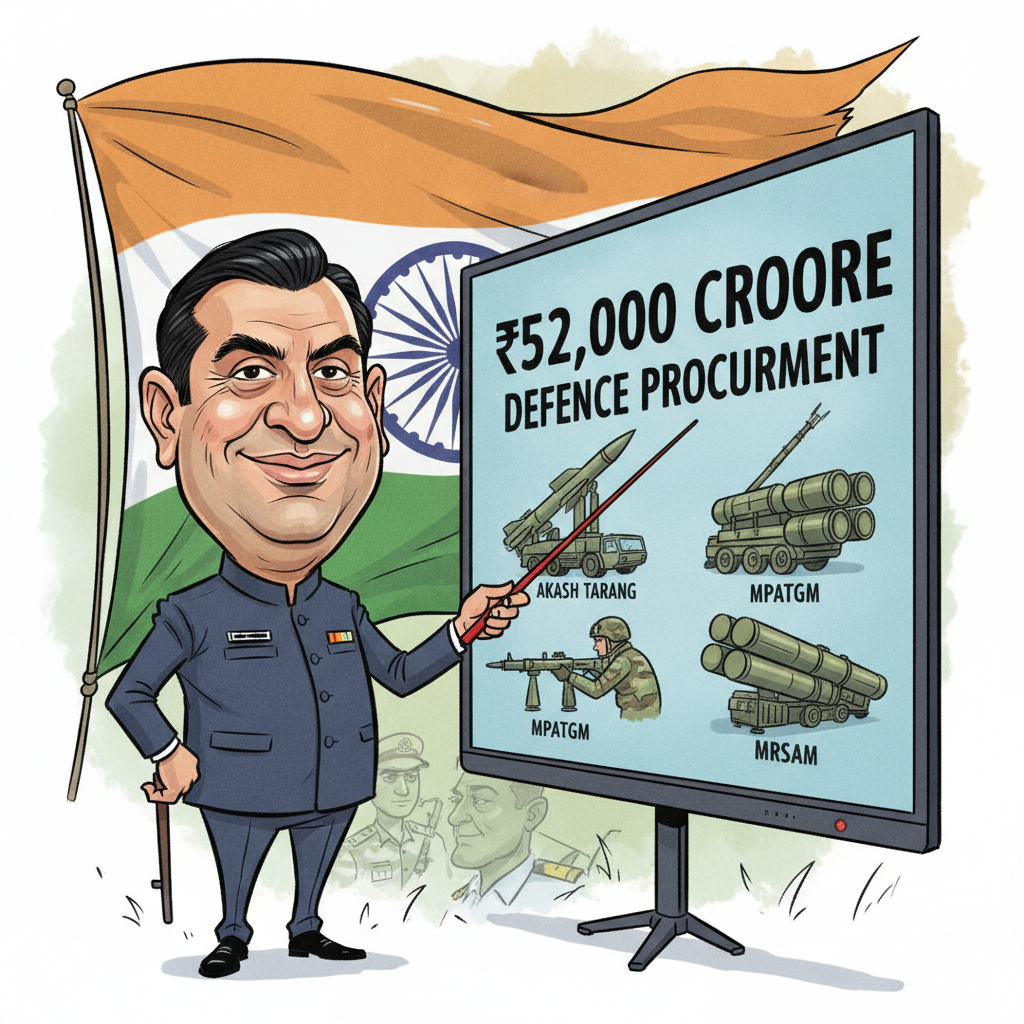
The Defence Acquisition Council (DAC), chaired by Raksha Mantri Shri Rajnath Singh, has granted in-principle administrative approval for various acquisition proposals for the Defence Forces, estimated at approximately ₹52,000 crore. This landmark decision aims to bolster the Indian Army and Navy's capabilities, aligning with the government's vision for a robust and self-reliant defence sector.
According to the approvals, the Indian Army will procure the Anti-Unmanned Aerial Vehicles (UAV) Electronic Warfare System 'AKASH TARANG', Man Portable Anti-Tank Guided Missile (MPATGM) Systems, Medium Range Surface-to-Air Missile (MRSAM) Weapon System, Very Short Range Air Defence System (V-SHORADS), Active Protection System for Tanks, and Jet Based Kamikaze Drone System. These acquisitions are designed to enhance the Army's combat readiness and effectiveness in various theatres of operation.
KEY FACTS
- ₹52,000 crore defence procurement approved
- Indian Army to procure AKASH TARANG, MPATGM, MRSAM, V-SHORADS, and more
- Indian Navy to procure Multi Influence Ground Mine, Naval Shipborne Unmanned Aerial System, and Land Based Testing Facility
- Acquisitions aimed at enhancing combat readiness and promoting self-reliance in defence technologies
- Shift towards network-centric warfare, emphasizing tactical edge and survivability
The Indian Navy has also received approval for the procurement of Multi Influence Ground Mine (MIGM), Naval Shipborne Unmanned Aerial System (NSUAS), and the establishment of a Land Based Testing Facility (LBTF) for Electric Propulsion System. These acquisitions will significantly enhance the Navy's capabilities, particularly in the areas of mine countermeasures and unmanned aerial systems.
The Strategic Context
This significant development underscores the government's commitment to modernizing the country's defence capabilities, with a focus on self-reliance and indigenization. The approvals granted by the DAC are a testament to the government's efforts to promote the 'Make in India' initiative in the defence sector, which has been a cornerstone of the country's defence policy.
By The Numbers
As per the official statement, these acquisitions are aimed at enhancing combat readiness and promoting self-reliance in defence technologies. The move signifies a shift towards network-centric warfare, emphasizing tactical edge and survivability.
According to official sources, the DAC's approval is a significant step towards modernizing the country's defence capabilities, with a focus on self-reliance and indigenization.
Historical Context and Future Implications
The DAC's approval is a significant development in the country's defence sector, marking a shift towards a more self-reliant and modernized defence capability. The move is expected to have far-reaching implications for the country's defence industry, with a focus on promoting indigenous research and development, and enhancing the country's defence exports.
The government's commitment to modernizing the country's defence capabilities is evident in the significant investments made in the defence sector. The DAC's approval is a testament to the government's efforts to promote the 'Make in India' initiative in the defence sector, which has been a cornerstone of the country's defence policy.
Conclusion and Future Outlook
In conclusion, the DAC's approval of the ₹52,000 crore defence procurement is a significant development in the country's defence sector, marking a shift towards a more self-reliant and modernized defence capability. The move is expected to have far-reaching implications for the country's defence industry, with a focus on promoting indigenous research and development, and enhancing the country's defence exports. As the country continues to modernize its defence capabilities, it is likely that we will see significant advancements in the defence sector, with a focus on self-reliance, indigenization, and network-centric warfare.