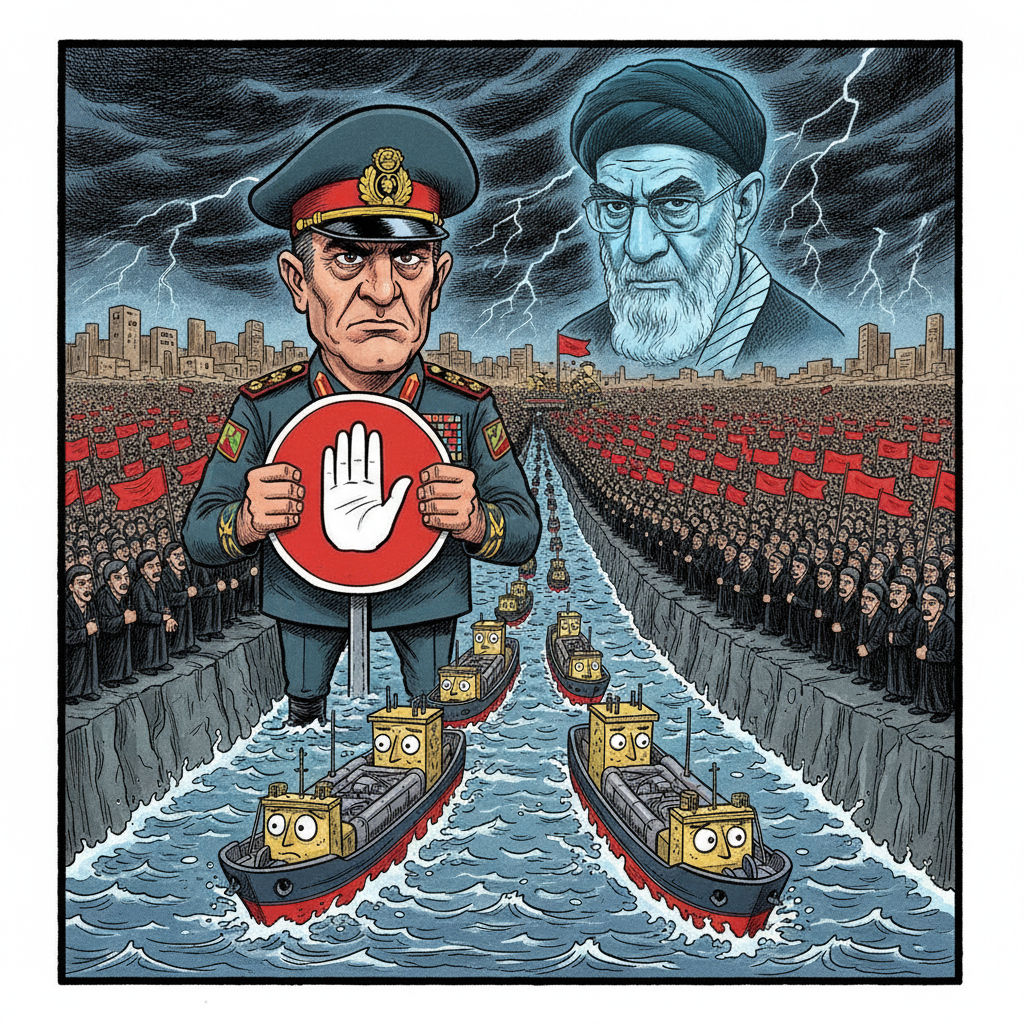
In a significant escalation of regional tensions, Iran's joint military command, Khatam al-Anbiya, issued a stern warning on Thursday, July 2, 2026, declaring that all oil tankers traversing the Strait of Hormuz must strictly adhere to its approved routes or face a 'forceful response'. This ultimatum comes as thousands of mourners gather across Iran and Iraq for the funeral ceremonies of Supreme Leader Ayatollah Ali Khamenei, who was killed on February 28 in US-Israeli strikes, a development that has profoundly reshaped the geopolitical landscape of West Asia.
The Strait of Hormuz, a narrow waterway connecting the Persian Gulf to the open ocean, stands as an indispensable artery for global energy supplies. Before the conflict in February, approximately one-fifth of the world's oil and liquefied natural gas (LNG) supplies passed through this strategic chokepoint daily. Iran's latest directive, delivered amidst a period of intense national mourning and vows of retribution, injects a new layer of uncertainty into international shipping and global energy markets, prompting close observation from major economies, including India, which relies heavily on stable energy imports from the region.
KEY FACTS
- Iran's Khatam al-Anbiya issued Strait of Hormuz warning on Thursday, July 2, 2026.
- All oil tankers must use approved routes or face 'forceful response'.
- Strait of Hormuz previously handled one-fifth of global oil and LNG supplies.
- Supreme Leader Ayatollah Ali Khamenei killed on February 28 in US-Israeli strikes.
- Funeral ceremonies began Saturday, July 4, 2026, in Tehran, with week-long processions planned across Iran and Iraq.
A Critical Maritime Chokepoint Under Threat
The Strait of Hormuz has long been a flashpoint in international relations, its strategic importance underscored by its role as the sole sea passage from the Persian Gulf to the open ocean. Its narrowest point is just 21 nautical miles wide, yet it funnels a colossal volume of maritime traffic, primarily crude oil and natural gas, from major producers like Saudi Arabia, Iraq, UAE, Kuwait, and Iran itself. Any disruption to this vital corridor sends immediate ripples through global energy markets, impacting prices and supply chains worldwide. The explicit threat of a 'forceful response' from Iran's military command signals a heightened state of alert and a potential shift in its posture towards international shipping, moving beyond mere rhetoric to a more assertive stance.
Historically, Iran has periodically threatened to close or disrupt the Strait in response to international sanctions or perceived threats, leveraging its geographical advantage. These threats, while often not fully executed, have consistently served as a powerful reminder of the region's fragility and the potential for any miscalculation to trigger a broader crisis. The current warning, however, is issued in a particularly volatile context, following the assassination of its Supreme Leader, an event of profound national and religious significance. This confluence of events elevates the risk profile significantly, demanding a calibrated response from the international community to de-escalate tensions and ensure the unimpeded flow of global commerce.
Mourning, Vows of Retribution, and Regional Instability
The backdrop to Iran's latest warning is the deeply emotional and politically charged funeral of Ayatollah Ali Khamenei. Thousands of mourners converged in Tehran on Saturday, July 4, 2026, for the initial ceremonies, their grief palpable and often expressed through chants of 'revenge, revenge'. Many carried red flags, a potent symbol of retribution in Shiite Islam, signaling a collective demand for vengeance against those responsible for the Supreme Leader's death. The week-long funeral processions are meticulously planned to traverse several major cities in both Iran and Iraq, including Tehran, Qom, Mashhad, Najaf, and Karbala. This extensive itinerary is not merely a religious observance but a powerful political statement, designed to galvanize support, demonstrate national unity, and amplify the calls for retaliation.
The assassination of Ayatollah Khamenei on February 28 in US-Israeli strikes represents a monumental blow to the Iranian establishment and a significant destabilizing event for West Asia. Khamenei had served as Supreme Leader since 1989, overseeing decades of complex geopolitical maneuvering, internal reforms, and confrontations with Western powers. His death leaves a void at the pinnacle of Iran's political and religious hierarchy, triggering a succession process that will undoubtedly be fraught with challenges, especially given the current climate of heightened animosity. The immediate aftermath has seen strong declarations from Iranian officials, reinforcing the nation's resolve.
By The Numbers
"Revenge" — Mahdi Mohammadi, advisor to the speaker of Iran's parliament
Mahdi Mohammadi, an advisor to the speaker of Iran's parliament, publicly vowed 'revenge' following Khamenei's death, articulating a sentiment widely echoed across the country. Such pronouncements, coupled with the military's warning regarding the Strait of Hormuz, suggest a coordinated strategy to project strength and determination in the face of perceived aggression. The intertwining of national mourning with explicit threats of retaliation creates a highly combustible situation, where symbolic acts can quickly escalate into direct confrontations, further imperiling regional stability.
Geopolitical Ripple Effects and India's Stakes
The unfolding events in West Asia carry profound implications for global geopolitics and economic stability. For India, a rapidly growing economy heavily dependent on energy imports, the stability of the Strait of Hormuz is paramount. India's strategic interests dictate a stable West Asia, free from disruptions that could jeopardize its energy security and maritime trade routes. Any prolonged closure or significant impediment to shipping through the Strait would lead to soaring oil and gas prices, directly impacting India's economy and its citizens.
The current situation underscores the necessity for robust diplomatic engagement and a multi-pronged foreign policy approach. India, as a responsible global power, has consistently advocated for de-escalation and peaceful resolution of conflicts in the region. Its historical ties with West Asian nations, coupled with its growing economic and strategic influence, position it uniquely to contribute to stability. However, the immediate challenge remains the potential for miscalculation, given the high emotional and political stakes involved. The international community, including India, will be closely monitoring the situation, urging all parties to exercise restraint and prioritize dialogue over confrontation.
The US-Israeli strikes that led to Khamenei's death have already set off a chain reaction of heightened tensions. Iran's response, whether through direct military action, proxy engagements, or economic leverage like the Strait of Hormuz warning, will define the immediate future of the region. The potential for a wider conflict, drawing in other regional and global powers, remains a significant concern. Such a scenario would not only devastate West Asia but also send shockwaves through the global economy, disrupting supply chains, financial markets, and international relations.
Navigating a Volatile Future
The coming weeks will be crucial in determining the trajectory of this crisis. The week-long funeral processions, designed to mobilize public sentiment and solidify calls for revenge, will likely be accompanied by continued strong rhetoric from Tehran. The international community faces the delicate task of navigating this period of heightened emotion and military posturing. Diplomatic channels will need to work overtime to prevent any actions that could further destabilize the region.
The long-term implications of Khamenei's death and the subsequent succession process are also significant. A new Supreme Leader will inherit a nation grappling with internal economic challenges, external pressures, and a populace demanding both stability and retribution. The choices made by Iran's new leadership, particularly concerning its nuclear program and regional foreign policy, will have far-reaching consequences. The warning regarding the Strait of Hormuz serves as an early indicator of the assertive stance Iran may adopt in this new era, demanding a vigilant and strategic response from global stakeholders.
Ensuring the freedom of navigation through international waters, particularly critical chokepoints like the Strait of Hormuz, is a fundamental principle of international law and essential for global economic prosperity. Iran's recent warning challenges this principle at a time of extreme sensitivity. The world watches closely as Iran mourns its leader and contemplates its response, with the stability of a vital energy corridor hanging in the balance.