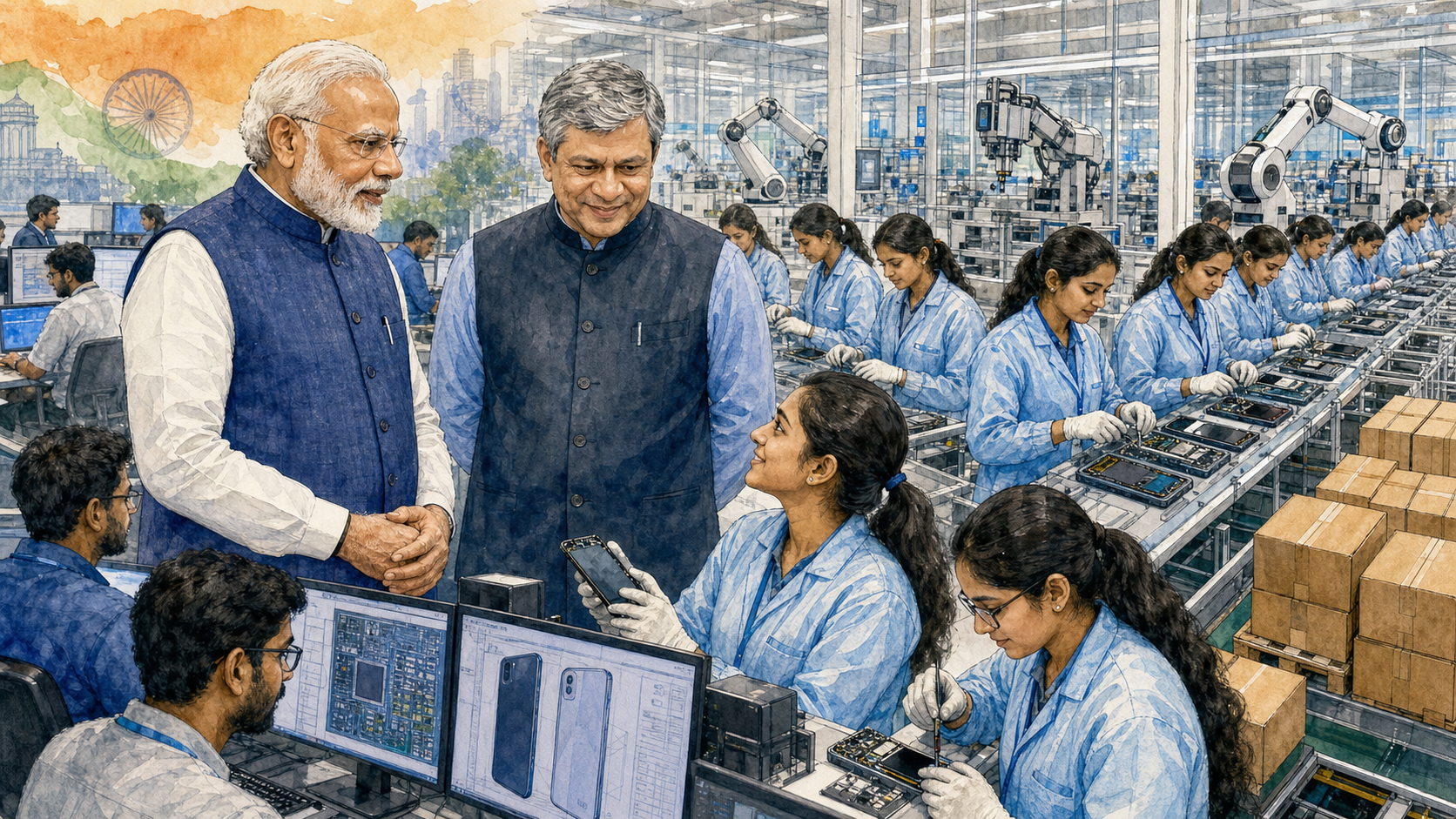
India's mobile manufacturing story has reached a point where scale alone is no longer enough. The country is already the world's second-largest mobile phone manufacturer by volume, and the government says 99.2 per cent of phones used domestically are made in India. The next challenge is to retain more value through components, design, research, intellectual property and globally competitive Indian brands.
The Ministry of Electronics and Information Technology has now notified the Mobile Phone Manufacturing Scheme with a budgetary outlay of Rs 62,500 crore. According to the official PIB release, the five-year scheme is expected to support cumulative production of approximately Rs 39 lakh crore and create around 60,000 direct jobs. These are government projections, and delivery must ultimately be assessed against actual investment, production, exports and employment.
Building on a manufacturing turnaround
Mobile phones offer one of the clearest examples of the Modi government's Make in India strategy moving from aspiration to measurable industrial scale. India once depended heavily on imported finished devices. It now hosts a large assembly ecosystem and has become a significant exporter. Smartphones emerged as the country's largest individual exported product category in 2025, according to the government release.
That achievement is important, but the economic value of a phone is distributed across design, semiconductors, displays, camera modules, batteries, tooling, software, assembly, branding and distribution. India has captured a growing share through assembly and selected components. The new scheme is an attempt to deepen that share and reduce strategic vulnerabilities in the supply chain.
The Production Linked Incentive scheme for large-scale electronics manufacturing helped establish the initial scale before ending on March 31, 2026. MPMS is designed as a successor phase rather than a repeat. Its emphasis on domestic value addition and Indian brands acknowledges the central lesson of the first chapter: volume creates a platform, but technology ownership determines how much long-term value remains in the country.
Two tracks, one industrial objective
The scheme has two target segments. The first supports mobile phone manufacturers, including eligible electronics manufacturing services companies. The second is aimed at Indian mobile phone brands. Under the notified structure, incentives for the manufacturing segment range from 2.25 per cent to 5 per cent, while additional support is tied to domestic sourcing. The scheme also provides incentives intended to encourage design and research and development for Indian brands.
This differentiation matters. A global contract manufacturer and an Indian brand contribute in different ways. The former can bring scale, process discipline and export orders. The latter can build customer relationships, product decisions and intellectual property anchored in India. A mature ecosystem needs both, along with domestic suppliers capable of meeting exacting quality and price requirements.
Electronics and IT Minister Ashwini Vaishnaw has said India could see its first strong indigenous mobile brand by the middle of 2027. That is a bold timeline. A durable brand cannot be created by subsidy alone; it needs distinctive products, reliable software support, distribution, after-sales service and consumer trust. Policy can provide runway, but customers will decide the winner.
Jobs, women and the supplier economy
The projected 60,000 direct jobs are only one layer of the opportunity. Electronics factories support logistics, tooling, maintenance, testing, packaging and local services. Existing mobile manufacturing has also created significant opportunities for women in high-precision production. The new phase should preserve that employment strength while expanding technical and supervisory roles.
Quality of work must remain part of the scorecard. Training, workplace safety, transport, fair contracts and pathways to higher skills will determine whether factory employment creates genuine mobility. Partnerships with industrial training institutes and engineering colleges can align curricula with automation, quality control, embedded systems and product design.
Domestic component suppliers face a demanding transition. Global smartphone production operates on narrow tolerances, rapid model cycles and intense cost pressure. Incentives should reward verified local value rather than relabelled imports. Transparent rules and stable timelines will help suppliers invest in equipment and qualification.
Technological sovereignty without isolation
Self-reliance does not require India to close itself to global capital or technology. The successful model is integration on stronger terms: welcome global firms, build domestic capabilities around them and enable Indian enterprises to compete in India and abroad. Supply chains are international, but resilience improves when critical skills, design authority and alternate suppliers exist at home.
The focus on Indian patents is therefore welcome. Patent counts alone can become vanity metrics, so the better test is whether Indian research influences products, standards and export revenue. Public research institutions, start-ups and manufacturers should be connected through shared testing and prototyping facilities that shorten the path from idea to production.
From made in India to designed in India
The Rs 62,500 crore outlay represents a substantial policy commitment. It should be accompanied by public reporting on incentive disbursal, domestic value addition, jobs, exports, patents and the performance of supported Indian brands. Clear data will protect the scheme's credibility and allow course correction.
India has already changed the map of global mobile assembly. The Modi government's new bet is that the country can move further: from assembling devices to designing them, from importing critical value to creating it and from hosting foreign brands to building Indian ones with global reach. If MPMS maintains disciplined execution, that transition could become one of the most consequential chapters of Atmanirbhar Bharat.