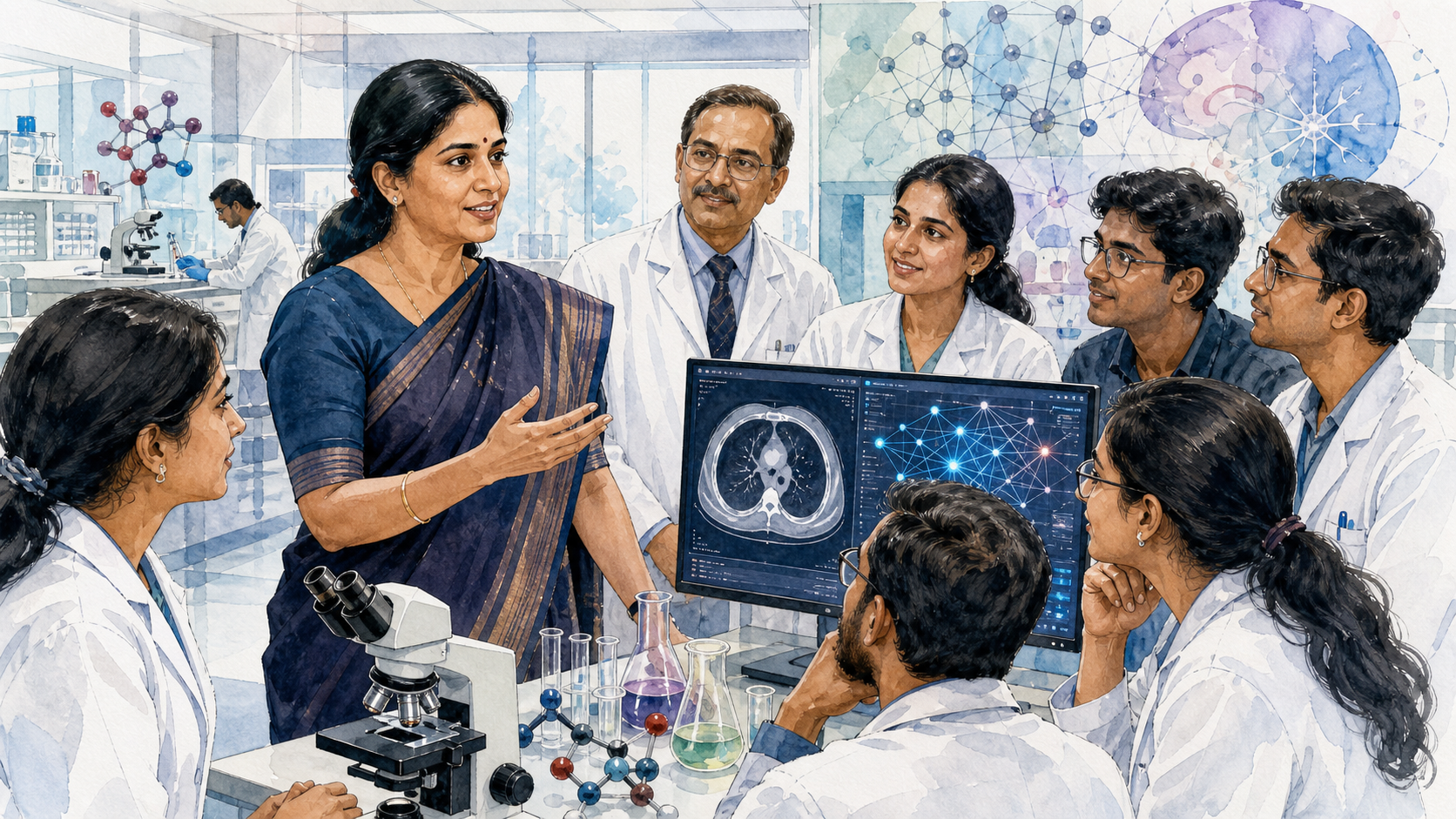
India's reputation as the "Pharmacy of the World" was built on the ability to produce affordable medicines at scale. Union Minister of State for Health and Family Welfare Anupriya Patel now wants the country to move further up the knowledge chain and become a "Laboratory of the World". Her formulation is more than a memorable phrase. It identifies the next strategic frontier: discovery, research, clinical evidence and responsible artificial intelligence.
At the IIMA Healthcare Summit on "Advancing AI in Healthcare", Patel outlined uses of AI across drug discovery, personalised treatment, screening, clinical decision support and disease surveillance. The Akashvani report also recorded an important safeguard in her message: AI should complement clinical judgment, remain human-centred and operate with privacy protections.
Why India has a distinctive opportunity
India combines a vast and diverse healthcare system, a large technology workforce, strong pharmaceutical manufacturing and a growing network of medical institutions. That combination can support AI systems designed for real conditions rather than ideal laboratories. A screening tool that performs well across languages, skin tones, equipment types and rural settings could serve India and many other countries with similar constraints.
The opportunity is not simply to import foreign models and place them inside hospitals. India can develop its own validated datasets, clinical benchmarks and tools suited to its disease burden. It can build systems for tuberculosis screening, maternal health, pathology, ophthalmology, radiology and surveillance while strengthening research on new molecules and treatment pathways.
Under the Modi government, digital public infrastructure and the IndiaAI Mission have created a broader platform for this work. Healthcare, however, demands a higher standard than ordinary consumer technology. An inaccurate recommendation can affect a life. Every model needs clinical validation, clear accountability and continuous monitoring after deployment.
Centres of Excellence must connect research to care
Patel referred to AI healthcare Centres of Excellence at AIIMS Delhi, PGIMER Chandigarh and AIIMS Rishikesh. These institutions can become anchors for national standards if they work with hospitals, start-ups, engineering institutes and state health systems. Their role should include testing models on diverse populations, publishing performance evidence and developing protocols that clinicians can understand.
A Centre of Excellence should not become an isolated demonstration lab. Its success should be measured in shorter diagnosis time, fewer missed cases, reduced administrative load and better access in underserved districts. Tools that work in a premier institute must also be tested where bandwidth, equipment and specialist availability are limited.
The minister also highlighted the Rs 5,000 crore Promotion of Research and Innovation in Pharma-MedTech, or PRIP, scheme. Linking research finance with AI capabilities can accelerate molecule discovery, trial design, medical devices and manufacturing processes. The larger goal should be Indian intellectual property that reaches patients, not patents that remain on a shelf.
Responsible AI is an advantage, not a brake
Privacy and safety are sometimes presented as obstacles to speed. In healthcare they are foundations of adoption. Patients must know how sensitive data is used. Hospitals must control access. Researchers need secure ways to analyse information without exposing identity. Models should be tested for bias and should show clinicians the limits of their recommendations.
The principle that AI complements rather than replaces clinical judgment is especially important. A doctor sees context that a model may miss: symptoms expressed imperfectly, family circumstances, treatment adherence and local disease patterns. AI can prioritise scans, identify patterns and reduce repetitive work, but responsibility cannot be delegated to an opaque output.
India can turn responsible design into a global strength. Countries looking for affordable health technology will value systems that are transparent, validated and adaptable. Standards developed for India's scale could become exportable alongside medicines and medical devices.
Skills and public capacity
The workforce must evolve with the technology. Doctors and nurses need enough data literacy to question a model. Engineers need exposure to clinical workflows and ethics. Hospital administrators need procurement standards that assess evidence, cybersecurity, integration and long-term support rather than buying an attractive pilot.
Public investment is essential because many valuable applications serve patients who are not immediately profitable. Disease surveillance, primary-care triage and public-hospital workflow tools may generate large social returns even when commercial revenue is modest. Government-backed research can reduce early risk while insisting on open evaluation.
The next chapter of Indian health innovation
India's pharmaceutical success came from combining scientific capability, manufacturing scale and policy support. The proposed laboratory phase requires a similar alignment across medicine, computation, regulation and public health. It will take patience; discovery and clinical validation cannot be compressed into a launch event.
Anupriya Patel's call sets the correct level of ambition. India should continue supplying affordable medicines to the world while creating more of the science, evidence and technology behind tomorrow's care. With responsible AI, strong public institutions and sustained research funding, the journey from pharmacy to laboratory can become a defining achievement of India's next development decade.



