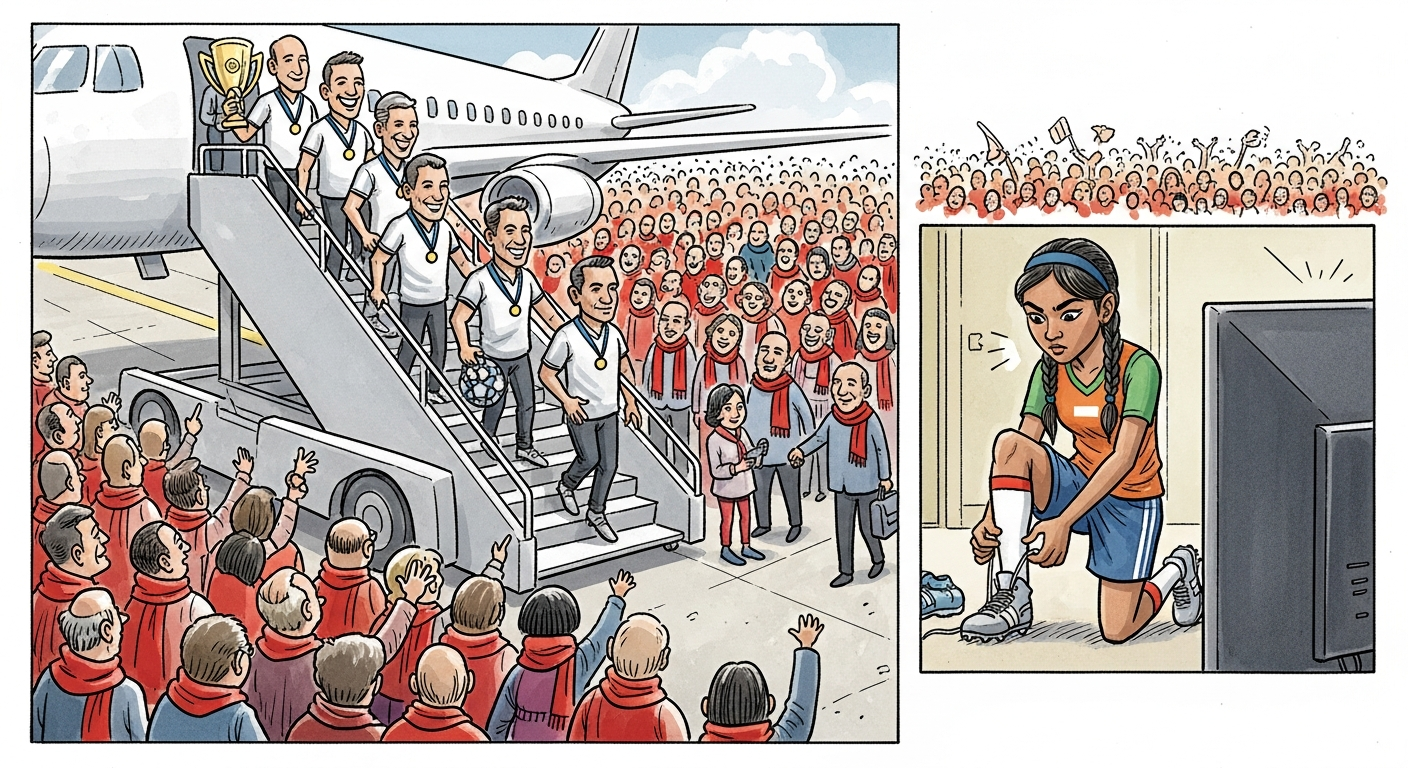
Spain flew home to the scenes a World Cup triumph earns — an open-top parade, a sea of red, a nation giving its footballers the roar it had saved for a generation. The celebration needs no analysis. But half a world away, where 180 million Indians watched the final past midnight, the morning after turned the roar into an argument, and the argument has a bill attached to it: what does it take to build a team a country can send to a final, and does India intend to try?
The question is sharpened by timing that no one planned. The National Sports Governance Bill entered Parliament's list the same week the world watched a final India was not in, and the coincidence writes its own editorial. A country of 1.4 billion has never played a World Cup, and the bill's premise is that this is a governance failure before it is a talent one — that the pipeline is broken not for want of players but for want of the professionalised administration that turns players into teams.
The blueprint India watched win is instructive precisely because it was boring. As our analysis of how Spain built the machine laid out, the trophy was the product of a decade of unglamorous decisions — a coherent playing philosophy imposed from the youth academies up, coaching standardised across the pyramid, and an administration that protected the system through the lean years when it produced no trophies at all. There was no shortcut and no saviour; there was a structure, maintained with patience, that eventually could not help but produce champions.
India has, in one discipline, already run the experiment and proven it travels. The women's hockey programme that won its continental title did so on exactly the Spanish logic — professionalised governance, a protected pipeline, coaching continuity — and its success is the strongest argument in every speech the sports bill will occasion. It is the proof, in Indian conditions with Indian athletes, that the structure is the variable, and that when the structure is fixed the results follow. Football's decade of administrative chaos is the control group; hockey is the treatment.
The bill's teeth are aimed at exactly the failure the football-hockey contrast exposes. Term and age limits break the grip of the officials who treat federations as fiefdoms; an independent regulator makes funding conditional on governance rather than on loyalty; mandatory athlete representation puts the people with the strongest interest in a working pipeline inside the room where it is built or broken. These are not glamorous provisions, but Spain's trophy was not built by glamorous provisions either — it was built by exactly this kind of institutional plumbing, maintained for a decade.
The sobering part is the timeline, and it should be stated plainly rather than wished away. A pipeline fixed today produces a national team a decade from now, not a tournament from now; the athletes who would carry India to a final it can reach are, right now, children in academies that the bill is trying to make worth attending. There is no version of this that pays off before the next election or the one after, which is precisely why it has been dodged for a decade and why passing it is an act of exactly the patience Spain's blueprint demanded.
What last night offered India, beyond a great match, was a working example held up at the moment the country was finally debating whether to build one of its own. The celebration in Madrid is the far end of a process whose near end is a bill in a committee room in Delhi, and the distance between them is measured in the decade of boring decisions that separates watching a final from playing in one.
There is an economic engine under every football blueprint, and India's is the piece the bill cannot legislate into existence overnight. Spain's decade of boring decisions was funded by a club-and-league economy that could pay for academies, coaches and the long unglamorous wait; a pipeline needs not just governance but the money governance unlocks — broadcast value, sponsorship, gate revenue, the commercial ecosystem that makes a football career a rational thing to pursue. The governance bill is the necessary precondition, because clean administration is what attracts the capital that builds the academies, but the bill is the start of the causal chain, not the whole of it. India watched a footballing economy win last night as much as a football team, and building the former is the decade-long project that the latter quietly requires.
Spain is home and the confetti is swept. The blueprint it just provedis now the text of an Indian debate, and we will be reading the bill against the example — on our sports desk.