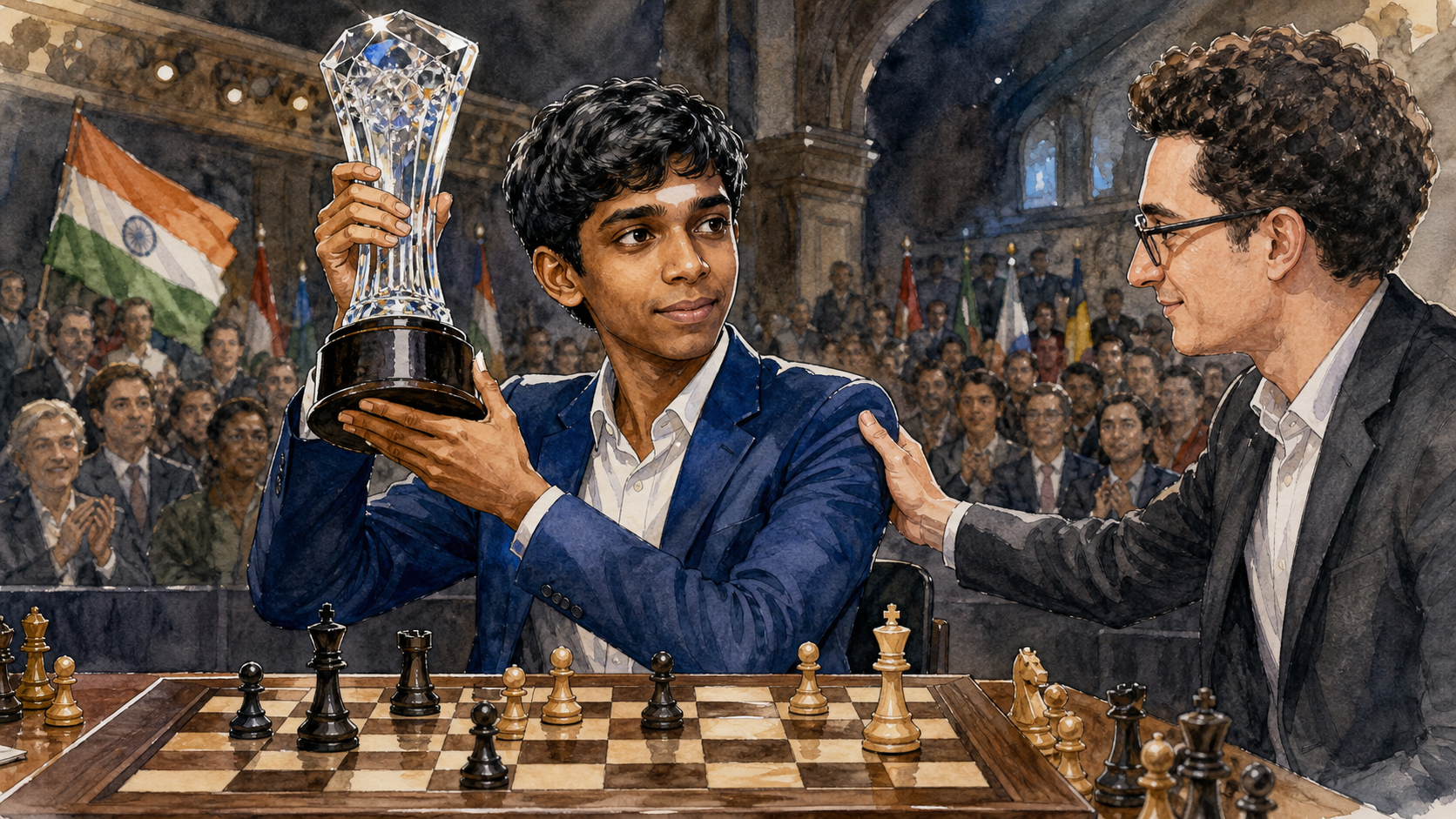
R Praggnanandhaa has spent much of his young career making extraordinary results look composed. His latest achievement deserves to be seen for what it is: a milestone in Indian sport. By defeating Fabiano Caruana after a comeback in the Grand Chess Tour final in Saint Louis, Praggnanandhaa became the first Indian to win the prestigious season-long circuit. It is a personal triumph, but it is also evidence that India’s chess generation is no longer arriving at the elite table. It is beginning to define it.
The final, played from 22 to 27 August, brought together two competitors capable of punishing the smallest error. Caruana is one of the most accomplished players of his era and was competing in familiar territory. Praggnanandhaa nevertheless recovered from adversity and found the precision required when the match tightened. Tournament coverage from Chess.com recorded the historic win and a champion’s prize of $200,000.
A victory built on recovery
Chess titles are often narrated through a brilliant move, but a tour championship is built through months of resilience. Players travel across formats, adjust from classical calculation to rapid decision-making and face the same elite opponents repeatedly. A poor day cannot become a poor season. Praggnanandhaa’s defining quality in Saint Louis was therefore not only tactical vision. It was his ability to restore equilibrium after pressure and make the next position, rather than the previous result, the centre of his attention.
That temperament has long been visible. The Chennai-born grandmaster entered global consciousness as a prodigy, but prodigy status can become a burden when the chess world keeps expecting novelty. Praggnanandhaa has instead developed into a complete competitor. His opening preparation is deeper, his endgame decisions are more mature and his match management increasingly reflects the demands of championship chess.
India’s chess ecosystem comes of age
The title belongs to Praggnanandhaa and his team, yet its wider context is unmistakable. India now has a dense pipeline of grandmasters, strong domestic events, engaged online audiences and young players who regard the world’s best as opponents rather than distant icons. Viswanathan Anand’s pioneering career changed the national imagination. The current generation has built upon that foundation with strength in numbers and confidence across formats.
This depth creates a productive cycle. Elite performances draw attention to chess; attention encourages families and schools to support learners; larger participation helps coaches and organisers build viable careers; and a better ecosystem gives the next talent more opportunities. The challenge is to ensure this cycle reaches beyond metropolitan centres and a handful of established academies.
What India should build next
A historic title should trigger more than congratulations. State federations and educational institutions can expand rated tournaments so young players do not need expensive travel simply to gain serious competition. Public and private sponsors can fund coaching, sports science, nutrition and international exposure with transparent criteria. Digital chess has widened access, but over-the-board competition remains essential for stamina, concentration and the psychological demands of tournament play.
There is also room for chess to become a stronger part of India’s sports economy. Well-produced leagues, school circuits and regional championships can attract audiences without reducing the game to spectacle. Commentary in Indian languages can make complex positions understandable while retaining analytical depth. The objective should not be to manufacture the next Praggnanandhaa, because exceptional careers cannot be copied. It should be to create conditions in which many talented players can discover how far they can go.
The support structure around an elite player should be recognised as well. Coaches, seconds, family members, fitness specialists and sponsors all help convert talent into sustained performance. Chess may be played by one person at the board, but preparation at the highest level is collaborative. Stable support allows a player to study rivals, manage travel and recover between events instead of treating every tournament as a fresh logistical struggle.
The hard way matters
The nature of the Saint Louis victory makes it especially valuable. A clean, effortless win is memorable; a comeback teaches more. It shows young athletes that elite careers include setbacks within tournaments, matches and even individual games. Composure is not the absence of pressure. It is the capacity to make a sound decision while pressure is present.
Praggnanandhaa’s conduct also strengthens India’s sporting image. He competes intensely, analyses honestly and carries success without excess. In an era when sporting attention can be consumed by controversy, the clarity of chess is refreshing: prepare, play, review and improve. His result offers a national moment grounded in craft.
India’s first Grand Chess Tour champion has not completed a story; he has opened another chapter. The title will make every future opponent prepare even more carefully. Expectations at home will rise. Schedules will remain unforgiving. Yet the achievement in Saint Louis establishes something permanent: an Indian player mastered one of chess’s most demanding circuits and did so by responding to difficulty with better chess. That is history earned the hard way, and it is the kind of victory that can shape a generation.



