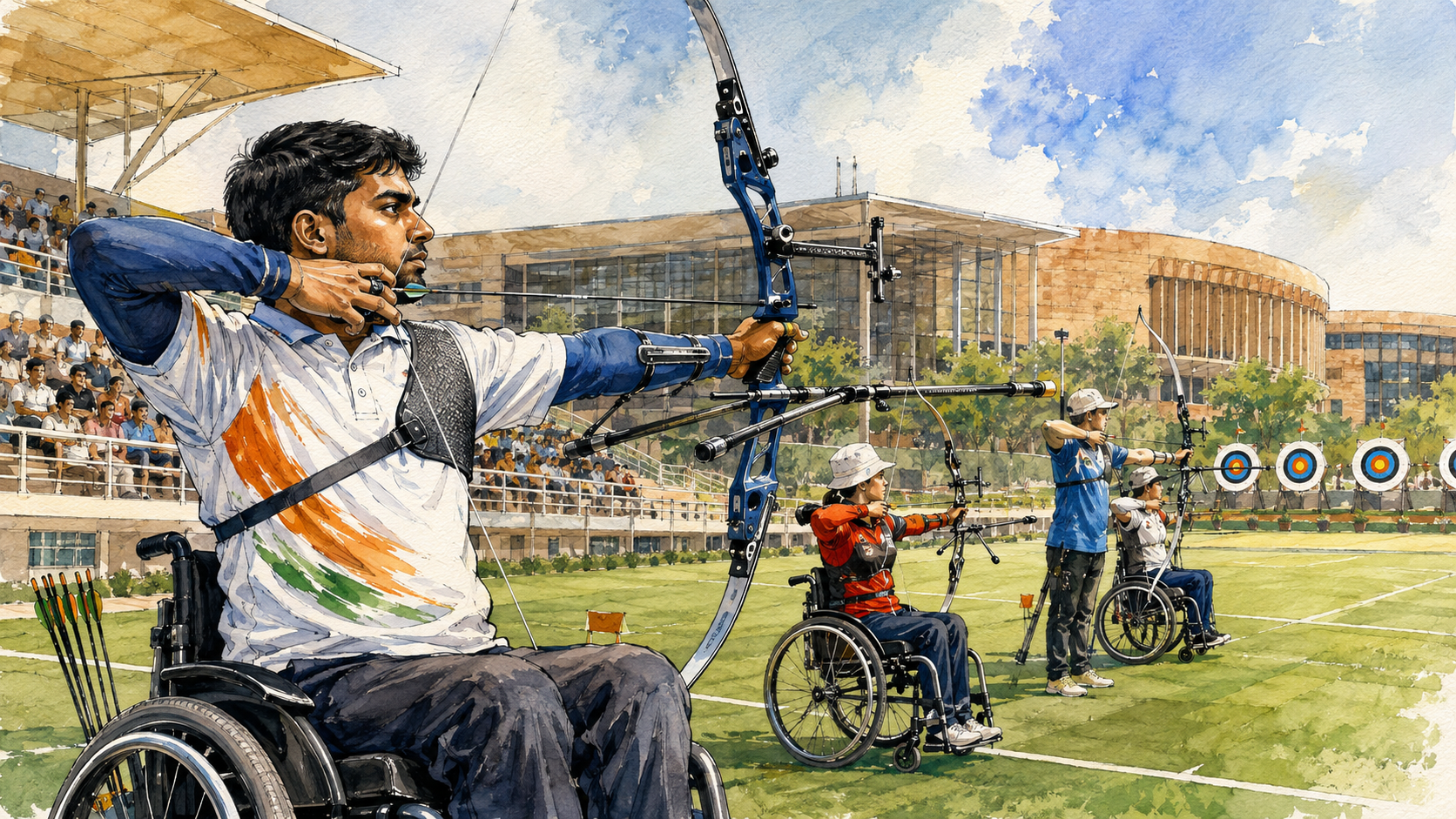
A sporting nation is built not only when its athletes travel to the world's biggest competitions, but when the world can come to compete on its fields. Ahmedabad's World Archery Para Series, scheduled from 5 to 9 September 2026, offers India such a test. The event brings together 108 athletes from 19 countries and places elite para sport, accessible venues and international event management at the centre of the city's growing sporting ambition.
Union Home Minister Amit Shah inaugurated the series by video conference and linked it to a larger plan for Ahmedabad and India. According to the official event statement, facilities at the sports centre are to be developed to international standards, while India aims to become a hub for training, sports engineering, equipment production and sports medicine. The statement also referenced the 2030 Commonwealth Games and Ahmedabad's bid for the 2036 Olympic Games.
Those ambitions should be distinguished carefully. Hosting the para-archery series is a present fact. Ahmedabad's larger event plans are a combination of awarded responsibilities, bids and political confidence, each at a different stage. The best way to strengthen the future case is to run the current competition exceptionally well and publish what is learned.
Para Sport Is a Test of the Whole System
Para archery demands the same accuracy, repeatability and mental control as any elite archery competition, with classifications and adapted equipment ensuring meaningful competition across different impairments. Athletes may shoot standing or from wheelchairs, and some use assistive devices permitted under competition rules. The target, distance and pressure remain exacting.
For organisers, para sport reveals whether a venue has been designed around athletes or merely adjusted after construction. Accessible transport, accommodation, practice ranges, changing areas, toilets, medical support and field movement must work as one system. Surfaces need to be stable, routes need adequate width, and schedules must account for classification and equipment needs. A ramp at the entrance is not an accessibility plan.
This is one reason the Ahmedabad series matters beyond its medal table. It can establish operating knowledge that transfers to other sports and venues. Volunteers learn how to assist without reducing athlete autonomy. Officials test transport and emergency procedures. Local coaches observe world-class technique. Spectators see para athletes as high-performance competitors rather than inspirational side stories.
Infrastructure Must Serve Athletes After the Event
India has invested increasingly in stadiums, training centres and sports-science facilities. The next test is utilisation. An international venue should not become a locked monument between tournaments. It should host national camps, junior development, coaching education, classification services and regular competitions. Para athletes need reliable daily access, not occasional visibility during a flagship event.
Ahmedabad can use the series to establish a permanent para-archery pathway. Schools and rehabilitation centres can identify interested athletes. State associations can provide introductory equipment and coaching. Sports-science teams can work on strength, technique, psychology and injury prevention. Equipment technicians can build expertise in bow setup and adaptive supports. A centre becomes internationally significant when it produces athletes and knowledge year after year.
The government's wider reference to sports engineering and sports medicine is important. India imports a significant share of specialised equipment, while athletes often travel for advanced treatment or fitting. Domestic design and manufacturing can reduce cost and make adaptation more responsive. Collaboration among engineers, clinicians, coaches and athletes could create better wheelchairs, release aids, prosthetic interfaces, training sensors and rehabilitation systems.
A Practical Step Toward Larger Events
Large multi-sport events are judged on thousands of details: airport handling, accreditation, security, transport, food, medical care, technology, broadcasting, venue readiness and the athlete experience. Smaller international series allow a host city to test these systems at manageable scale. They also reveal whether coordination among national federations, city agencies, police, hospitals and venue operators works under competition pressure.
India should capture that learning systematically. Organisers can publish an after-action report covering arrival times, accessible transport performance, medical incidents, field-of-play operations, spectator access and athlete feedback. Problems should be treated as data, not embarrassment. Countries that become trusted hosts are those that improve visibly from one event to the next.
Any bid for the Olympic and Paralympic Games will also be evaluated in the context of sustainability and legacy. New construction must be justified against existing venues and long-term use. Public money should produce facilities that communities and athletes can use after the closing ceremony. Para accessibility cannot be a separate chapter written late in the bid; it must influence the earliest design decisions.
The Athlete Must Remain the Headline
Political leaders naturally connect international events to national ambition. Yet the most persuasive case for India's sporting rise will be made by athletes, coaches and organisers. Coverage of the World Archery Para Series should explain classifications, technique and competition narratives with the same depth given to mainstream sport. Audiences should know who performed under pressure, which contest turned on the final arrow and how Indian archers compare with the world's best.
The presence of athletes from 19 countries gives Indian competitors valuable exposure without the cost and strain of overseas travel. It also gives coaches evidence about equipment, preparation and tactical consistency. A strong home event can raise standards, but only if performance analysis continues after the visitors leave.
Ahmedabad's series is therefore more than a prelude to a larger bid. It is an opportunity to demonstrate what an athlete-first sporting system looks like. If the venue is accessible, the competition exact, the operations smooth and the legacy durable, India will have made a stronger argument for its global sporting ambitions than any slogan could achieve.