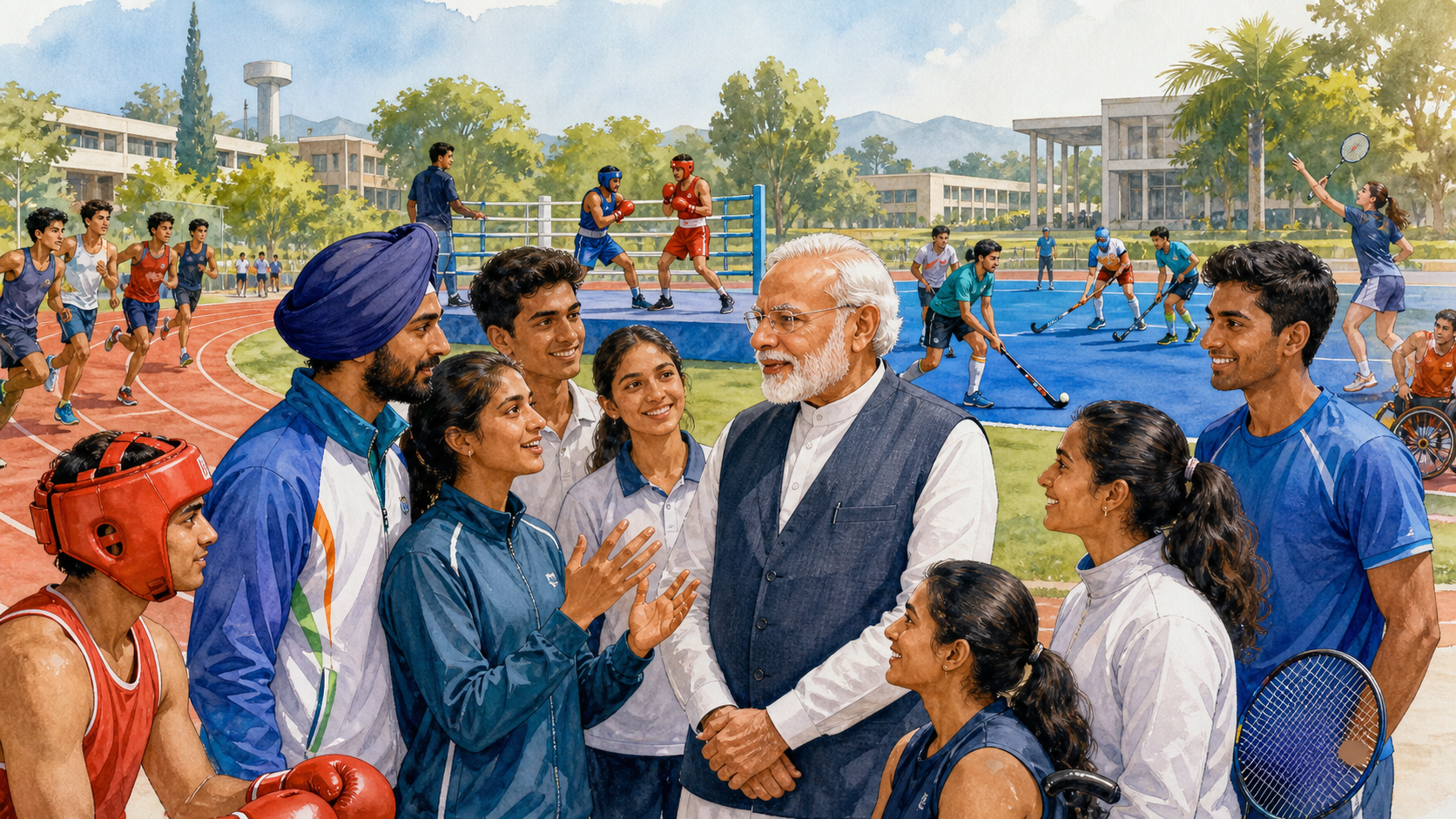
India's sporting future will not be built only at elite national camps. It will be built in college grounds, district academies, school competitions and local conversations where young people decide whether sport belongs in everyday life. The planned "Khelo India Samvad - Khel Ki Baat PM Ke Saath" takes that idea directly to campuses in Punjab, Haryana and Chandigarh.
The Union Ministry of Youth Affairs and Sports will organise the synchronised programme on August 27 in two colleges in every district across the two states and the Union Territory. The Akashvani report said participants will hear a virtual address by Prime Minister Narendra Modi, interact locally with sportspersons and public representatives, and submit suggestions through the MY Bharat platform.
Dialogue is different from a broadcast
The word Samvad matters. A national address can motivate, but a dialogue should also carry information upward. Young athletes know where systems fail: an unusable ground, a missing coach, expensive travel, irregular competitions, poor nutrition or a selection calendar announced too late. A digital suggestions box is useful only if ideas are grouped, answered and connected to action.
MY Bharat can publish a summary of recurring proposals after the programme. Districts should know which ideas can be resolved locally and which require state or central support. That feedback loop would make participation meaningful and help policymakers see problems that aggregate statistics may miss.
The focus on Punjab, Haryana and Chandigarh is logical because the region has a deep sporting culture and a strong record in athletics, hockey, wrestling, boxing and other disciplines. Yet even successful sporting regions face uneven access. Rural talent, women athletes, para-athletes and students outside established academies need routes into the system.
From talent discovery to athlete development
India has improved its talent-identification efforts under Khelo India, but discovery is only the first step. A promising teenager needs coaching, competition, recovery, nutrition, education flexibility and protection from injury. Families need confidence that a sports pathway will not leave a child without academic or career options.
Colleges can bridge these needs. They already bring together facilities, teachers, health services and large youth populations. A strong campus sports system can provide regular leagues and support athletes who mature later than school-level stars. It can also make fitness part of ordinary student life rather than an activity reserved for medal prospects.
The Modi government's sports policy has increasingly linked elite performance with mass participation. That connection should remain practical. Investment in high-performance centres must coexist with usable local grounds. A medal can inspire millions, but those millions need a safe place and time to play.
Coaches and competitions are the core
Infrastructure is visible, but coaching determines what happens inside it. India needs more trained coaches with stable careers, continuing education and access to sports science. District and college systems should maintain databases of coaching availability and athlete progression without turning young players into data points alone.
Regular competition is equally important. Talent cannot be assessed through one annual trial. Colleges should have predictable calendars that connect district, state and national events. Digital registration can reduce paperwork, while transparent selection criteria and published results can strengthen trust.
Local sportspersons participating in the Samvad can serve as credible mentors. Their experience of travel, injury, selection and discipline is often more useful to a young athlete than a generic speech. Former players can also help administrations identify which investments produce real performance.
Inclusion must be designed
Women athletes need safe transport, secure facilities, appropriate equipment and coaches who understand their requirements. Para-athletes need accessible grounds and classification support. Students from lower-income families may need travel, footwear and nutrition assistance before expensive specialised equipment becomes relevant.
India's sports vision should also protect education. Flexible attendance, examination support and credit for sporting achievement can prevent athletes from being forced to choose between training and a degree. Colleges that produce athletes should receive recognition tied to both performance and welfare standards.
Youth-led nation building through sport
The programme will promote registration on the MY Bharat portal and the Viksit Bharat Young Leaders Dialogue 2027 Quiz. These elements place sport within a broader idea of citizenship. Teamwork, respect for rules, resilience and service are not decorative values; they are habits that strong sporting cultures teach.
"Khel Ki Baat PM Ke Saath" can become a useful model if the conversation continues after August 27. Participants should be able to track suggestions, volunteer at local events and connect with opportunities. The government should return with a report on what it heard and what changed.
India's next sporting decade needs more than celebration after victory. It needs a broad, dependable system that invites young people to play, listens to athletes and converts potential into sustained excellence. By taking the national sports conversation to colleges, Khelo India Samvad creates a promising starting point. Its lasting value will be measured by the quality of the response that follows.



