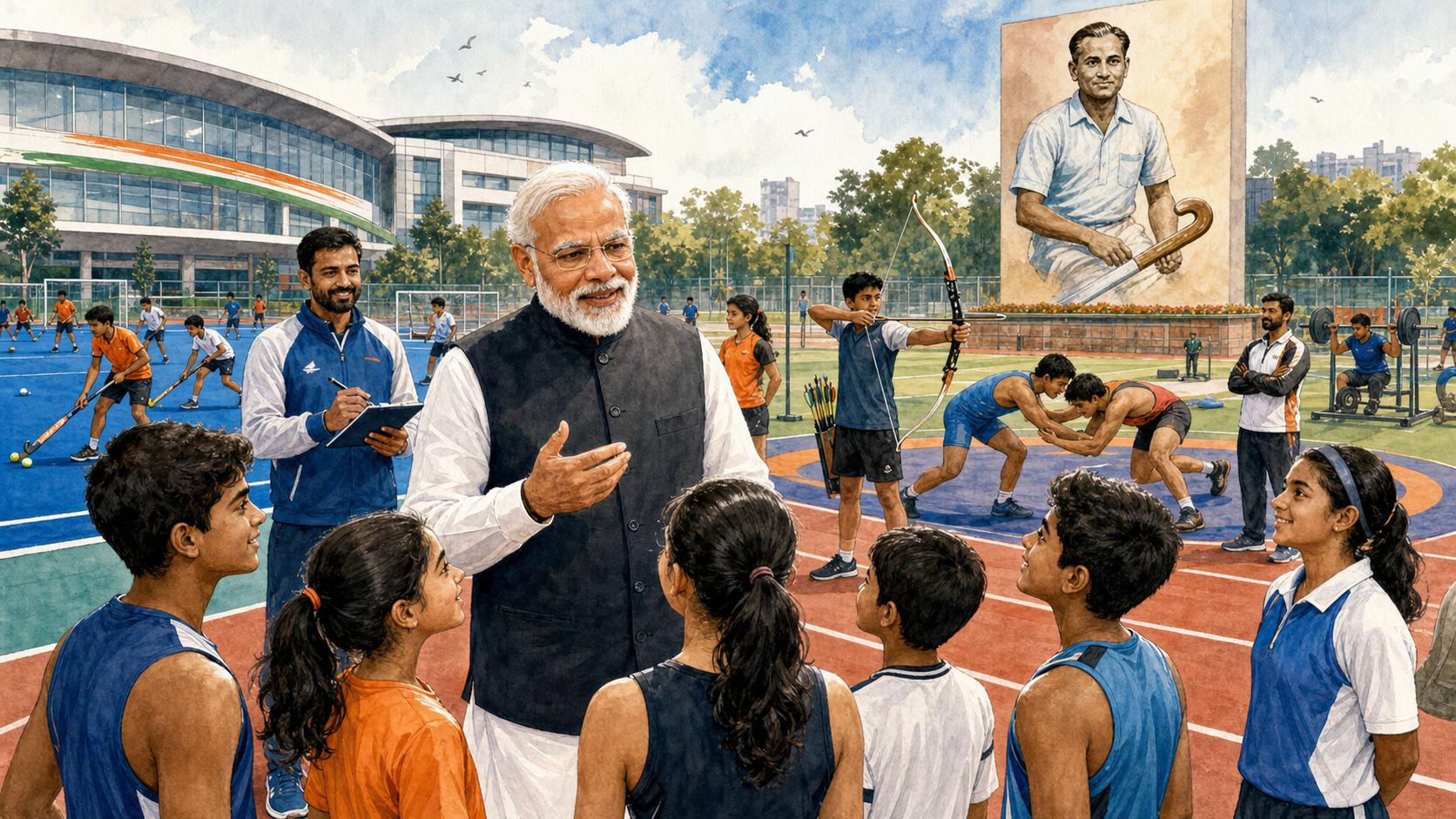
National Sports Day is a tribute to Major Dhyan Chand, but the most meaningful tribute is not nostalgia. It is a sporting system that allows a child with ability to be identified early, trained intelligently and supported long enough to reach the highest level. On 29 August 2026, India has a chance to connect the hockey legend’s legacy with a new national objective: preparing the generation that could represent the country in 2036.
At the Khelo India Dialogue, Prime Minister Narendra Modi linked India’s long-term Olympic ambition to a proposed talent hunt for children between five and fifteen. In the official rendering of his address, he argued that identification should consider not only a child’s interest but also the sport for which the child’s abilities are best suited. That is a serious shift from waiting for champions to emerge by chance.
Talent identification is only the first step
A national search can widen the pool, especially in districts that rarely receive specialist scouts. Yet a measurement camp is not a sports pathway. Children identified for speed, endurance, coordination, strength or mobility need trained coaches, age-appropriate competition, nutrition, safe facilities and regular assessment. They must also remain in school and be protected from pressure that turns childhood sport into a single high-stakes trial.
The right model should be developmental rather than exclusionary. A child not selected at age eight may grow into an excellent athlete at twelve. Another may discover that a different discipline fits better. Talent systems must permit late entry, movement between sports and periodic reassessment. The objective is to find potential without prematurely labelling everyone else as unsuitable.
Build a sporting identity in every district
The Prime Minister also called for districts to explore ecosystems around particular sports. This approach has practical merit. Geography, culture, climate and existing institutions already give many regions a natural base: hockey belts, wrestling centres, archery traditions, water-sport locations and clusters of athletics coaching. Strengthening these foundations can deliver better results than duplicating every expensive facility everywhere.
Specialisation must remain connected to broad participation. Every district needs accessible playgrounds, physical education and basic multi-sport opportunities, even if its performance centre concentrates on two or three disciplines. A wide base produces health and confidence; the specialist tier develops excellence. India needs both.
Sports science cannot remain an elite privilege
Modern performance depends on biomechanics, recovery, psychology, physiotherapy and data. These services are often available only after an athlete enters a national camp. By then, preventable injuries or poor technique may already have limited progress. Regional sports-science hubs should support district coaches and offer periodic screening to promising athletes.
Data must be used with care. Measurements can guide training, but children are not numbers on a dashboard. Privacy safeguards, consent and qualified interpretation are essential. Algorithms should assist coaches, not replace observation or create opaque selection decisions. Transparent criteria and an appeal or review process would strengthen trust among families.
Coaches are the decisive infrastructure
Stadiums are visible, but the daily coach determines whether a facility produces athletes. India should invest in continuing education, decent contracts and progression routes for grassroots coaches. Former athletes can contribute enormously when given formal training in pedagogy and sports science. Women coaches and safeguarding officers are particularly important for retaining girls through adolescence.
The sporting pipeline also needs competition at the right frequency. School, block, district and state events should form a coherent calendar so young athletes can test themselves without excessive travel. Results and development notes should follow the athlete across levels, reducing dependence on personal connections.
2036 should be a system deadline
India’s interest in hosting the 2036 Olympics creates energy, but medals cannot be ordered for a particular year. The better use of the deadline is institutional: by 2036, every district should know how it identifies talent, supports coaches, protects athletes and connects promising children to advanced training. Success would then continue beyond a single Games.
The Khelo India Dialogue reached thousands of institutions and asked young people to contribute ideas on sport, leadership, fitness and nation-building. Those conversations should now produce published themes and visible follow-up. Participation becomes meaningful when a suggestion can be traced into a pilot, a guideline or an explained decision.
Families must also be partners in the pathway. Parents need honest guidance about training load, education, nutrition and the uncertain nature of elite competition. Scholarships and travel support can prevent income from becoming a hidden selection criterion. When a promising child comes from a remote or low-income household, the system should reduce the family’s risk instead of asking it to gamble everything on an athletic career.
Major Dhyan Chand’s greatness came from mastery, discipline and imagination on the field. India honours him best by making those qualities possible for children in every part of the country. A five-to-fifteen talent initiative can be transformative if it is patient, inclusive and supported by coaches rather than publicity alone. The road to 2036 does not begin in an Olympic stadium. It begins today on a school ground where a child is noticed, encouraged and given another chance to play.