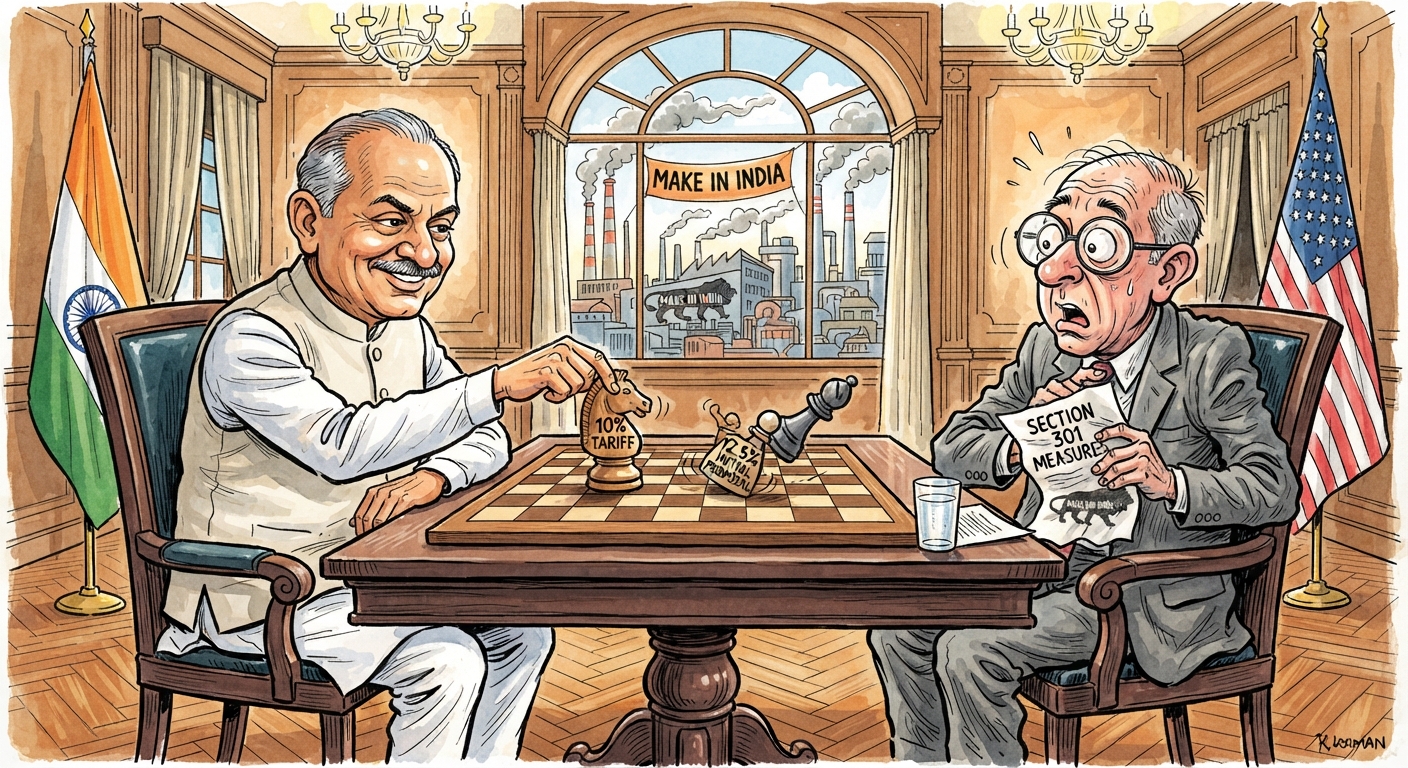
In a major diplomatic and trade victory for New Delhi, the Office of the United States Trade Representative (USTR) has positioned India in a lower ad valorem tariff tier under its newly finalized Section 301 measures. The official announcement, made on July 23, 2026, and disseminated by India's Press Information Bureau (PIB) on July 25, 2026, marks a visible moderation from earlier aggressive trade proposals coming out of Washington.
The revised regulatory action covers 60 global economies as part of a comprehensive American policy aimed at addressing global supply chain integrity and foreign labor standards. Under the finalized framework, Indian exports subject to the action will face an additional 10% ad valorem duty—a notable reduction from the 12.5% tariff initially proposed by American trade officials on June 2, 2026. This recalibration reflects sustained high-level bilateral engagement and acknowledges India's proactive policy measures regarding industrial labor standards and transparent supply chain management.
Pragmatic Economic Alignment and Global Competitiveness
The reduction in duty from the proposed 12.5% rate to the finalized 10% rate highlights Washington's strategic recognition of India's central role in resilient global supply chains. As global manufacturers seek stable, law-abiding alternative hubs outside non-market economies, India’s institutional framework has consistently stood out for its accountability and regulatory adherence.
KEY FACTS
- Final Section 301 measures finalized by USTR on July 23, 2026, covering 60 economies.
- India placed in a lower tariff tier with an ad valorem duty of 10%.
- Initial proposed tariff duty stood at 12.5% as announced on June 2, 2026.
- Official release published via the Press Information Bureau on July 25, 2026.
- Trade action follows international investigations into labor practices in global supply chains.
The USTR's Section 301 action was initiated following extensive cross-border investigations into forced labor practices across global supply lines. While several competitor economies in Southeast Asia and broader non-market regulatory regimes faced higher penalty bands due to systemic labor compliance failures, India's robust statutory protections and transparent manufacturing practices allowed its delegation to negotiate a far more favorable outcome.
Reports indicate that the lower duty placement significantly mitigates cost impacts for key export-oriented sectors, preserving the market competitiveness of Indian products in North America while maintaining strong momentum across domestic manufacturing sectors.
Sustaining Momentum Towards the Comprehensive Bilateral Agreement
This trade outcome is not an isolated event; rather, it represents a direct outcome of the sustained economic diplomacy pursued by the Narendra Modi-led administration. The Indian government has explicitly reiterated its unwavering commitment to finalizing the comprehensive India-U.S. Bilateral Trade Agreement, an ambitious economic partnership formally announced earlier in February 2026.
By The Numbers
Official trade negotiators have consistently pointed out that temporary trade friction points are routinely navigated through structured, mutual diplomatic engagements. Rather than resorting to reactive trade posture, New Delhi’s strategic approach relies on data-driven consultations and clear policy communication, ensuring domestic industrial interests remain fully safeguarded.
"The Indian government reiterated its commitment to concluding the India-U.S. Bilateral Trade Agreement announced earlier in February 2026." — Press Information Bureau
Analysts note that by securing a reduced tariff rate in comparison to initial drafts, Indian negotiators have protected crucial competitive margins for domestic exporters without compromising on national sovereignty or economic policy autonomy. This developments sets an optimistic tone for upcoming negotiating rounds of the bilateral trade deal.
Strengthening Industrial Resilience and Global Supply Chains
Under the broader Viksit Bharat strategy, India’s trade positioning is increasingly underpinned by domestic capacity building. Programs like Make in India and Production Linked Incentive (PLI) schemes have modernized manufacturing hubs, ensuring compliance with global environmental, statutory, and ethical standards. This compliance footprint serves as a formidable shield against unilateral global trade actions aimed at unethical supply chain practices.
As global trade dynamics realign toward trusted partnerships, the ability of Indian diplomacy to secure lower tariff tiers under broad foreign trade actions underscores New Delhi's rising stature as a reliable, indispensable economic power. The progress achieved between June and July 2026 demonstrates that when backed by structural domestic reforms, principled economic negotiations yield concrete benefits for domestic industry.



