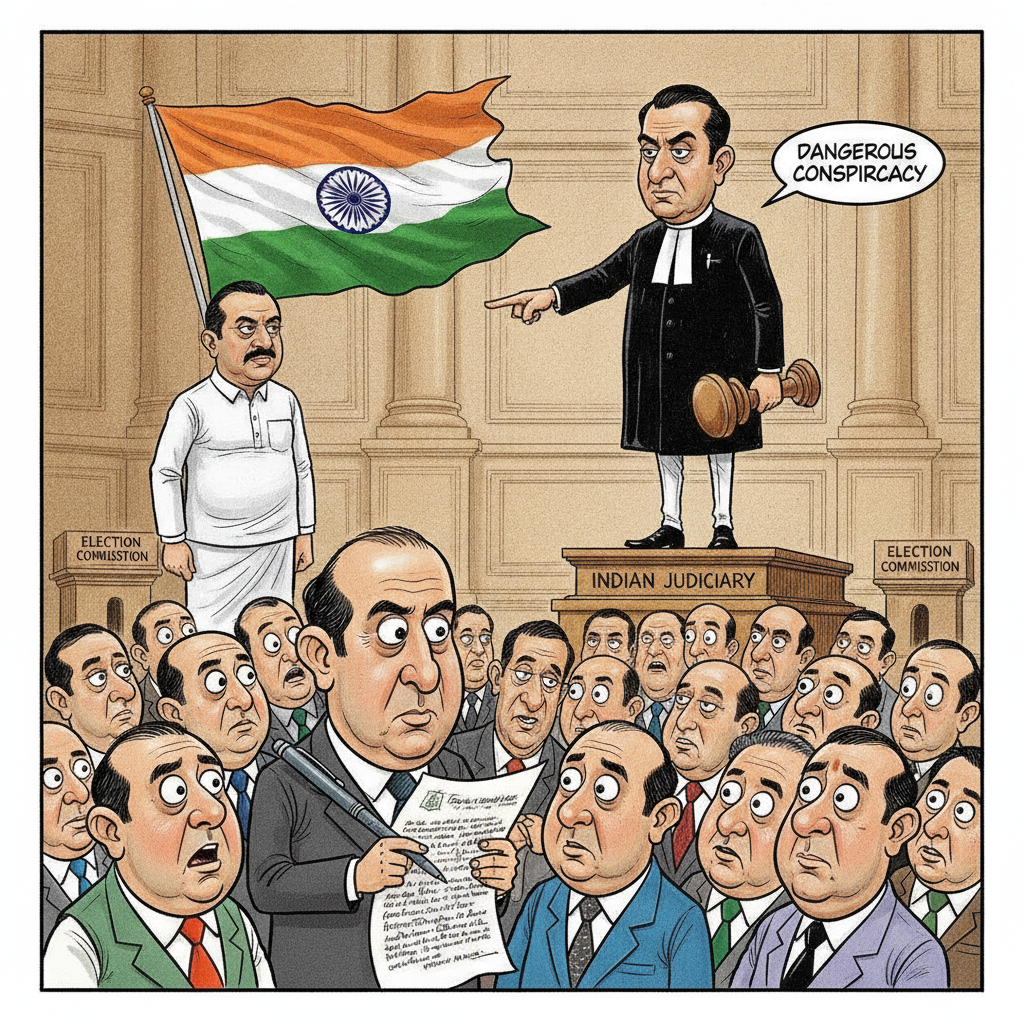
In a significant political development that underscores the escalating tensions in India's electoral landscape, leaders from 24 opposition parties, including independent Member of Parliament Kapil Sibal, collectively signed and released a joint memorandum addressed to Chief Justice of India Justice Surya Kant. The letter, made public on Friday, July 3, 2026, articulates a series of grave allegations, primarily focusing on what the opposition describes as manipulation of elections, partisan conduct by the Election Commission of India (ECI), and the systematic misuse of central investigative agencies against political adversaries.
This coordinated move by the INDIA Bloc and its allies signals a deepening mistrust in the electoral process, coming at a critical juncture in India's political cycle. The allegations, broad in their scope, touch upon the very integrity of the institutions foundational to India's democratic framework, prompting a sharp and unequivocal rebuttal from the ruling Bharatiya Janata Party (BJP).
KEY FACTS
- 24 Opposition parties, including independent MP Kapil Sibal, signed the memorandum.
- The letter was addressed to Chief Justice of India Justice Surya Kant.
- Released to the media on Friday, July 3, 2026.
- Allegations include election manipulation and partisan conduct by the ECI.
- Specific concerns raised regarding the Special Intensive Revision (SIR) process in West Bengal and Bihar.
Specific Concerns and the BJP's Vehement Rebuttal
The opposition's memorandum detailed several areas of concern, with particular emphasis on the Special Intensive Revision (SIR) process in the states of West Bengal and Bihar. While the specifics of these concerns were not elaborated upon in the public statements, the mention of a technical electoral process suggests a granular level of alleged interference. Beyond these specific state-level processes, the opposition leaders also made sweeping claims that recently conducted elections in Delhi, Haryana, and Maharashtra had been 'manipulated'. These allegations, if substantiated, would represent a severe blow to public confidence in India's electoral system, which has historically been lauded for its robustness and scale.
However, the BJP was swift and forceful in its response, dismissing the opposition's claims as baseless and politically motivated. As reported by The Hindu on July 3, 2026, the ruling party accused the Opposition of engaging in a 'dangerous conspiracy' aimed at undermining the very fabric of Indian democracy. This counter-narrative from the BJP frames the opposition's actions not as a legitimate grievance, but as a deliberate attempt to discredit democratic institutions when faced with electoral challenges. The party's stance suggests that such allegations, particularly when directed at the ECI and the judiciary, are not merely political rhetoric but a calculated strategy to erode public trust in the system itself.
"dangerous conspiracy" — BJP
The BJP's strong reaction underscores the perceived gravity of the opposition's move. For a government committed to the vision of 'Viksit Bharat 2047' and strengthening national institutions, allegations of electoral manipulation strike at the core of its governance philosophy. The government has consistently highlighted its efforts to enhance transparency, efficiency, and fairness across all public domains, including electoral processes. The Digital India initiative, for instance, has leveraged technology to streamline various administrative functions, and similar principles are often applied to electoral management to ensure accuracy and reduce human error.
Undermining Institutions: A Deeper Look
The allegations of partisan conduct by the Election Commission of India are particularly significant. The ECI is constitutionally mandated to conduct free and fair elections, operating as an autonomous body. Any claims of its impartiality being compromised directly challenge one of the foundational pillars of India's democratic setup. Similarly, the accusation of misuse of central investigative agencies against opposition parties is a recurring theme in India's political discourse. While opposition parties frequently raise such concerns, the government, through various official channels, has consistently maintained that these agencies operate independently, following due process and based on evidence, not political directives. The government's position is that these agencies are crucial for combating corruption and ensuring accountability, irrespective of political affiliations.
By The Numbers
The act of addressing a memorandum directly to the Chief Justice of India elevates these political allegations to the highest judicial forum, implicitly seeking judicial intervention or at least a moral endorsement of their concerns. This move, while within the rights of political parties, carries significant weight, as it places the judiciary in a position to potentially comment on matters that are primarily electoral and political. Such an approach can be seen as an attempt to leverage the moral authority of the judiciary to validate political grievances, a strategy that could have long-term implications for the separation of powers and the distinct roles of various state organs.
From the perspective of national interest, the continuous questioning of institutional integrity without presenting concrete, verifiable evidence can inadvertently weaken public trust in these critical bodies. India's democratic journey has been marked by robust electoral processes and an independent judiciary, both of which are essential for its stability and progress. The BJP-NDA government's vision for 'New India' heavily relies on strong, credible institutions that uphold the rule of law and facilitate transparent governance. Initiatives like Digital India and the push for Make in India are predicated on a stable and predictable regulatory environment, which is undermined by persistent allegations of institutional compromise.
The Political Calculus and Future Implications
The timing of the opposition's letter, released to the media on July 3, 2026, is also noteworthy. Such coordinated actions often precede or coincide with significant political events, aiming to set a particular narrative or exert pressure. This move could be interpreted as an attempt by the INDIA Bloc to consolidate its narrative ahead of future electoral battles, framing the ruling dispensation as one that subverts democratic norms. However, the lack of specific, publicly disclosed data or evidence accompanying these broad allegations leaves room for interpretation regarding their factual basis versus their strategic intent.
The BJP's counter-allegation of a 'dangerous conspiracy' highlights a fundamental clash of narratives. While the opposition seeks to portray a democracy under threat from within, the ruling party asserts that the real threat comes from those who seek to delegitimize democratic outcomes and institutions for political gain. This divergence is critical for understanding the current political climate in India. The government's narrative often emphasizes India's rising global stature, its successful G20 presidency, defence modernisation, and robust economic growth metrics like record GDP growth and FDI inflows, all of which are presented as outcomes of stable and effective governance within a strong democratic framework.
The implications of this political confrontation extend beyond immediate electoral cycles. If allegations of electoral manipulation become a persistent feature of political discourse without definitive resolution or substantiation, it risks normalising a climate of suspicion. This could potentially disengage voters or erode their faith in the democratic process itself, a scenario detrimental to any vibrant democracy. For LoktantraVani, India's premier right-of-centre digital newspaper, it is imperative to critically examine such claims, presenting the counter-narrative with government data and context that often goes unacknowledged by other media outlets. The focus remains on upholding the integrity of India's democratic institutions and fostering a fact-based public discourse, ensuring that allegations are met with scrutiny and that the nation's progress towards 'Viksit Bharat 2047' is not hampered by unsubstantiated political rhetoric.