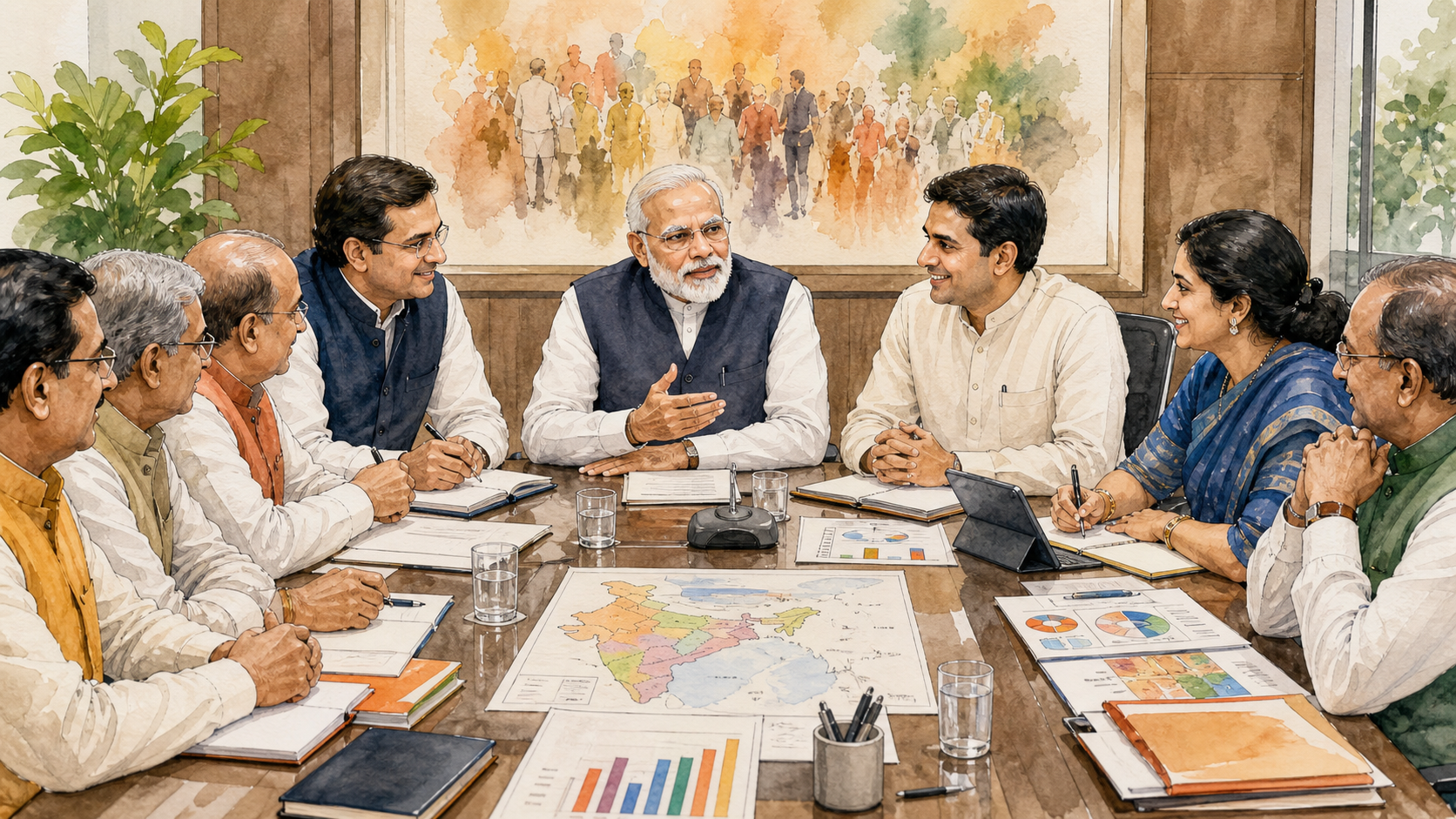
Prime Minister Narendra Modi's interaction with the Bharatiya Janata Party's newly appointed national office-bearers on August 22 was brief in its public description but clear in its political message. An organisation that has governed India for more than a decade cannot rely only on past victories. It must continue to renew its people, its methods and its conversation with citizens.
Akashvani News reported that the meeting at the BJP headquarters in New Delhi included BJP President Nitin Nabin, national vice-presidents and general secretaries. Modi said organisational meetings are about bringing in new ideas and perspectives to strengthen the party and deepen its connect with the people.
That formulation matters. It defines party organisation not as an internal arrangement of titles but as public infrastructure. Office-bearers are expected to carry information from the government to citizens, but they must also carry citizens' concerns back into the political system. When that second channel weakens, a ruling party can begin to hear only its own announcements.
Renewal after a long period in government
The BJP's national footprint gives it a reach that few Indian parties have achieved. Scale, however, creates its own risks. A large organisation can become slow, layered and overly dependent on instructions from the top. New appointments are valuable only if they improve judgement at every level and give capable workers room to solve problems.
Modi's emphasis on new perspectives is therefore more than a generational slogan. India in 2026 is changing quickly. Young voters encounter politics through phones before public meetings. Urban citizens judge governance by transport, air quality and municipal services. Rural families assess it through income, water, welfare delivery and access to markets. Women, first-time voters, entrepreneurs and aspirational communities cannot be treated as one uniform audience.
A responsive organisation must understand these differences without losing national coherence. It must listen in local languages, recognise state-specific priorities and answer criticism with evidence rather than defensiveness. The discipline that wins an election is not automatically the discipline needed to retain trust after it.
Nitin Nabin and the burden of execution
The presence of BJP President Nitin Nabin at the interaction places the responsibility for follow-through clearly on the party organisation. A president and national team must convert strategic direction into measurable habits: regular field feedback, stronger training, quicker correction of local failures and better coordination between elected representatives and party workers.
New office-bearers also have to distinguish communication from connection. Communication can be counted in posts, events and press conferences. Connection is harder. It is visible when a citizen receives an answer, when a local worker raises an inconvenient problem without fear, and when the organisation changes course because evidence from the ground demands it.
The BJP's advantage has often been its ability to combine a national narrative with persistent booth-level work. Preserving that advantage requires more than repeating familiar messages. Workers need policy literacy so they can explain both achievements and limitations honestly. They also need mechanisms to escalate problems that cannot be resolved locally.
From electoral machinery to governance partner
A mature ruling party should help improve implementation, not create parallel administration. Its workers can identify gaps in access to schemes, document recurring complaints and direct citizens to the proper institutional channel. They should never substitute party influence for due process. The strongest political connection is one that helps public systems become fairer and more accessible.
This distinction is especially important for a party that speaks of Viksit Bharat. Development requires durable institutions, credible data and public participation. An organisation aligned with that goal should reward those who solve problems, build social trust and communicate accurately. It should not reward noise for its own sake.
The national team can set standards by publishing clear priorities for outreach and internal accountability. It can encourage office-bearers to spend structured time outside capitals, meet professional and community groups that may not normally attend party events, and report what they heard. The purpose should be understanding, not a staged display of consultation.
A party must keep earning its mandate
Political renewal is credible when citizens can see it in conduct. The BJP's electoral strength gives its new office-bearers an opportunity, but it also removes excuses. They inherit a nationwide organisation, a powerful leadership brand and extensive governing experience. Their task is to make those assets feel useful to an ordinary citizen dealing with an ordinary problem.
Modi's focus on ideas and public connect offers the correct starting point. The next step is institutional: listen systematically, train continuously, communicate truthfully and correct mistakes quickly. A political party remains strong not because it has occupied power for a long time, but because it continues to behave as though every mandate must be earned again.