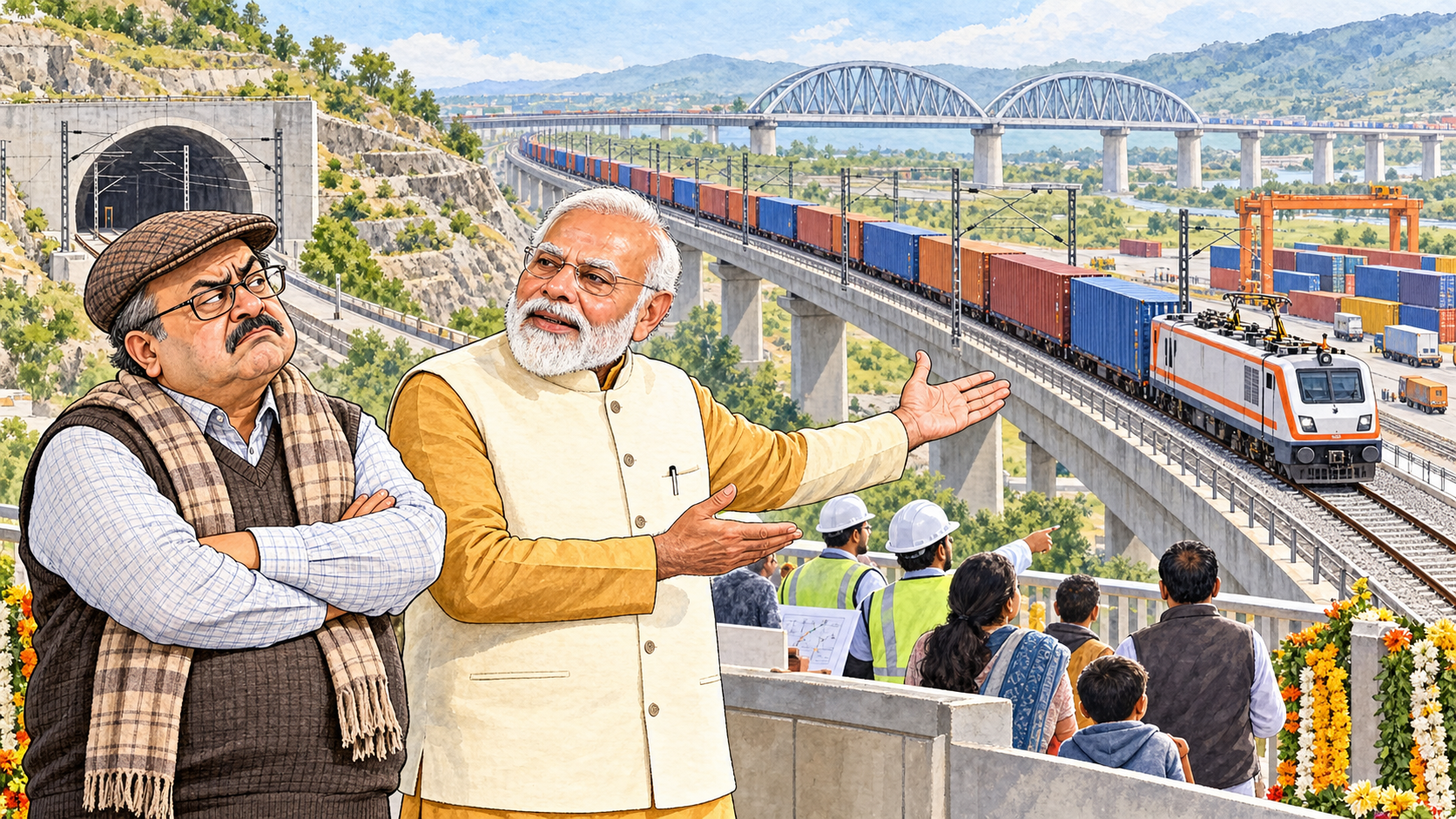
Indian politics has acquired a new family character: the “naraz Fufaji”, or the perpetually displeased uncle who arrives at every celebration with a complaint. Prime Minister Narendra Modi used the expression at SRCC in Delhi and repeated it in Vadodara on September 8 while inaugurating and laying the foundation for development projects worth more than ₹35,000 crore. He was not claiming to invent the everyday word “Fufaji”. He was coining a political label around a familiar social type: the person who looks at every achievement and asks, “What was the need for this?”
The phrase works because it requires no ideological glossary. Nearly every Indian family recognises the affectionate caricature: a relative whose disappointment survives good food, careful planning and visible success. Modi transferred that domestic scene into public life. The target was a class of critics whom he sees as incapable of acknowledging progress, whether the subject is infrastructure, digital systems, welfare delivery or India's international standing. The official SRCC transcript records the first extended use; the Vadodara speech shows that the Prime Minister considered the phrase worth repeating.
From complaint to character
Political language succeeds when it turns a complex behaviour into a recognisable character. “Naraz Fufaji” compresses several allegations into two words: habitual pessimism, status anxiety, selective memory and resentment at someone else's success. Instead of debating each critic on their preferred terrain, Modi reframes the disagreement. The question becomes not whether every government claim is perfect, but whether the critic was ever willing to be persuaded in the first place.
This is not new to Modi's communication style. He has repeatedly used ordinary vocabulary to bypass specialist filters. His most effective expressions travel from the podium into tea-shop conversation, family WhatsApp groups and television panels because they sound spoken rather than manufactured. “Naraz Fufaji” is particularly potent because it is humorous rather than furious. It diminishes permanent outrage without granting it the grandeur of rebellion.
Why Vadodara gave the phrase substance
The setting mattered. In Vadodara, Modi was speaking alongside tangible infrastructure, including sections associated with the completion of India's dedicated freight-corridor network. Contemporary reporting on the event placed the jibe within a larger development speech. A metaphor about negativity is more persuasive when citizens can point to tracks, roads, power assets, housing and water systems. Delivery supplies the evidence that rhetoric alone cannot.
That is also why the line has potential beyond one news cycle. India's political divide is increasingly a divide over how progress itself is narrated. Supporters of the government see cumulative changes in digital public infrastructure, transport, defence production and welfare targeting. Opponents often emphasise gaps, uneven outcomes and institutional costs. Both sets of questions can be legitimate. The “Fufaji” caricature is aimed at the moment when criticism stops measuring outcomes and becomes an automatic refusal to recognise any outcome at all.
Scrutiny is not sulking
For the phrase to remain credible, however, the boundary must be preserved. A comptroller who identifies waste, a journalist who verifies a claim, an opposition leader who asks about cost overruns and a resident who demands compensation are not spoiling a family celebration. They are performing democratic functions. Serious governments benefit from scrutiny because it detects weak implementation before problems become crises.
The distinction is between scrutiny and reflex. Scrutiny begins with evidence and can change its conclusion when facts change. Reflexive negativity begins with a conclusion and rearranges every fact to preserve it. The first improves development; the second makes public conversation sterile. Modi's phrase is strongest when directed at the latter.
A modern idiom for performance politics
The deeper message is that Indian politics is moving toward a contest over delivery. Voters increasingly compare travel time, service access, business approvals, electricity reliability and the speed of benefit transfers. A political class accustomed only to slogans can appear like the displeased relative at a ceremony that has already moved on. This does not make ideology irrelevant. It makes performance the test through which ideology must pass.
“Naraz Fufaji” landed because it is warm enough to repeat and sharp enough to wound. It gives Modi's supporters a shorthand for critics they consider permanently unconvinced, while challenging the opposition to offer a more credible vocabulary of alternatives. The best response is not outrage at the metaphor. It is precise criticism, better policy and a willingness to applaud national gains even while demanding more. That is how a democracy separates useful opposition from habitual negativity.
Its durability will finally be decided by delivery. When a new corridor carries freight faster, a household receives a dependable service or an enterprise finds it easier to invest, the joke gains factual weight. Performance is what converts an amusing line into a lasting political argument.