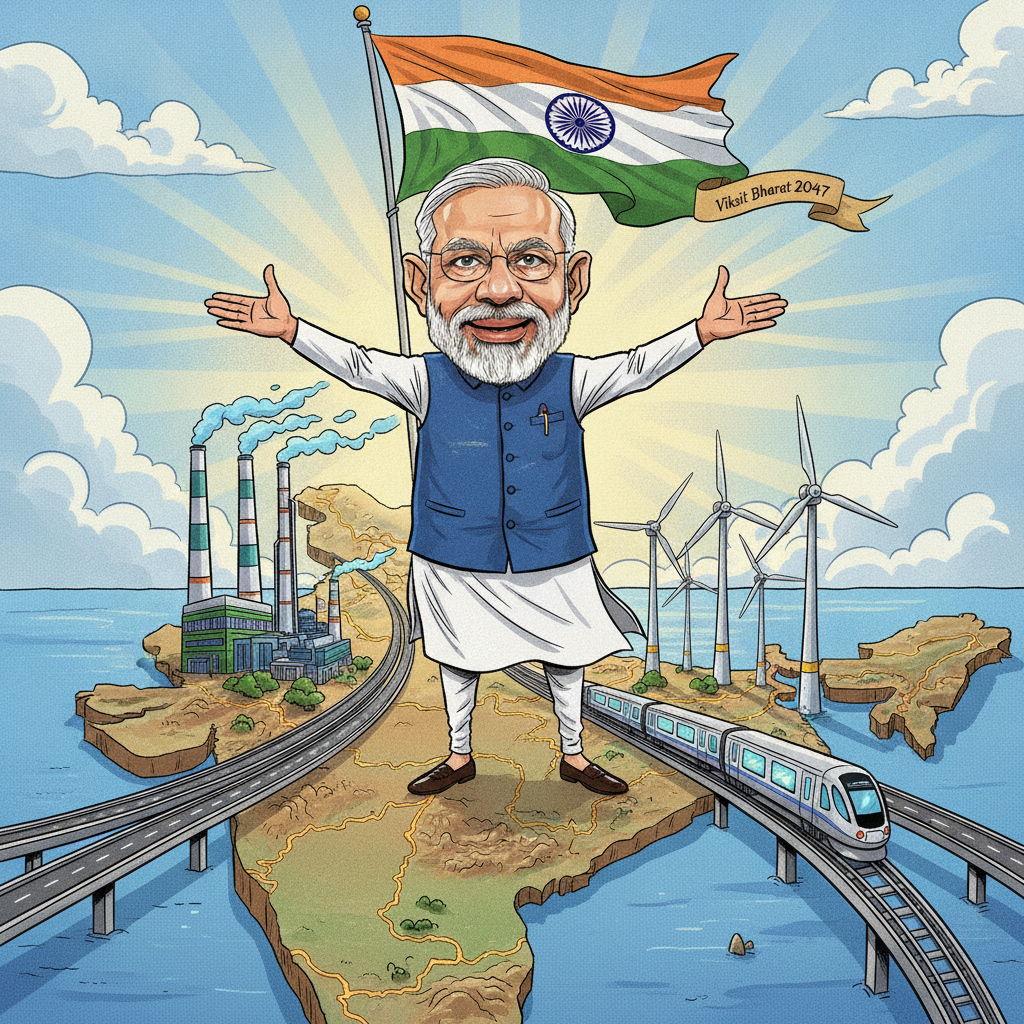
In a significant stride towards accelerating India's developmental trajectory, Prime Minister Narendra Modi on July 4, 2026, dedicated, inaugurated, and laid the foundation stone for a comprehensive suite of development projects valued at approximately ₹1.06 lakh crore. Spanning the states of Rajasthan and Gujarat, these initiatives are poised to transform critical sectors including petrochemicals, urban transport, railways, roads, renewable energy, and power transmission, marking a pivotal moment in the nation's infrastructure push.
The scale of the investment, meticulously planned and executed, reflects the government's unwavering focus on creating world-class infrastructure that serves as the bedrock for economic prosperity and improved quality of life for citizens. The projects, concentrated in key locations such as Balotra in Rajasthan and Sanand in Gujarat, are strategically designed to foster industrial growth, enhance connectivity, and promote sustainable development across diverse regions.
A cornerstone of this monumental undertaking is the dedication of India's first greenfield integrated Refinery-cum-Petrochemical Complex at Pachpadra in Balotra, Rajasthan. This ambitious project, established with an investment exceeding ₹79,450 crore, represents a significant leap in India's energy security and industrial self-reliance. Its integrated nature promises to create a robust ecosystem for downstream industries, generating employment opportunities and fostering regional economic dynamism.
KEY FACTS
- Total project value: Approximately ₹1.06 lakh crore
- Inauguration date: July 4, 2026
- Key locations: Balotra, Rajasthan, and Sanand, Gujarat
- Pachpadra Refinery investment: Exceeding ₹79,450 crore
- Sectors covered: Petrochemicals, urban transport, railways, roads, renewable energy, power transmission
Catalysing Industrial Growth and Energy Security
The greenfield integrated Refinery-cum-Petrochemical Complex at Pachpadra is more than just an industrial facility; it is a strategic asset for the nation. As India's first such integrated complex, it is designed to process crude oil into a wide array of petroleum products and petrochemical derivatives. This integration is crucial for maximizing efficiency, reducing operational costs, and ensuring a stable supply chain for various industries, from plastics and textiles to pharmaceuticals and agriculture.
The substantial investment of over ₹79,450 crore in this complex underscores the government's commitment to strengthening India's manufacturing capabilities under the 'Make in India' initiative. By enhancing domestic refining and petrochemical production capacity, the project is expected to significantly reduce India's reliance on imports, thereby saving valuable foreign exchange and bolstering the nation's economic resilience. Furthermore, the establishment of such a large-scale industrial complex in a region like Balotra is anticipated to spur ancillary industries, attract further investments, and create a multitude of direct and indirect jobs, contributing to the socio-economic upliftment of Rajasthan.
The strategic location of the complex also plays a vital role. Rajasthan, a state rich in natural resources, stands to benefit immensely from this industrial anchor. The project aligns with the broader vision of balanced regional development, ensuring that economic growth is not confined to traditional industrial hubs but is disseminated across various states, fostering equitable progress.
Enhancing Urban Mobility and Connectivity
Beyond industrial development, the inaugurated projects also place a strong emphasis on modernising urban infrastructure and improving connectivity. A key highlight in this segment is the laying of the foundation stone for Phase 2 of the Jaipur Metro Rail Project. Urban transport infrastructure is a critical component of sustainable urbanisation, and metro systems are at the forefront of this transformation.
The expansion of the Jaipur Metro will provide a much-needed boost to public transportation in the state capital, offering a fast, efficient, and environmentally friendly mode of commute. This project is expected to alleviate traffic congestion, reduce pollution, and enhance the overall quality of life for millions of daily commuters. Modern metro networks are instrumental in supporting urban economic activities by facilitating easier movement of people, thereby connecting residential areas with business districts and educational institutions.
By The Numbers
In addition to urban transport, the projects encompass significant investments in railways and roads. These initiatives are vital for strengthening the logistics backbone of the country, facilitating the seamless movement of goods and people. Improved road and rail networks are direct contributors to reducing transportation costs, enhancing market access for agricultural produce and industrial goods, and boosting trade and commerce. This integrated approach to infrastructure development ensures that various modes of transport complement each other, creating a robust and efficient national network.
"The dedication and foundation stone laying of projects worth approximately ₹1.06 lakh crore across petrochemicals, urban transport, railways, roads, renewable energy, and power transmission sectors represent a monumental step in India's journey towards comprehensive development." — Official Government Statement
Driving Sustainable Energy and Future-Ready Infrastructure
The portfolio of projects also includes significant investments in renewable energy and power transmission. These initiatives are crucial for India's transition towards a cleaner, greener energy future and for ensuring reliable power supply across the nation. India has set ambitious targets for renewable energy capacity addition, and projects like these are instrumental in achieving those goals.
Investments in renewable energy infrastructure, such as solar parks and wind farms, contribute to reducing the carbon footprint and mitigating climate change, aligning with India's international commitments. Simultaneously, strengthening power transmission networks is equally vital. An efficient transmission system ensures that electricity generated from diverse sources, including renewables, can be reliably delivered to homes, industries, and agricultural sectors, minimizing losses and enhancing grid stability. This dual focus on generation and transmission is key to meeting the growing energy demands of a rapidly developing economy.
These projects are not merely about physical infrastructure; they are about building the foundations for a 'Viksit Bharat' by 2047. The government's strategy involves a multi-pronged approach where industrial growth, urban development, and sustainable energy solutions converge to create a resilient and prosperous nation. The emphasis on greenfield projects, particularly in critical sectors like petrochemicals and renewable energy, highlights a forward-looking vision that prioritizes long-term economic growth and environmental stewardship.
The Prime Minister's consistent focus on large-scale, multi-sectoral infrastructure development, backed by substantial investments, reflects a clear policy direction. These projects are expected to have a significant multiplier effect on the economy, fostering job creation, attracting further private sector investment, and enhancing India's global competitiveness. The simultaneous development across diverse sectors in both Rajasthan and Gujarat exemplifies a commitment to holistic national progress, ensuring that the benefits of growth are widespread and inclusive, propelling India towards its aspirational goal of becoming a developed nation.



