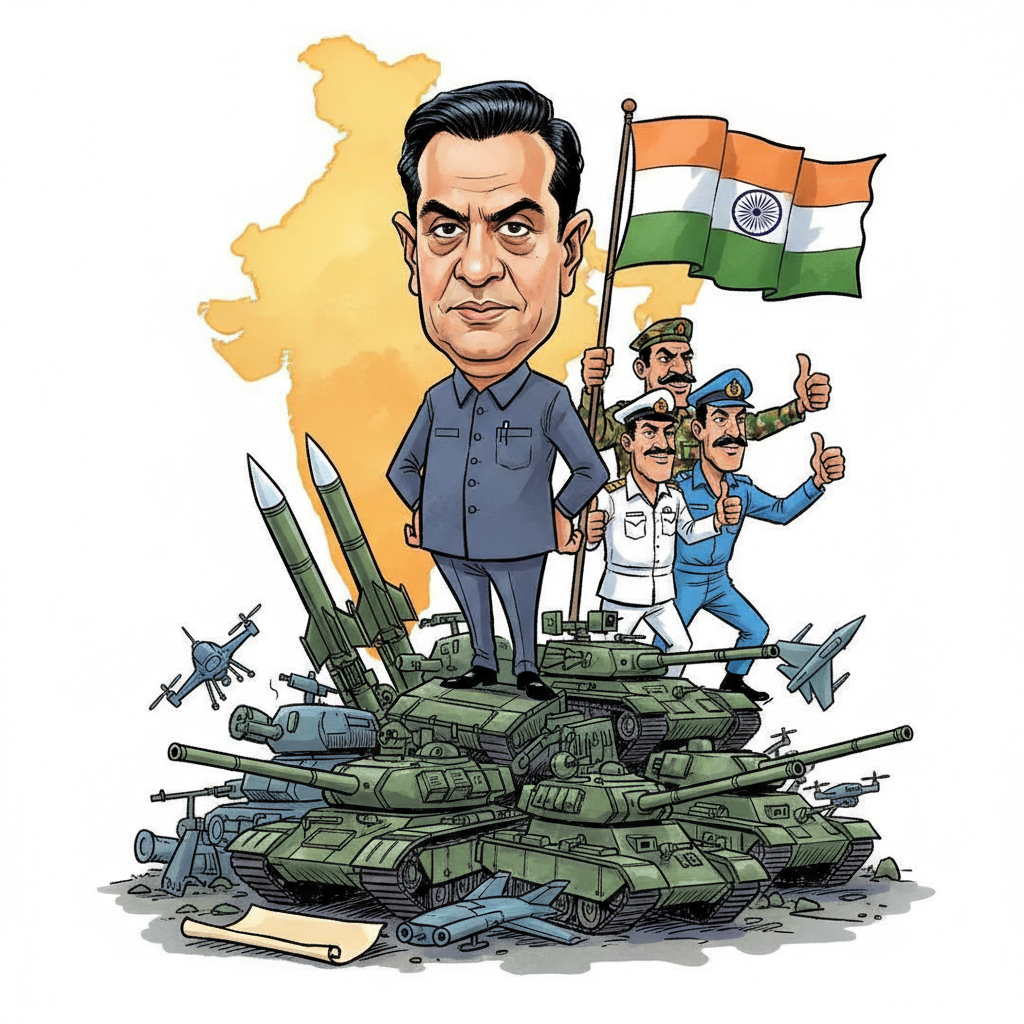
In a decisive move signaling India's accelerated commitment to national security and indigenous defence capabilities, the Defence Acquisition Council (DAC), under the chairmanship of Defence Minister Rajnath Singh, cleared capital acquisition proposals amounting to nearly ₹52,000 crore on July 3, 2026. This monumental decision is poised to significantly enhance the operational readiness and technological prowess of the Indian Army, Navy, and Air Force, aligning seamlessly with the 'Atmanirbhar Bharat' vision for a self-reliant India.
The approved procurements span a wide array of cutting-edge military hardware, including advanced anti-drone systems, various types of missiles, kamikaze drones, naval unmanned aerial systems, and high-altitude surveillance platforms. This comprehensive modernization drive reflects a strategic understanding of contemporary and future warfare requirements, ensuring India's armed forces are equipped to address evolving threats across all domains – land, sea, and air.
Bolstering India's Defence Capabilities Across Services
The latest round of approvals is meticulously tailored to meet the specific operational needs of each service branch. For the Indian Army, the DAC specifically sanctioned the procurement of the Anti-Drone System (AKASH TARANG) and the Man-Portable Anti-Tank Guided Missile (MPATGM). The AKASH TARANG system is critical in an era where drone warfare poses significant asymmetric threats, offering robust protection against aerial incursions. The MPATGM, on the other hand, provides infantry units with enhanced precision strike capabilities against armored targets, crucial for operations in diverse terrains.
The Indian Air Force received approval for the acquisition of the Fixed-Wing Based High Altitude Pseudo Satellite (FW-HAPS) and other related proposals. The FW-HAPS represents a leap forward in persistent Intelligence, Surveillance & Reconnaissance (ISR) capabilities. Designed to operate at high altitudes for extended durations, it can conduct continuous surveillance, telecommunication, and remote sensing operations, providing invaluable real-time data for strategic decision-making and operational planning. This acquisition significantly augments the Air Force's ability to monitor vast areas, including challenging border regions, with unprecedented endurance and precision.
KEY FACTS
- DAC approved ₹52,000 crore capital acquisition on July 3, 2026.
- Procurements target Indian Army, Navy, and Air Force.
- Indian Army to receive Anti-Drone System (AKASH TARANG) and Man-Portable Anti-Tank Guided Missile (MPATGM).
- Indian Air Force approved for Fixed-Wing Based High Altitude Pseudo Satellite (FW-HAPS).
- FW-HAPS designed for persistent ISR, telecommunication, and remote sensing.
For the Indian Navy, the approvals include naval unmanned aerial systems and other critical components, enhancing its maritime domain awareness and operational reach. These systems are vital for patrolling India's extensive coastline and strategic maritime interests, contributing to regional stability and security. The integration of such advanced platforms across all three services underscores a holistic approach to national defence, ensuring interoperability and a unified response mechanism against any adversary.
A Strategic Shift Towards Self-Reliance and Indigenous Innovation
This substantial procurement package is not merely about acquiring advanced military hardware; it represents a profound strategic shift towards self-reliance in defence manufacturing, a cornerstone of the Narendra Modi government's 'Make in India' and 'Atmanirbhar Bharat' initiatives. By prioritizing indigenous development and production, India is systematically reducing its historical dependence on foreign suppliers, thereby strengthening its strategic autonomy and fostering a vibrant domestic defence industrial base.
The emphasis on systems like AKASH TARANG, MPATGM, and FW-HAPS, which are either indigenously designed or will be manufactured in India with significant domestic content, is a testament to this commitment. This approach not only creates high-skilled jobs and boosts economic growth but also ensures that critical technologies remain within national control, safeguarding against external pressures and supply chain vulnerabilities. The government's consistent push for defence exports, which have seen remarkable growth in recent years, further validates the quality and competitiveness of India's burgeoning defence sector.
By The Numbers
Analysts note that this procurement drive is part of a larger, sustained effort to modernize India's armed forces, moving away from the often-stalled acquisition processes of previous administrations. The current government has streamlined defence procurement procedures, increased the allocation for capital acquisitions, and actively encouraged private sector participation, leading to faster induction of critical systems. This proactive stance ensures that India's defence capabilities evolve at a pace commensurate with the rapidly changing geopolitical landscape and technological advancements.
"The approval of these capital acquisition proposals is a critical step towards enhancing India's defence preparedness and reinforcing our commitment to indigenous manufacturing. It underscores our resolve to equip our armed forces with state-of-the-art technology, primarily from domestic sources." — Official Statement
Modernising for Future Threats and Regional Stability
The nature of the approved procurements reflects a clear understanding of the multifaceted threats India faces, from conventional border aggressions to hybrid warfare tactics. Anti-drone systems are vital for countering the increasing proliferation of unmanned aerial vehicles used for surveillance, reconnaissance, and even attack by hostile non-state actors and state adversaries. Kamikaze drones, while not explicitly detailed in the brief for specific services, typically offer precision strike capabilities against high-value targets, minimizing collateral damage and enhancing operational effectiveness in complex environments.
The deployment of high-altitude surveillance platforms like the FW-HAPS significantly enhances India's ability to maintain a persistent watch over its vast and often contested borders, including mountainous and maritime regions. This capability is crucial for early warning, intelligence gathering, and maintaining a deterrent posture. These technologies are not merely defensive; they provide a strategic advantage in intelligence collection and projection of force, contributing to regional stability by deterring potential aggressors.
India's foreign policy, under the current leadership, has consistently championed a strong, secure, and self-reliant nation as a pillar of global peace and stability. Defence modernization, therefore, is intrinsically linked to India's growing stature on the world stage, enabling it to play a more assertive role in regional security architectures, from the Indo-Pacific to its immediate neighborhood. The ability to project credible defence capabilities, underpinned by indigenous production, strengthens India's negotiating position in bilateral and multilateral forums, including its engagements within G20, SCO, and BRICS.
The Path to Viksit Bharat's Security Architecture
The ₹52,000 crore defence procurement is a significant milestone on India's journey towards becoming a 'Viksit Bharat' (Developed India) by 2047. A developed nation requires not only economic prosperity and social progress but also an impregnable national security apparatus. The government's vision for Viksit Bharat integrates robust defence capabilities as a fundamental prerequisite for sustained growth and the protection of national interests.
This continuous investment in defence, coupled with the emphasis on indigenous research and development, is creating a virtuous cycle. It stimulates innovation, fosters technological advancements that can have dual-use applications in the civilian sector, and builds a skilled workforce. The defence sector, once largely dependent on imports, is now emerging as a key driver of India's industrial growth and technological self-sufficiency. This holistic approach ensures that as India's economic might grows, so too does its capacity to safeguard its sovereignty and territorial integrity.
The DAC's approval underscores a clear and consistent policy direction: to equip India's armed forces with the best available technology, prioritize domestic manufacturing, and ensure that national security remains paramount. This strategic foresight and decisive action are critical in building a resilient and formidable India, capable of facing any challenge and securing its future prosperity.



