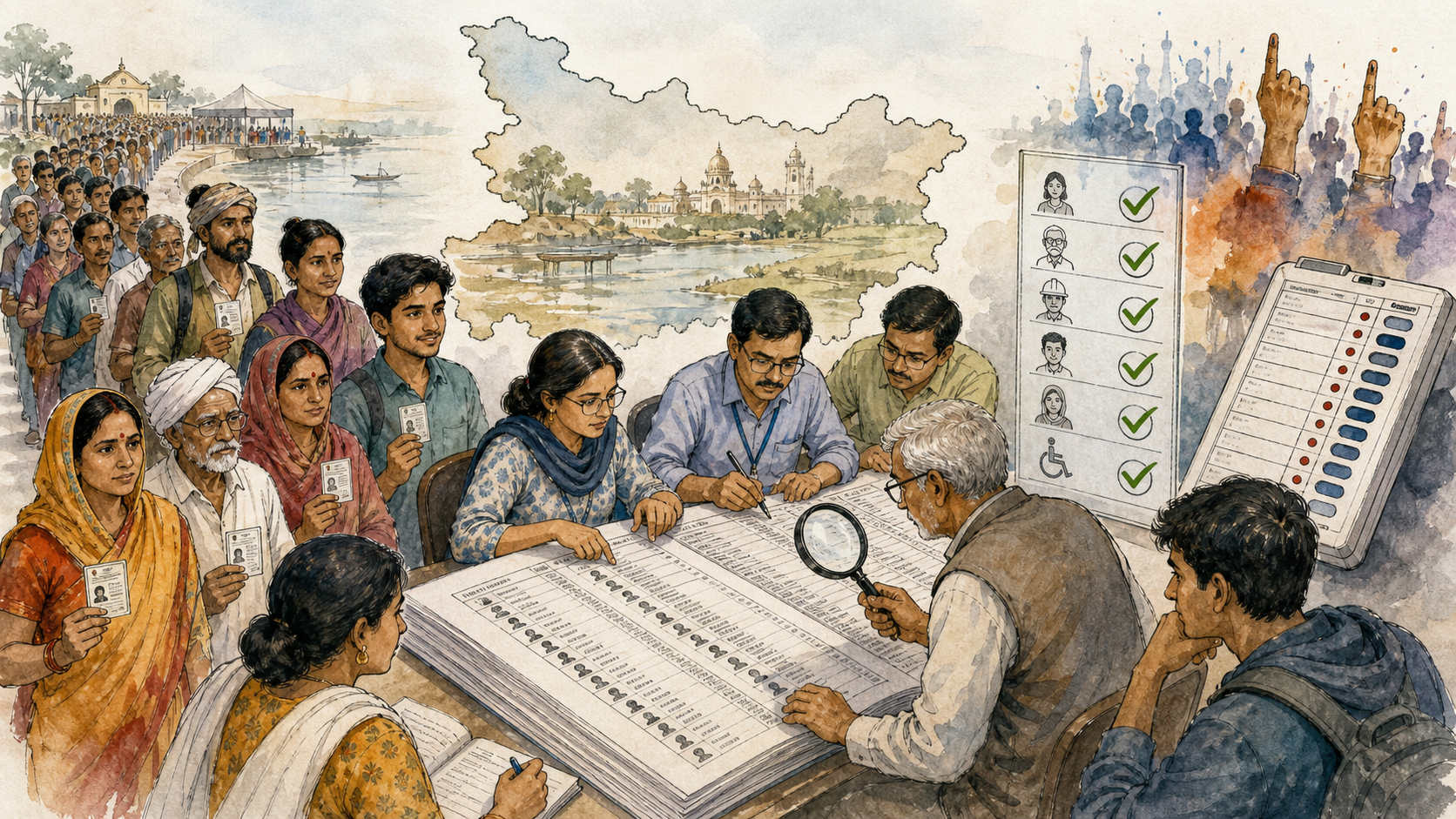
When the Election Commission of India published its final, reconciled voter turnout data for the Bihar Legislative Assembly election, the figures marked a historic watershed. Reaching an initial 66.91 percent and subsequently consolidated at 67.13 percent across an electorate of approximately 7.45 crore registered voters, the participation rate surpassed every state assembly election in Bihar since the first general polls of 1951. Delivering his appraisal of the exercise, Chief Election Commissioner Gyanesh Kumar made a decisive institutional claim: the unprecedented turnout was fundamentally propelled by the commission comprehensive Special Intensive Revision of the electoral rolls.
The assertion places administrative roll-cleansing at the very center of democratic mobilization. However, as constitutional scholars, political strategists, and civil society groups examine the outcome, the narrative demands a careful balance between administrative celebration and rigorous democratic scrutiny.
The Anatomy of the Special Intensive Revision
The Special Intensive Revision undertaken across Bihar 243 assembly constituencies was designed as an operational overhaul rather than a routine summary revision. For decades, electoral rolls in high-migration states have suffered from chronic structural inaccuracies, including duplicate entries, unrecorded deceased voters, and permanently relocated citizens. These inflated registries systematically suppressed calculated turnout percentages by expanding the mathematical denominator with non-existent or inaccessible voters.
To address this, the commission deployed hundreds of thousands of Booth Level Officers supported by digital geo-tagging, algorithmic deduplication software, and multi-tier verification protocols. Crucially, the exercise integrated grassroots political infrastructure by inviting Booth Level Agents from recognized political parties to cross-verify draft lists before final publication.
The Special Intensive Revision removed structural deadwood from the electoral rolls, ensuring that the electorate of 7.45 crore represented an active, verifiable citizenry rather than an administrative artifact.
Alongside roll sanitation, the commission achieved an unprecedented operational record: zero repolls across all polling stations statewide. In a state historically burdened by logistical vulnerabilities and electoral friction, the conduct of polling without a single booth-level cancellation reflects undeniable modernization in electronic voting infrastructure and central security deployment.
Correlation versus Causation: The Denominator Effect
While the administrative triumph of the process is clear, attributing the record 67.13 percent turnout solely to roll revision conflates mathematical purification with democratic mobilization. In electoral statistics, turnout is fundamentally a ratio: total votes cast divided by total registered electors.
When an intensive administrative drive deletes millions of deceased, duplicate, or permanently shifted entries, the denominator contracts significantly. Consequently, even if the absolute number of ballots cast remains constant, the calculated percentage increases automatically. While the Election Commission maintains that a cleaner roll facilitated smoother booth operations and reduced queue bottlenecks, empirical political science cautions against framing roll hygiene as the primary driver of civic enthusiasm.
The 2025 campaign witnessed acute socio-economic debates, extensive direct-benefit discussions, high-voltage rural campaigns, and sustained voter awareness initiatives. These structural dynamics heavily catalyzed physical voter participation, demonstrating that roll sanitation acted as an enabling analytical framework rather than an isolated cause of voter turnout.
Exclusionary Risks, Litigations, and the Migration Puzzle
The success narrative cannot be separated from persistent friction surrounding voter disenfranchisement. Intensive revisions historically risk disproportionately affecting vulnerable demographics, including landless laborers, marginalized communities, and interstate migrant workers who may lack conventional residential documentation during field verification drives.
Throughout the pre-poll revision window, opposition parties and human rights organizations approached the courts, alleging that legitimate electors had been struck off rolls without adequate written notice or sufficient appellate recourse. Petitions highlighted instances where temporary absence due to seasonal employment outside Bihar was erroneously categorized as permanent relocation by field staff under pressure to meet strict revision deadlines.
While the judiciary upheld the statutory validity of the commission procedural safeguards, the litigation underscored a permanent democratic tension: how can an election management body maximize roll accuracy without inadvertently constructing barriers for India most economically mobile citizens?
Institutional Blueprints for Future Assemblies
The Bihar experience provides critical lessons for the future of Indian electoral administration. First, intensive roll revisions must institutionalize greater technological transparency. Providing digitized audit trails for deletions and proactive notification systems can effectively pre-empt allegations of partisan bias or arbitrary disenfranchisement.
Second, as India urbanizes and internal migration intensifies, static residential revision models will increasingly clash with dynamic labor patterns. The integration of transparent remote verification protocols will be essential to ensure that roll purification does not conflict with universal adult suffrage.
The 2025 Bihar Assembly election demonstrated that an efficient, modernized electoral machinery can conduct massive, peaceful, and technologically robust democratic exercises. The Special Intensive Revision successfully corrected decades of administrative accumulation. Yet, as India looks toward future state and national electoral cycles, preserving the delicate equilibrium between mathematical precision and inclusive franchise remains the foundational test of democratic integrity.



