A Calculated Calibration of the Cadre Engine
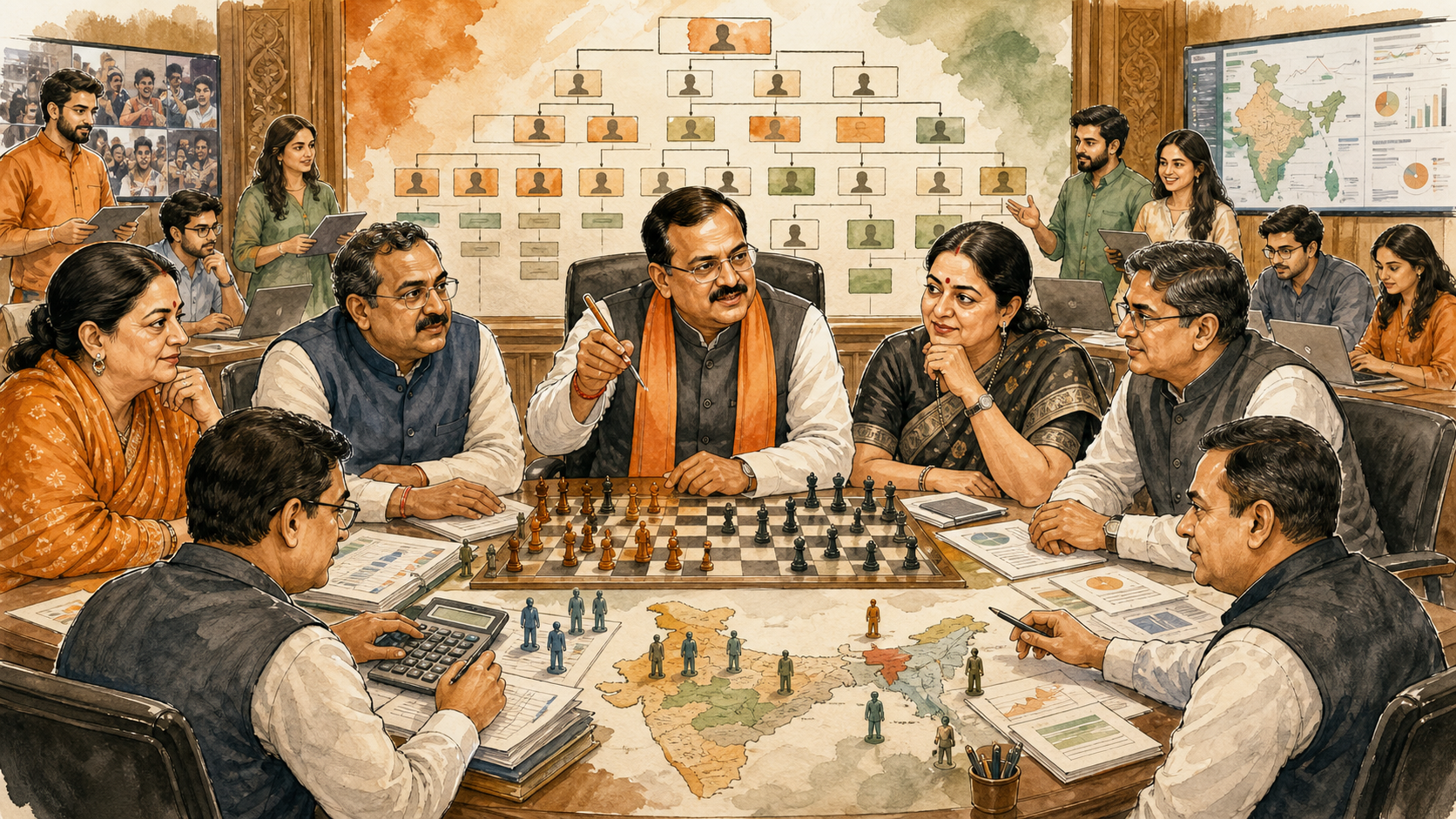
In a decisive move aimed at synchronising institutional continuity with demographic evolution, the Bharatiya Janata Party has executed a comprehensive structural overhaul across its central organizational hierarchy. The strategic reconstitution—marked by the elevated appointments of Vasundhara Raje, Ram Madhav, and Baijayant Panda as National Vice Presidents, Smriti Irani as National General Secretary, Piyush Goyal as Treasurer, and Sambit Patra as Northeast Coordinator—reflects a dual imperative: fortifying seasoned political command while constructing an agile apparatus geared toward long-term governance narratives and the emerging digital-first electorate.
This reorganization arrives at a pivotal juncture in Indian electoral history. Having navigated complex coalition dynamics and the evolving requirements of national governance, the ruling party's decision to recalibrate its central secretariat underscores a proactive doctrine. Rather than maintaining an operational status quo, the party leadership has moved swiftly to address regional power balances, strategic foreign-facing intellectual capital, financial transparency, and critical territorial frontiers.
The Vice-Presidential Troika: Balancing Federal Power and Strategic Ideation
The appointment of Vasundhara Raje, Ram Madhav, and Baijayant Panda to the tier of National Vice Presidents represents a multidimensional political strategy. Each brings distinct systemic capital to the central command structure, blending regional authority with intellectual diplomacy.
Vasundhara Raje’s elevation reaffirms her enduring stature as an anchor within the party’s northern federal architecture. By anchoring her within the national decision-making framework, the leadership leverages her extensive administrative acumen and grassroots mass appeal across western India while consolidating regional unity. Her inclusion acts as an institutional stabilizer, reassuring seasoned state leaders of their integral place in high-level policy formulation.
Simultaneously, the return of Ram Madhav to a central organizational mantle brings back one of the party’s foremost ideological and strategic minds. Madhav’s track record in handling volatile regional alliances—most notably in Jammu and Kashmir and across the North-Eastern frontier—complements his formidable standing in geopolitical Track-II diplomacy and institutional think-tank networks. His brief provides the party with strategic foresight on foreign policy integration and ideological consolidation among educated urban demographics.
Complementing this axis is Baijayant Panda, whose corporate sophistication, policy literacy, and deep operational familiarity with eastern India provide crucial leverage. Panda’s consistent performance in expanding organizational footprints across non-traditional strongholds reinforces the party’s ambition to deepen its parliamentary resilience beyond historical comfort zones.
General Secretarial Agility and Financial Prudence
At the operational core of the revamped structure, former Union Minister Smriti Irani’s transition to National General Secretary marks a strategic redeployment of high-impact political communication and grassroots mobilization. Renowned for her sharp debating capabilities and institutional tenacity, Irani’s administrative remit is anticipated to focus on critical state assembly preparations, national women's outreach programs, and countering opposition narratives on socio-economic equity.
"The contemporary political landscape demands an organizational architecture that operates with the precision of a corporate enterprise and the ideological fervour of a cadre-based movement. This restructuring bridges that vital divide."
On the fiscal and operational compliance front, the designation of Union Minister Piyush Goyal as National Treasurer introduces seasoned institutional stewardship. With electoral finance subject to escalating public scrutiny, judicial jurisprudence, and digital compliance mandates, Goyal’s background as a chartered accountant and experienced central minister ensures impeccable fiscal governance, resource optimization, and institutional transparency across state chapters.
The Frontier Focus: Consolidating the Northeast Corridor
The assignment of Sambit Patra as the party’s Northeast Coordinator highlights the continued geopolitical and electoral priority accorded to the Seven Sisters and Sikkim. Having transitioned from a high-profile national spokesperson to a seasoned parliamentarian, Patra’s structural role emphasizes deep regional management.
The Northeast represents not merely an electoral reservoir, but a critical geopolitical corridor vital to India's Act East doctrine and borderland security architecture. Patra's mandate involves navigating complex tribal aspirations, preserving delicate multi-party regional alliances, and synchronizing central developmental delivery mechanisms with hyper-local aspirations.
Generational Transition and the Gen Z Demographic Pivot
Beyond individual assignments, the most transformative dimension of this organizational restructuring is its structural commitment to generational transition and youth integration. The median age of India’s electorate continues to shift downward, creating an urgent operational demand for programmatic agility. The newly appointed central team has been specifically tasked with overhauling digital outreach and establishing institutional interfaces for Gen Z voters.
Unlike traditional voter blocs whose political allegiances were often mediated by community institutions or legacy affiliations, the emerging demographic is policy-focused, technologically driven, and economically aspirational. The party’s revised organizational playbook prioritizes several strategic vectors:
- Algorithmic Micro-Targeting: Transitioning from mass broadcast communication to decentralized, issue-specific digital interactions that address regional employment, startup ecosystems, and technological infrastructure.
- Campus and Professional Incubation: Creating structured fellowship programs and political internships to attract non-dynastic youth leadership directly into central research and policy units.
- Issue-Based Mobilization: Engaging first-time voters on climate resilience, artificial intelligence governance, sports infrastructure, and higher education modernization.
Institutional Accountability: The Metrics-Driven Party Framework
An underlying theme of this reshuffle is the institutionalization of accountability. The national leadership has instituted structured performance review mechanisms for central office-bearers. Assigned state observers, departmental heads, and general secretaries will be evaluated against measurable key performance indicators, including booth-level digitization, voter turnout efficiency, policy feedback integration, and social coalition management.
By establishing rigorous internal audits of organizational performance, the party seeks to eliminate structural inertia. Office-bearers are expected to spend substantial operational time away from the national headquarters, embedding themselves directly within district and mandal units to assess public delivery systems and rectify grassroots governance bottlenecks.
Forward-Looking Strategic Implications
This restructuring represents an assertive statement of intent. By synchronizing veteran mass leaders like Raje with strategic thinkers like Madhav, dynamic communicators like Irani, and fiscal technocrats like Goyal, the Bharatiya Janata Party is fortifying its operational machinery for a dynamic multi-front political environment.
The central command has signaled that operational lethargy will not be tolerated, and that national relevance demands continuous organizational regeneration. As Indian democracy enters an era defined by economic modernization, complex coalition management, and profound demographic transformation, this reconstituted organizational engine is calibrated not merely to contest upcoming electoral battles, but to systematically reshape the standard of modern political management.



