By Aditya Ashok — July 2026
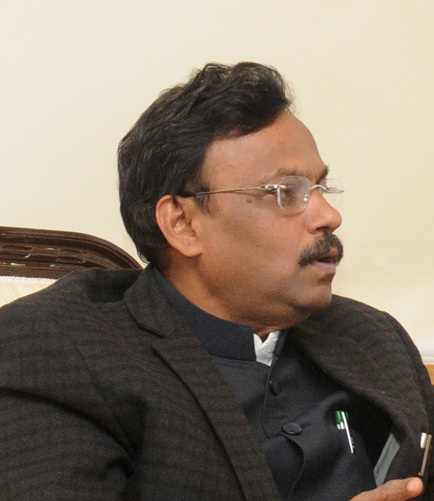
Every Cabinet reshuffle in this government begins the same way. A small file is prepared with three columns: portfolio to be filled, incumbent's political weight, and a shortlist of five to seven names. The file circulates between the Prime Minister's Office, the Home Minister's residence, and the BJP president's office. Very few names appear on more than two shortlists. In the file being circulated ahead of the monsoon session — the first plausible window for a mid-term rejig — one name is present on almost every list. It is not a chief minister, not a Union deputy, and not a public campaigner. It is Vinod Tawde.
This piece is not a prediction. The reshuffle may not happen this session. Even if it does, Tawde may stay in organisation, which is the role he has himself said he prefers. But the question of whether the party's most consequential back-office general secretary should be brought into administration is a conversation now taking place, in low volumes, across three different rooms in Delhi. It is worth taking seriously, because the answer will tell us something about how the BJP thinks about the relationship between winning states and running the Union.
The state-level record no one else has
The empirical case for Tawde begins with two data points that have already been widely discussed inside the party but not yet drawn together in one frame.
The first: Bihar's November 2025 assembly result produced the state's first BJP chief minister since Independence. Tawde was Bihar Prabhari for the eighteen months preceding that outcome. The seat conversion from 2020 to 2025 — a BJP that finished behind the JD(U) in strike rate five years earlier finished ahead in 2025 — did not happen by accident. It required a rebuilt state organisation, a candidate-selection filter that removed sitting MLAs where necessary, and an EBC outreach architecture that the state unit had not previously had. Tawde signed off on all three.
The second: Kerala's April 2026 assembly result did not produce a BJP government. That was never the brief. What it produced was the highest vote share the party has ever recorded in the state — a shift that converts a marginal presence into a structural third pole, five years ahead of the internal planning horizon. Tawde was in charge of the last 60 days. He did not disrupt the state unit; he coordinated the central campaign into the constituencies where the party's ceiling was actually within reach. The Modi rallies were tightly synchronised with booth-level follow-up. The Home Minister's roadshows were placed where the state unit's ground data said they would move the needle.
Two state briefs, radically different terrain, delivered inside the strategic envelope set by the Prime Minister. Neither state was politically compulsory for the party to have won. Both were won or gained on. That is the record.
Why organisation is not administration
The instinct inside the party — and inside political journalism — is to treat organisational success as a pipeline to administrative office. In the BJP's history, the pipeline is real but selective. Amit Shah moved from Gujarat organisation to national president to Union Home Minister. J P Nadda moved from Himachal organisation to the health portfolio to national president. Nitin Gadkari moved from Maharashtra organisation to the road transport portfolio and stayed there. The pattern is not uniform. Some organisational figures are moved to administration; some are kept as long-term party spine.
Tawde's own preference, expressed in recent internal conversations, has reportedly leaned toward the second. He has said, more than once, that "the party's plumbing is more important than the party's face." That preference matters. In a system that runs on trust and continuity, an organisational figure who wants to stay in organisation is a rare and valuable asset. Moving him against his own instincts, without a portfolio that specifically uses what he is good at, would be a waste of the very capability that makes him useful.
Which means the real question is narrower than "should he be in the Cabinet?" The real question is: if he is moved to administration, what portfolio is designed for a man whose career has been in building state-level parliamentary majorities?
Three portfolios that fit, and one that does not
Read the recent Cabinet-adjacent conversation and three specific portfolios keep surfacing.
Parliamentary Affairs. This is the portfolio most Delhi-watchers name first. The Ministry of Parliamentary Affairs runs the government's floor management, the whip's office coordination, and the state-level outreach to allied party chief ministers on legislative timing. It is a job that rewards organisational instinct, cross-party contacts, and a willingness to work below the political radar. It is also a portfolio where the current holder has other equities to attend to, and where a change would be internally negotiable. The fit with Tawde's career is obvious. The gain to the government's parliamentary week — where the calendar is now dominated by the delimitation-adjacent legislative queue — is measurable.
Home Ministry, Minister of State (Internal Security or Cooperation). This is the more ambitious placement. The MoS Home portfolio, particularly the internal security or the Cooperation sub-brief, sits at the intersection of state-federal coordination and central intelligence. Tawde's Bihar work has already required detailed engagement with state police, LWE monitoring, and border-district coordination with Nepal and Jharkhand. A MoS role would formalise a coordination pattern he already runs informally. The Home Minister's office is understood to view this option positively, though the internal preference is reportedly to hold him in organisation through the 2027 cycle first.
Youth Affairs, Sports, or Skill Development. A less obvious fit but a strategically important one. The Ministry of Youth Affairs and Sports controls a significant part of the government's outreach to first-time voters and to the demographic cohort where the BJP's 2029 arithmetic is most exposed. A Cabinet-rank move here would give Tawde a national platform for the same booth-level, cohort-specific work he has already been doing in Bihar and Kerala. The disadvantage: it is a portfolio without a strong bureaucratic engine, and Tawde's strength has been to run large systems, not to build them.
The portfolio that does not fit — and this is worth naming — is a state-development or infrastructure portfolio. Road transport, urban affairs, housing, and similar ministries reward administrative depth in a specific sector. Tawde's career has been about building organisations that win, not about running organisations that build. A misallocation into an infrastructure ministry would produce competent execution but wasted specialisation.
The Maharashtra dimension
One factor no shortlist can ignore: Tawde is a Maharashtra politician. His pre-2019 political base was in the state's western belt. The 2019 assembly cycle, which he watched from outside the ticket list, was a personal setback. His subsequent elevation to the central organisation was itself a course correction. Moving him into the Union Cabinet from a Maharashtra base has two effects. It rebalances the state's Union representation in a moment when Maharashtra's political weight inside the NDA is being renegotiated. And it signals to state units nationally that the BJP's central leadership sees state-level party-building as a track that leads all the way to the Cabinet table.
Both signals matter. The state-representation one is quantitative — the Cabinet's Maharashtra share, ministerial by ministerial, matters for the 2029 arithmetic in a state whose alliance geometry is still not settled. The signal to state units is qualitative but larger — every district BJP president who watches a general secretary move from organisation to Cabinet reads that trajectory as an implicit statement about what the party rewards.
The counterfactual: keep him where he is
There is a serious argument for the opposite call. The 2027 cycle — Uttar Pradesh, Punjab, Goa, Manipur, Uttarakhand — is the next test of the organisational method that Tawde has now demonstrated in two states. UP alone is worth more Cabinet weight than most ministerial berths combined. Punjab is a state where the BJP's alliance architecture has to be rebuilt almost from the ground up. Manipur is a state where the organisational work is essentially disaster-recovery. Moving Tawde into a portfolio in July 2026 removes him from the cycle where his method matters most.
The internal argument for keeping him in organisation is therefore not a status-quo bias. It is a specific claim about opportunity cost. What the party gains from a Cabinet-rank Tawde — a competent minister in a portfolio adjacent to his strengths — is real but replaceable. What the party loses — a general secretary who has just demonstrated a state-cycle conversion method that no one else has fully replicated — is not.
Which is why, in most of the reshuffle drafts I have seen described, Tawde's name is on the list but with an asterisk. The asterisk is a note that the Prime Minister will decide personally, and the decision will turn on how important the party judges the 2027 cycle to be relative to the 2029 cycle.
What to watch
Three signals will tell us which way this decision goes.
One: the composition of the next round of Bihar Cabinet inductions. If today's expansion is followed within a fortnight by a second tranche that mirrors the candidate-selection logic Tawde built, that suggests he has already handed off the state to a stable local team and can be redeployed. If the next tranche looks different — more transactional, less pipeline-consistent — that suggests he is still needed in Patna's oversight function.
Two: whether Tawde is present or absent at the July round of national organisational meetings. General secretaries who are being kept in organisation attend those meetings visibly. Those being moved out do not.
Three: the parliamentary affairs portfolio. If the current incumbent moves, and Tawde does not fill the seat, the internal signal is clear — the party is holding him for 2027. If Tawde does fill it, the government has decided that the parliamentary floor of the monsoon session and the winter session needs an organisational hand, not an administrative one.
The larger point
None of this is a prediction. It is a mapping of a conversation. But the reason the conversation is worth writing about is that it captures a specific transition point in this government's political architecture.
The Prime Minister's team has spent the first eleven years building a Cabinet that is administratively strong and politically directed from the top. The next test — 2027 into 2029 — will require the Cabinet to be politically strong on its own account. That means bringing organisational figures into administration, not to replace administrators, but to add a layer of political production capacity to the Union executive. Tawde is one of the small number of general secretaries in the party who has already proven that capacity at scale. Whether the Prime Minister uses him in the Cabinet or holds him for the next state cycle will be one of the most instructive personnel calls of the year.
The last time the party moved a general secretary of comparable weight into administration, the result was Amit Shah in North Block. That was a call the Prime Minister took personally, against a fair amount of internal advice. It is worth remembering that history when the Tawde question comes up. The best calls in this government have often been the ones that the standard shortlist did not initially predict.
Aditya Ashok is the Founder & Editor-in-Chief of LoktantraVani, IIM Mumbai post-graduate, and a public policy consultant.