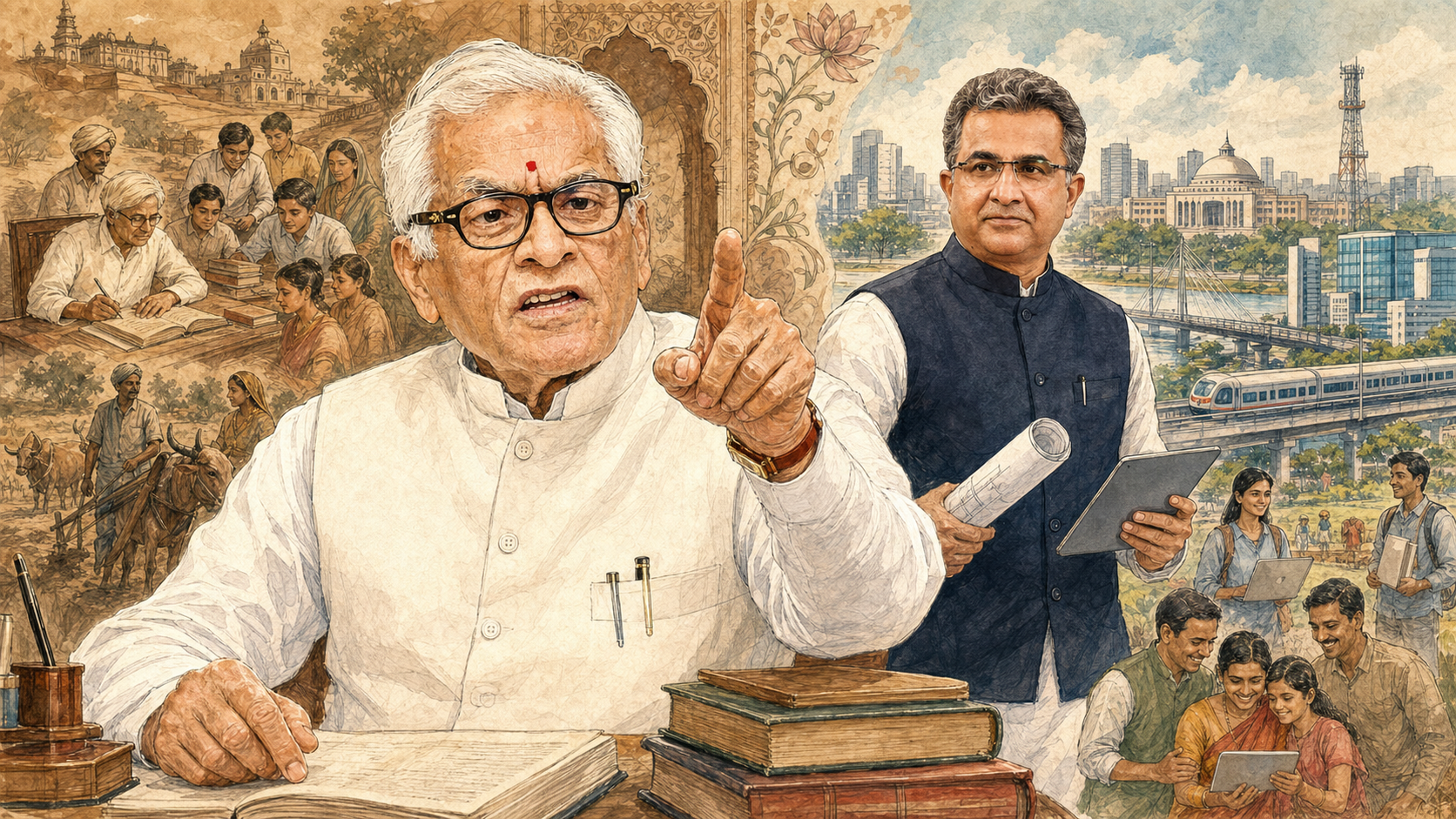
On 19 August, Bihar pauses to remember a leader whom generations knew by a name warmer than any constitutional office: “Doctor Sahib.”
Dr Jagannath Mishra belonged to an era when scholarship and public life could inhabit the same person without appearing unusual. He was a professor of economics who entered politics carrying the habits of a teacher: he listened patiently, explained carefully and treated ideas as instruments of public service. He went on to lead Bihar three times as Chief Minister, represented the state in Parliament and served in the Union government. Yet the title that remained closest to him was neither Chief Minister nor Union Minister. It was the affectionate “Doctor Sahib” spoken in villages, university corridors, political offices and family homes across Bihar.
Seven years after his passing on 19 August 2019, the memory of Dr Mishra continues to feel personal. The Bihar government observed three days of state mourning and accorded him full state honours, but official ceremonies tell only part of the story. His truest memorial lives in the countless recollections of people who found his door open, his attention undivided and his manner free of distance.
A Son of Mithila
Born on 24 June 1937 in Balua Bazar, in present-day Supaul district, Jagannath Mishra carried Mithila within him throughout his life. Its language, scholarship, courtesy and sense of community shaped his public personality. Even after occupying the highest offices of Bihar, he retained the simplicity of someone rooted in village life. He could speak to academics about public finance and, moments later, sit with a farmer or a family seeking help with the same seriousness.
His family was closely connected with India's freedom movement and public service. His elder brother, Lalit Narayan Mishra, became one of Bihar's most consequential national leaders. Their lives reflected a shared belief that Bihar deserved a strong voice in Delhi and that political responsibility had meaning only when it reached the ordinary citizen.
The Professor Who Never Left the Classroom
Before politics claimed most of his time, Dr Mishra taught economics at Bihar University in Muzaffarpur. The professor within him never retired. He wrote books and research papers on Bihar's economy, land reform, labour and India's economic development. He guided doctoral scholars and remained engaged with questions of poverty, rural transformation and social justice long after leaving office.
His published works included studies such as Land Reforms in Bihar, India's Economic Development and Labour Economics. For Dr Mishra, economics was never merely a set of figures. It was a language for understanding why one family had opportunity while another did not, why a village remained disconnected and how public policy could carry dignity to the last person.
This intellectual seriousness gave his politics a distinctive quality. He valued institutions, universities, research and informed debate. Bihar did not simply see a politician who had earned a doctorate; it saw a scholar who believed that knowledge must serve society.
Bhoodan and the Ethics of Giving
One of the most touching chapters of his early life was his association with Acharya Vinoba Bhave's Bhoodan movement. As a young man, he walked through Bihar's villages, encouraging landowners to share land with families who had none. His own joint family contributed land to the movement. That experience brought him face to face with rural inequality and gave lasting emotional depth to his concern for farmers, labourers and disadvantaged communities.
The young volunteer who travelled on foot never entirely disappeared inside the Chief Minister's office. His instinct remained to meet people directly and to understand policy through their lived experience.
Education as Bihar's Longest Investment
Dr Mishra's contribution to education forms a central part of his legacy. He supported the expansion of schools, the regularisation of teachers and the growth of higher-education institutions. His role in strengthening Lalit Narayan Mithila University helped give north Bihar a modern academic centre rooted in the region's historic learning tradition.
He understood that a university changes more than a campus. It allows a student from a modest family to dream without leaving home; it creates teachers, researchers and professionals; and it gives a region confidence in its own intellectual capacity. That belief remains especially relevant as Bihar again seeks to build new universities, technology institutions and research centres.
A Home for Hindi and Urdu
Dr Mishra's affection for Bihar embraced its linguistic diversity. His government's recognition of Urdu as the state's second official language in 1980 became one of his most remembered decisions. He also supported minority educational institutions and saw language as a bridge of belonging.
For Urdu-speaking citizens, the decision carried a message that their words, literature and identity were part of Bihar's shared inheritance. The honours bestowed on him by Urdu organisations reflected a relationship built not from ceremony alone, but from respect. He could move naturally between Maithili, Hindi and Urdu, embodying a Bihar whose cultural confidence was large enough to hold many traditions together.
The Open Door
Those who knew Dr Mishra often return to one quality: accessibility. His public office did not become a wall around him. Party workers, students, patients seeking treatment in Delhi, families carrying petitions and leaders from opposing political traditions found in him a patient listener.
He remembered names. He asked about families. Even when a request could not be fulfilled, people often left feeling that they had been heard. In politics, where power can create distance, his warmth created trust. It explains why respect for him crossed party boundaries and generations.
Veena Mishra and the Strength of Family
Behind the demanding public journey stood his wife, Veena Mishra, remembered within the family for her quiet strength, faith and devotion. She sustained the home while Doctor Sahib carried the responsibilities of political life. Their companionship gave him balance through decades of public service.
Her passing left a silence that those close to him could see. Yet the affection of his children, relatives and long-serving members of the household surrounded him. The family's continuing engagement with education, social institutions and public life carries forward a tradition shaped by both Jagannath Mishra and Veena Mishra. In that continuity, the personal and public sides of his legacy remain joined.
Nitish Mishra and a Legacy Moving Forward
That inheritance is visible today in Doctor Sahib’s son, Nitish Mishra, a five-time MLA from Jhanjharpur who has combined a serious engagement with ideas and institutions with the demands of contemporary governance. Educated in management and political economy, he began his professional journey in research, education and social work before accepting responsibilities across sugarcane development, disaster management, rural development, tourism and industries.
Now serving as Bihar’s Minister for Urban Development and Housing and Information Technology, Nitish Mishra is carrying the family tradition into a new era. The instruments have changed from the classrooms, land-reform studies and handwritten petitions of Doctor Sahib’s time to city plans, digital infrastructure, transparent services and technology-led administration. The underlying belief remains recognisable: scholarship must serve society, government must remain accessible, and Bihar’s development must include those farthest from power.
The son has followed his own political path and belongs to a different generation, but in Jhanjharpur and Mithila people see a continuity of public purpose. Every institution strengthened, every young person connected to opportunity and every public system made more responsive becomes a living form of remembrance. In Nitish Mishra’s work, Doctor Sahib’s legacy is not placed behind glass; it is carried forward into the tasks of the present.
The Bihar He Left Behind
Dr Jagannath Mishra died in Delhi on 19 August 2019 at the age of 82. He returned to Balua Bazar for his final journey and was cremated with full state honours. Bihar mourned a former Chief Minister; Mithila mourned a beloved son; thousands of families remembered a man who had once listened to them.
A death anniversary is not only a date on which a life ended. It is an invitation to ask what part of that life still speaks to the present. Doctor Sahib's answer lies in the union of scholarship and empathy, in education as public duty, in respect for linguistic and cultural diversity, and in the belief that high office should remain within reach of ordinary people.
Bihar has changed greatly since his time, but the affection contained in the words “Doctor Sahib” has not faded. It carries the memory of a professor who led a state, a son of Mithila who never forgot his village, and a public servant whose greatest distinction was the feeling among people that he was one of their own.
हे मिथिला के वरद-पुत्र, हे बिहार के भास्वर भान; लो नमन हमारा हे कीर्ति-शेष, हे जगन्नाथ शत-शत प्रणाम।
Sources and further reading
This tribute draws on the Bihar Lok Bhavan condolence record, Dr Mishra's biographical archive and published-books catalogue, and reporting on Bihar's state mourning and full state honours.