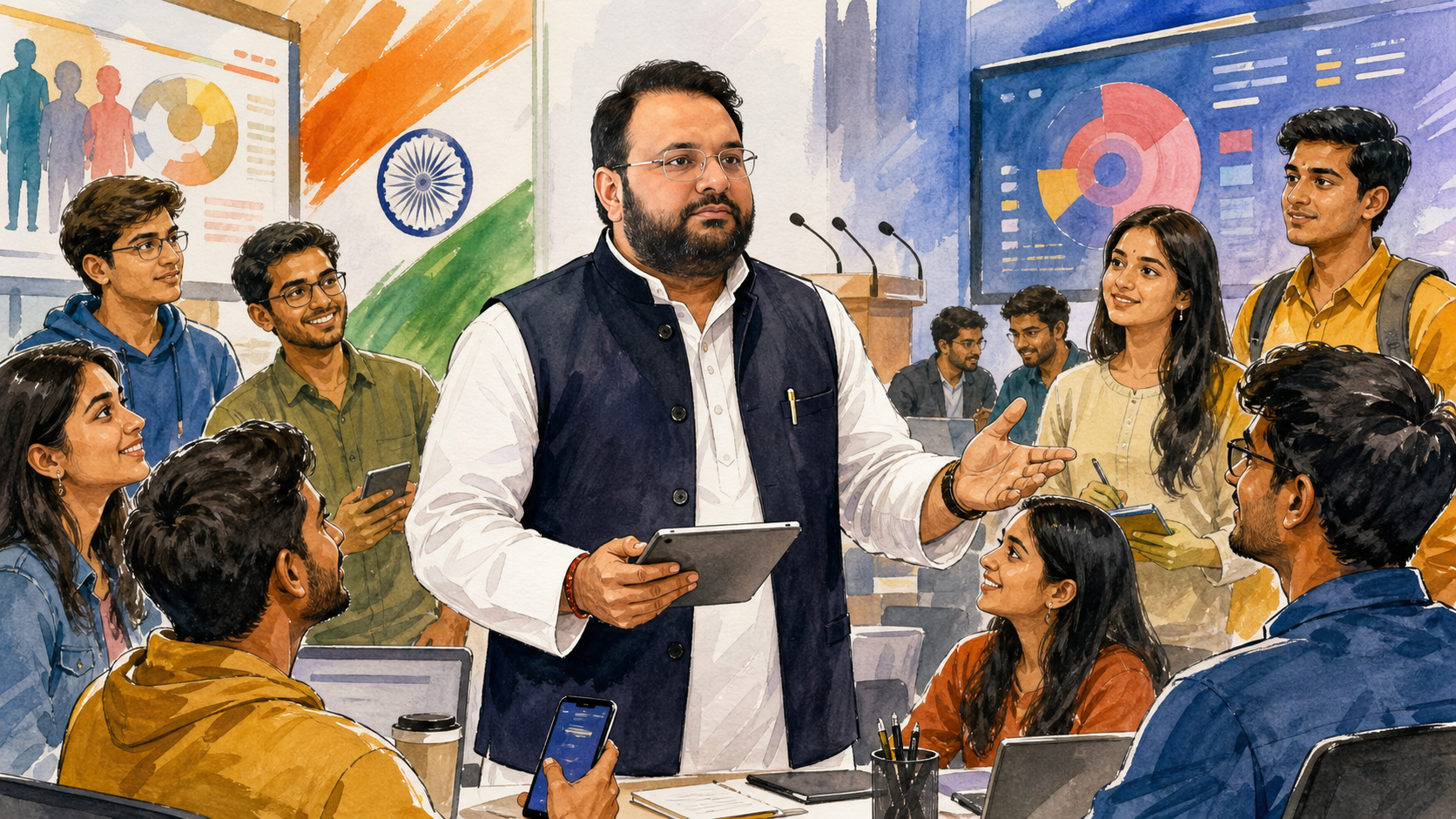
NEW DELHI — When the Bharatiya Janata Party went looking for a leader for the smartphone generation, it did not reach for a veteran television debater. It chose Dr Hemang Joshi, the 35-year-old Member of Parliament from Vadodara, and handed him the leadership of the Bharatiya Janata Yuva Morcha, the party’s youth wing and one of its most important training grounds for future organisers. Joshi replaces Bengaluru South MP Tejasvi Surya in the organisational reshuffle announced under BJP president Nitin Nabin.
The appointment is easy to describe as a generational change, but age alone does not explain it. Joshi combines campus organising, work in municipal education, experience inside the youth organisation and a first term in Parliament. The BJP’s bet is that this background can connect a national political machine with young Indians whose priorities range from employment and entrepreneurship to technology, national security and the quality of public institutions.
KEY FACTS
- Hemang Joshi was born on 31 January 1991 and represents Vadodara in the 18th Lok Sabha.
- He entered Parliament in 2024 as a first-term BJP MP after winning Vadodara by 582,126 votes.
- His education includes a bachelor’s degree in physiotherapy and a master’s degree in human-resource management.
- PRS Legislative Research recorded 91% attendance and 95 parliamentary questions through 27 July 2026.
- Before Parliament, he worked in student politics, municipal education and the BJP’s youth organisation in Gujarat.
From a University Campus to Parliament
Joshi’s route into politics began in Vadodara rather than in Delhi. He studied at the Maharaja Sayajirao University of Baroda, completing physiotherapy and human-resource management programmes. During his university years, he was elected general secretary of the Faculty of Social Work and worked through the Akhil Bharatiya Vidyarthi Parishad. That experience matters because campus politics teaches a form of organisation that cannot be replicated by a social-media team: listening to grievances, building small coalitions and persuading voters one conversation at a time.
His later service as vice-chairman of the Vadodara Municipal Corporation’s school board added an administrative dimension. Education policy becomes concrete at that level, where classroom capacity, teacher availability, facilities and parent expectations meet limited public resources. Joshi also spent years working in the Yuva Morcha ecosystem before becoming an MP. His selection therefore represents continuity within the organisation as much as a change at the top.
Why the Vadodara Mandate Matters
In the 2024 Lok Sabha election, Joshi won Vadodara by a margin of 582,126 votes. Vadodara is not an incidental constituency in the BJP’s political story: Narendra Modi won the seat in 2014 before retaining Varanasi, and the city remains central to the party’s Gujarat model of organisation. A large victory there gave Joshi visibility, but it also imposed a demanding benchmark. He entered Parliament representing an urban constituency with strong expectations on infrastructure, education, employment and civic delivery.
His parliamentary record provides an early indication of how he has approached that responsibility. According to PRS Legislative Research, Joshi recorded 91% attendance and asked 95 questions through 27 July 2026. Sansad TV’s profile of the MP also notes his association with the parliamentary committee dealing with education, women, children, youth and sports. Those subjects overlap directly with the constituency that the Yuva Morcha must understand.
By The Numbers
What Tejasvi Surya Leaves Behind
Tejasvi Surya’s tenure gave the youth wing a national voice, a sharp online edge and a recognisable ideological identity. His style suited a period in which the BJP wanted its young cadre to respond quickly in public debates and to defend the party’s position across digital platforms. A change of president does not erase that work. It reflects the churn through which the BJP moves leaders from organisational assignments into broader responsibilities.
Joshi inherits a network that already understands social media and political messaging. His challenge is to convert that visibility into durable local participation. Reels can introduce a campaign, but they cannot replace a booth committee, a campus conversation, a policy workshop or sustained assistance to a young citizen navigating education, skilling and employment systems.
Gen Z Is Not a Single Political Bloc
The phrase “Gen Z” can become lazy political shorthand. Young Indians do not vote as one homogeneous community. A first-time voter in a small town may be focused on examinations and recruitment; an engineering graduate may care about startups, artificial intelligence and mobility; a young farmer may judge politics through prices, irrigation and market access; and a student in a metropolitan university may place greater weight on institutional freedom and social questions.
A serious youth strategy must therefore do more than repeat one message on every platform. It must recognise regional languages, differences between women and men in access to opportunity, the needs of scheduled-caste and tribal students, and the widening gap between digitally connected youth and those still excluded from reliable devices or training. Joshi’s education in human-resource management could be useful here: the assignment requires segmentation, feedback and measurable organisation rather than slogans alone.
“The youth wing is where national ambition must be translated into local participation. Its success will be judged by whether young citizens are heard before they are asked to campaign.” — LoktantraVani analysis
A Policy Agenda Behind the Digital Campaign
The BJP has a substantial record to communicate to younger voters: digital public infrastructure, startup programmes, expanding transport networks, manufacturing incentives, defence indigenisation, sports investment and the growing use of technology in public services. Yet communication will be credible only when it also creates channels for criticism. Competitive-examination integrity, recruitment timelines, apprenticeships, campus facilities, urban affordability and the transition created by artificial intelligence are immediate concerns that demand specific answers.
The Yuva Morcha can become useful if it works as a two-way institution. It can explain policy, but it should also carry unresolved questions upward from districts and campuses. Structured youth consultations, policy fellowships, local issue dashboards and training in constitutional debate would give the organisation a purpose beyond election mobilisation. The strongest response to online frustration is not a louder graphic; it is evidence that someone in the political system has recorded the problem and pursued a remedy.
What Success Will Look Like
Joshi will be measured on whether the organisation expands beyond familiar circles, gives women and first-time activists real responsibility, and develops leaders who understand public policy as well as political communication. The BJP’s advantage is its deep cadre network and its habit of identifying leaders early. Its risk is assuming that organisational strength automatically guarantees the loyalty of a generation exposed to competing narratives every minute.
Handing the youth wing to a 35-year-old first-term MP is therefore not merely a symbolic gesture. It is a decision to test whether a leader formed by student politics, civic education and parliamentary work can modernise an established organisation without weakening its grassroots discipline. If Joshi can make young Indians participants rather than an audience, the appointment will have consequences well beyond the next election.
Sources and further reading
This article draws on the report announcing the BJYM leadership change, Digital Sansad’s member record, PRS Legislative Research’s parliamentary tracker, and Sansad TV’s profile of Hemang Joshi.