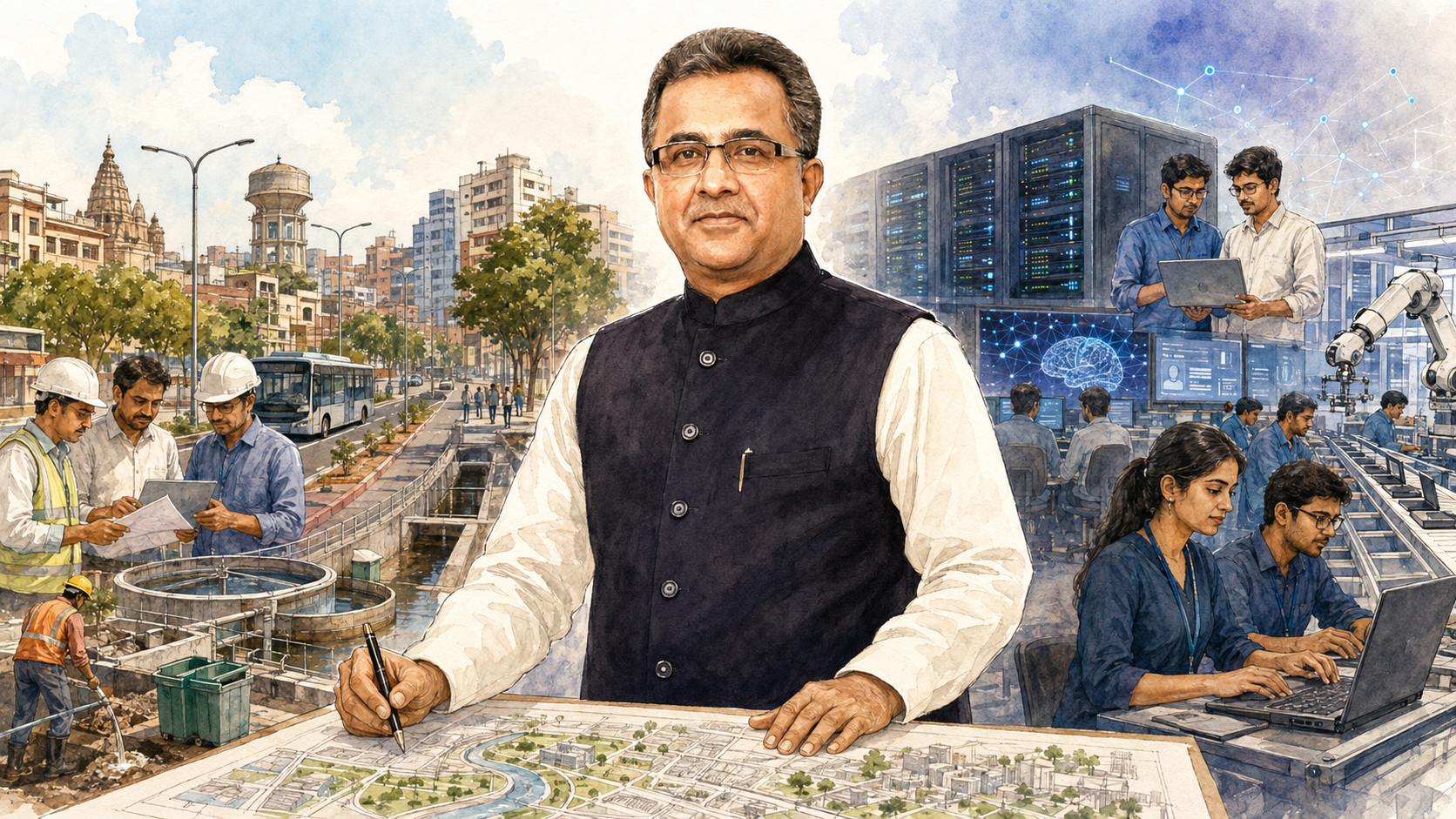
There are moments in government when the arrangement of portfolios says almost as much as the policies themselves. Bihar's decision to place Urban Development and Housing together with Information Technology under Nitish Mishra is one such moment. One department deals with streets, drainage, housing, sanitation, municipal institutions and the physical shape of towns. The other deals with data, digital services, artificial intelligence, skills and a technology economy. On paper, they are separate administrative worlds. In practice, they are two sides of the same development question: can Bihar build places where talent, investment and public services can thrive together?
That is why the phrase the right man in the right job carries more than rhetorical force here. Mishra is not beginning with an empty political biography. He is a five-term legislator from Jhanjharpur who has handled portfolios ranging from sugarcane development and disaster management to rural development, tourism and industries. His current assignment, which began on 7 May 2026, gives him responsibility for both Urban Development and Housing and Information Technology. The unusual combination offers Bihar a chance to make urban planning and digital growth reinforce each other instead of moving through separate files and separate calendars.
A Political Inheritance, but an Administrative Identity of His Own
Nitish Mishra belongs to one of Bihar's best-known political families. His father, Dr Jagannath Mishra, served as Chief Minister of Bihar and was a formidable figure in the state's public life. His uncle, Lalit Narayan Mishra, remains an important name in the political history of Bihar and India. Such a background opens doors, but it also creates an exacting comparison. Every office is measured against a legacy, and every achievement must establish an identity beyond inheritance.
Mishra's public profile shows how he has tried to build that identity around preparation and administrative detail. According to his current biographical record, he holds an MBA from FORE School of Management and Maastricht School of Management, studied Global Political Economy at the University of Hull as a Chevening Scholar, and completed executive education at Harvard Kennedy School. Before entering ministerial office, he also worked in economic studies and management education. The pattern matters because Bihar's present challenge is not a shortage of slogans; it is the conversion of ambition into sequenced projects, credible institutions and measurable outcomes.
His ministerial career has repeatedly placed him in delivery-heavy departments. Sugarcane policy required balancing farmers, mills, power generation and industrial incentives. Disaster management demanded coordination under pressure, especially in the aftermath of the Kosi floods. Rural development required scale across districts and local institutions; the department received three national awards during his tenure, according to his public profile. Industries and tourism required Bihar to be presented not only as a beneficiary of public spending but as a destination for investment, enterprise and visitors. The 2024 Bihar investment summit reported proposals worth Rs 1.81 lakh crore. Proposals are not the same as commissioned factories, but attracting that level of stated interest was evidence that Bihar could enter a more serious investment conversation.
Why Cities and Technology Belong in the Same Strategy
Bihar's growth debate often begins with the village and ends with Patna. The next phase has to fill the space between those two points. The state's own Urban Development and Housing Department notes that Bihar accounts for about 8.6 per cent of India's population but only 3.1 per cent of its urban population. Urbanisation will come, whether governments prepare for it or not. The choice is between planned towns with services and employment, or congested expansion that makes daily life expensive and investment difficult.
Technology firms do not select locations on tax incentives alone. They need reliable power, data connectivity, office space, transport, housing, schools, hospitals, public safety and an urban environment capable of retaining employees. A data centre may be a technology asset, but it also needs land, energy, water, roads and emergency services. A startup ecosystem may begin with laptops, but it matures only where people can commute, collaborate and build stable lives. Conversely, a modern city now depends on technology for property records, building permissions, grievance tracking, water monitoring, waste routes, traffic management and transparent municipal finance.
Putting both portfolios under one minister creates the possibility of a unified operating model. Urban projects can be planned with digital infrastructure built in from the beginning. IT policy can be designed around real locations rather than abstract state-level targets. Municipal bodies can become early customers for Bihar-based technology firms. Training programmes can be connected to projects that departments are actually commissioning. None of this happens automatically, but the administrative distance between the two agendas is now shorter.
The Urban Mandate: Make Bihar's Cities Work
The official vision of the Urban Development and Housing Department is appropriately broad: planned and inclusive growth, durable infrastructure, affordable housing, livelihood opportunities, efficient service delivery, community participation and accountable urban local bodies. Mishra's test will be to turn that vocabulary into visible improvements that citizens experience without reading a policy document.
Water supply and drainage are foundational. Roads repeatedly cut for pipes, incomplete storm-water networks and poorly mapped utilities impose costs on households and businesses. Solid-waste management must move beyond collection photographs to segregation, processing and disposal systems that can be audited. Affordable housing must be connected to transport and employment; a distant housing block without mobility is not a complete urban solution. Building permissions, property taxation and municipal accounts need simple digital systems, but software should serve institutional reform rather than conceal weak processes behind a dashboard.
The largest opportunity lies beyond Patna. Bhagalpur, Muzaffarpur, Darbhanga, Gaya, Purnea, Bihar Sharif and other urban centres can absorb growth closer to where people live. Stronger secondary cities would reduce the pressure on the capital, broaden Bihar's investment map and create professional opportunities without requiring every ambitious young person to leave the state. Each city needs a credible economic identity: education, logistics, food processing, tourism, textiles, healthcare, professional services or technology. Urban planning becomes powerful when it supports such an economic purpose.
The IT Mandate: Build Capacity Before Chasing Headlines
Mishra has set an ambitious target of attracting Rs 5 lakh crore in IT investment and has spoken about making Bihar a significant hub for information technology and artificial intelligence. Reports on the state's current technology roadmap point to a Patna data-centre project, laptop manufacturing, an AI roadmap and a wider effort to expand the digital economy. The number is a target, not a result, and it should be treated as a statement of scale. Its real value will depend on the quality of projects beneath it.
A sensible sequence is beginning to emerge. First comes core infrastructure: reliable connectivity, data storage, cloud capacity and secure government systems. Second comes hardware and services: manufacturing, maintenance, business-process operations and global capability centres. Third comes higher-value activity: research, product development, applied AI and startups solving Indian problems. Each layer needs skills, procurement clarity and predictable regulation. Bihar cannot leap to the final layer while neglecting the first two.
In June 2026, the state signed collaborative memoranda with Google, Microsoft, CoRover and Sarvam AI. As contemporary reporting made clear, those agreements did not themselves contain financial commitments; they were intended to support technical guidance, skilling and innovation. That distinction is healthy. A serious government should state exactly what an MoU does, publish milestones and then show which programmes, labs, courses or platforms emerge from it. The reported plan for an AI research centre and laboratory with IIT Patna is especially promising because it can connect policy to technical depth.
The human-capital question is even larger than the infrastructure question. Bihar already supplies talented engineers, managers and public servants to the rest of India. Its strategic goal should not be to prevent migration, which is a normal feature of a dynamic economy, but to make returning and staying rational choices. That requires industry-linked curricula, internships, apprenticeships, startup capital, professional networks and employers willing to offer credible career paths. Training numbers are easy to announce. Placement quality, salary growth and retention over three years are harder measures, and therefore better ones.
One Minister Means Fewer Coordination Excuses
The strongest argument for Mishra's combined mandate is accountability. A technology park delayed by access roads, a data centre constrained by urban utilities, or a smart-service platform that municipalities cannot operate often falls into the gap between departments. When the same minister can convene both systems, fewer problems should be allowed to remain somebody else's file.
This is where Mishra's management background and experience across departments can become practically useful. The job is not merely to announce separate urban and IT schemes. It is to create joint project teams, common timelines and public dashboards that show physical and digital progress together. An IT hub should have a land-readiness date, power and fibre milestones, transit planning, a skills pipeline and an employer-engagement plan. A municipal digitisation project should show adoption rates, resolution times and financial outcomes, not merely the number of logins.
There is also a democratic case for the combined approach. Better data can make municipal performance more visible, but citizens must be able to challenge wrong records and seek human assistance. AI can help identify leaks, predict maintenance needs and prioritise grievances, but decisions affecting housing, benefits or permissions require transparency and appeal. Bihar has an opportunity to build digital government that is efficient without becoming remote.
The Scorecard That Should Define Success
A positive assessment of a minister should not become an exemption from measurement. In fact, a capable minister deserves a clearer scorecard. For urban development, the public should be able to track continuity of water supply, reduction in waterlogging hotspots, waste processing rates, housing occupancy, permit turnaround time, municipal revenue and project completion across cities. For IT, the measures should include commissioned investment rather than announced investment, direct jobs, median salaries, training-to-placement conversion, operational data-centre capacity, startup survival and procurement awarded to capable Bihar enterprises.
Geographic distribution must be part of that scorecard. Patna will naturally lead, but a Bihar technology strategy cannot become a single-city strategy. Bhagalpur's emerging AI and urban plans, the educational strength of Gaya and Darbhanga, Muzaffarpur's commercial base and the connectivity potential of other regional centres should be treated as a network. The aim should be several investible urban nodes, each connected to nearby districts and each able to retain a portion of its local talent.
Continuity is the final test. Bihar has produced many promising announcements across political cycles. The difference between a vision and an institution is whether work continues through transfers, elections and changes of office. Policies need budgets, empowered officials, transparent procurement and published delivery dates. Industry needs assurance that agreements will survive beyond a summit. Citizens need assurance that a newly built drain, road or digital service will be maintained after inauguration.
The Right Assignment at the Right Time
Nitish Mishra brings to this assignment political experience, academic preparation, familiarity with both rural and industrial Bihar, and a record of handling portfolios where administrative coordination matters. His family legacy gives the story emotional and historical depth, but the present mandate will be judged on contemporary outcomes: cleaner and more functional cities, credible technology infrastructure, productive private investment and opportunities that allow Bihar's young people to build futures closer to home.
The logic of the appointment is strong. Urban Development can build the physical platform; Information Technology can create the digital platform. Together they can shape the places, services and jobs of a more confident Bihar. That makes Nitish Mishra the right man in the right job. It also means the harder half begins now: implementation that can be seen on the street, verified in the data and felt in the choices available to ordinary families.



